Hippocrates — "If a man has a pain in his knee, and it is on the outer side, it is a sign that …"
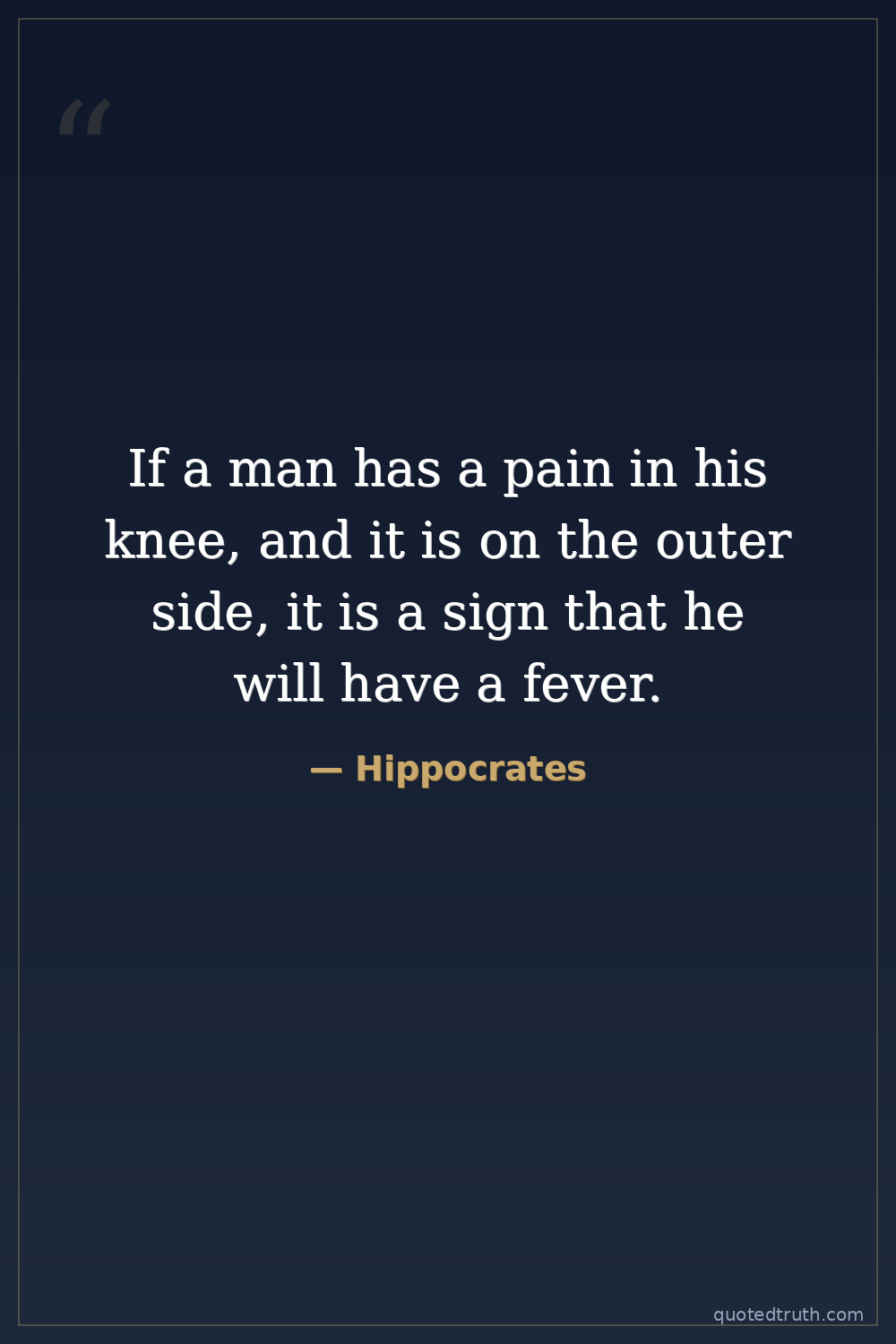
If a man has a pain in his knee, and it is on the outer side, it is a sign that he will have a fever.
If a man has a pain in his knee, and it is on the outer side, it is a sign that he will have a fever.
Click any product to generate a realistic preview. Up to 3 at a time.
* Initial load can take up to 90 seconds — revising the preview in another color is nearly instant.
"The art of healing comes from nature, not from the physician."
"Cure sometimes, treat often and comfort always."
"The physician must be able to tell the antecedents, know the present, and foretell the future."
"Into whatsoever houses I enter, I will go into them for the benefit of the sick, and will abstain from every voluntary act of mischief and corruption."
"The causes of disease are in the air, the water, and the place."
Found in 1 providers: grok
1 source checked
This expresses that specific physical symptoms can predict future systemic illness — a pain on the outer knee signals an oncoming fever. The underlying idea is that the body gives early, localized warning signs before full disease manifests. While this specific correlation isn't medically validated today, the core principle — observable signs forecast future conditions — remains foundational to clinical diagnosis and prognostic medicine.
Hippocrates built his legacy through systematic observation at Cos, producing the Aphorisms and Prognostics — catalogues linking clinical signs to disease outcomes. He believed a physician's primary duty was prognosis: anticipating illness, not merely reacting to it. This quote is quintessentially Hippocratic — connecting a localized physical sign to systemic disease, replacing divine or superstitious explanation with empirical pattern recognition drawn from careful bedside observation.
In 5th-century BCE Greece, fever was among the most feared and deadly conditions, entirely unexplained without germ theory or microbiology. Temple healers under Asclepius dominated medicine through ritual. Hippocrates and the Cos school challenged this by asserting disease followed natural, predictable patterns. Prognosis — knowing a patient's fate from early signs — was especially valued when treatments were scarce, making symptom-to-outcome catalogues like this quote genuinely revolutionary for the era.
AI-generated insights based on extensive research and information for context. Factual errors? Email [email protected].
Your cart is empty