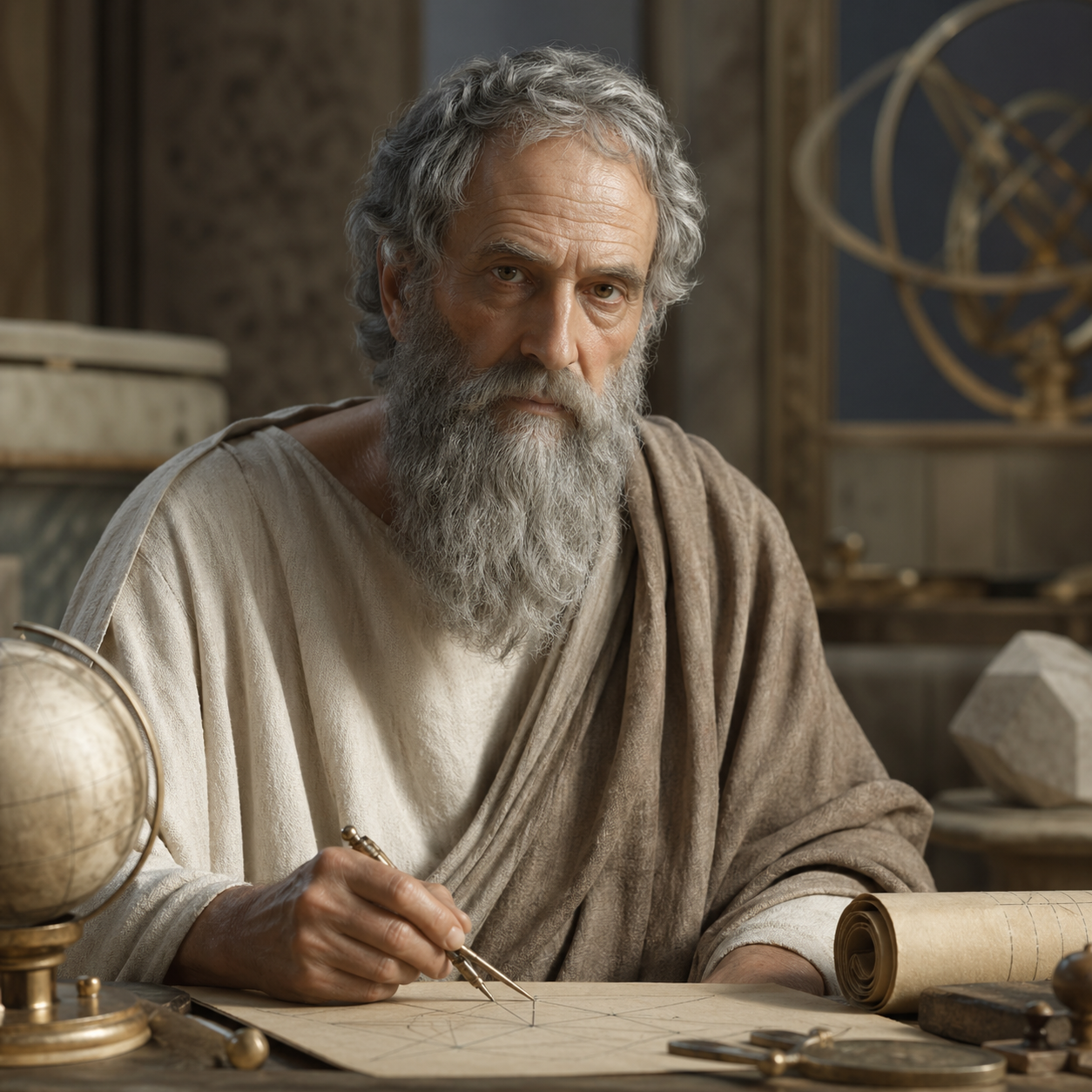
Euclid — "If a number be the least that is measured by any prime numbers, it will not be m…"
If a number be the least that is measured by any prime numbers, it will not be measured by any other prime number except those originally measuring it.
If a number be the least that is measured by any prime numbers, it will not be measured by any other prime number except those originally measuring it.
Click any product to generate a realistic preview. Up to 3 at a time.
* Initial load can take up to 90 seconds — revising the preview in another color is nearly instant.
"To produce a finite straight line continuously in a straight line."
"The properties of figures are derived from their definitions and postulates."
"Trilateral figures are those contained by three straight lines, quadrilateral those contained by four, and multilateral those contained by more than four straight lines."
"A semicircle is the figure contained by the diameter and the circumference cut off by it. And the center of the semicircle is the same as that of the circle."
"The greatest of the parts is called the antecedent, and the less the consequent."
Found in 1 providers: grok
1 source checked
This states that the smallest number divisible by a given set of primes cannot be divisible by any additional primes outside that set. In modern terms: if you build the smallest possible number using specific prime factors, no other prime can divide it evenly. This is a foundational insight into prime factorization — the idea that every number has a unique set of prime building blocks, central to number theory and modern cryptography.
Euclid's Elements (c. 300 BCE) systematically organized all known mathematics into rigorous proofs across 13 books. This proposition, from Book IX, shows his engagement went far beyond geometry into number theory. His defining trait was building complex truths from simple axioms through pure deduction. That he recognized prime factorization's uniqueness — a concept modern cryptography now depends on — nearly 2,300 years before RSA encryption reveals the timelessness of his logical framework.
Around 300 BCE, Euclid worked at Alexandria's great Library under Ptolemy I, where Greek scholarship flourished. This era saw mathematics shift from Egyptian and Babylonian practical calculation toward abstract universal proofs. Greek philosophers sought eternal truths untouched by physical reality. The concept of primes — indivisible numbers — captivated thinkers searching for the universe's fundamental units. Euclid's work synthesized centuries of scattered mathematical knowledge into one coherent logical system that would dominate for two millennia.
AI-generated insights based on extensive research and information for context. Factual errors? Email [email protected].
Your cart is empty