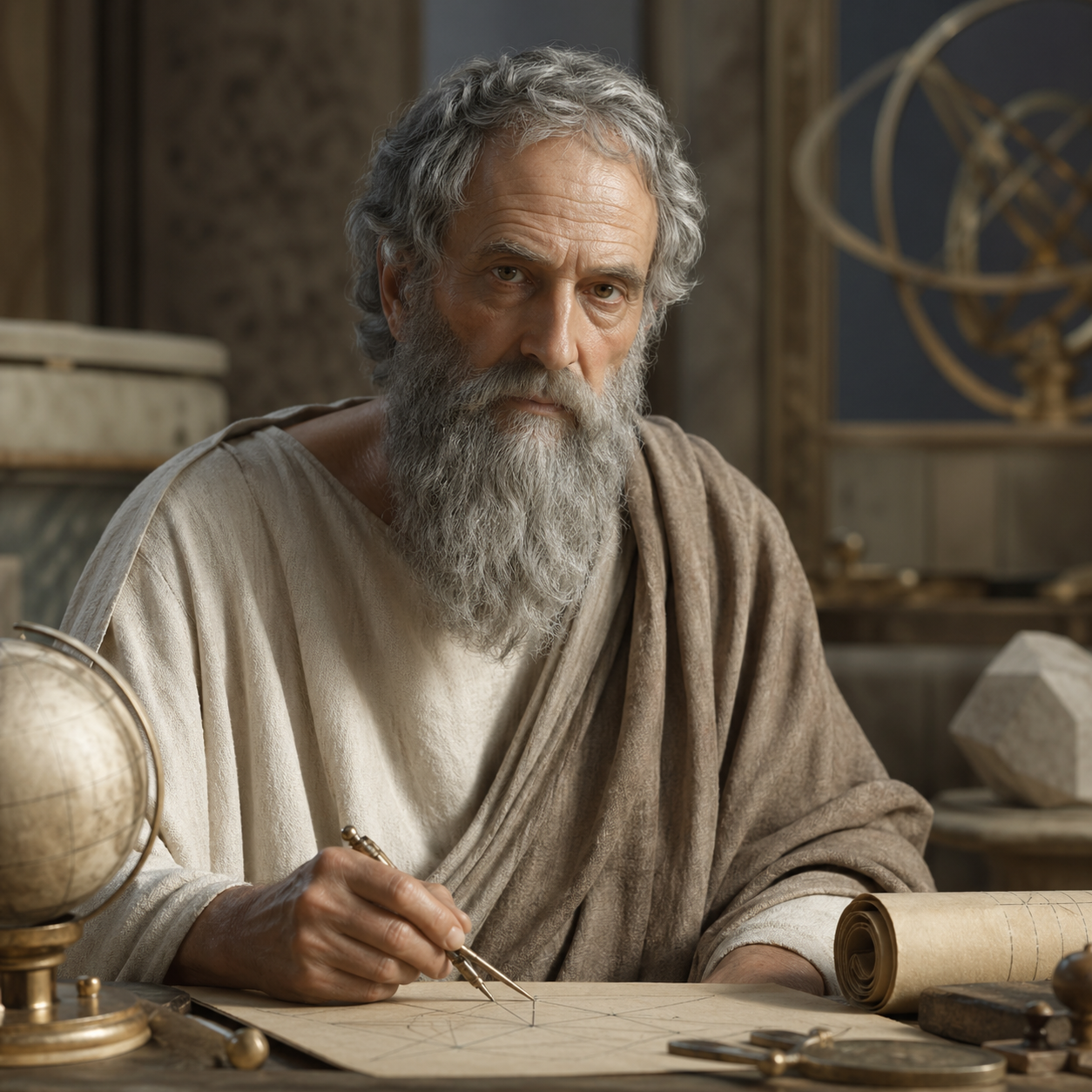
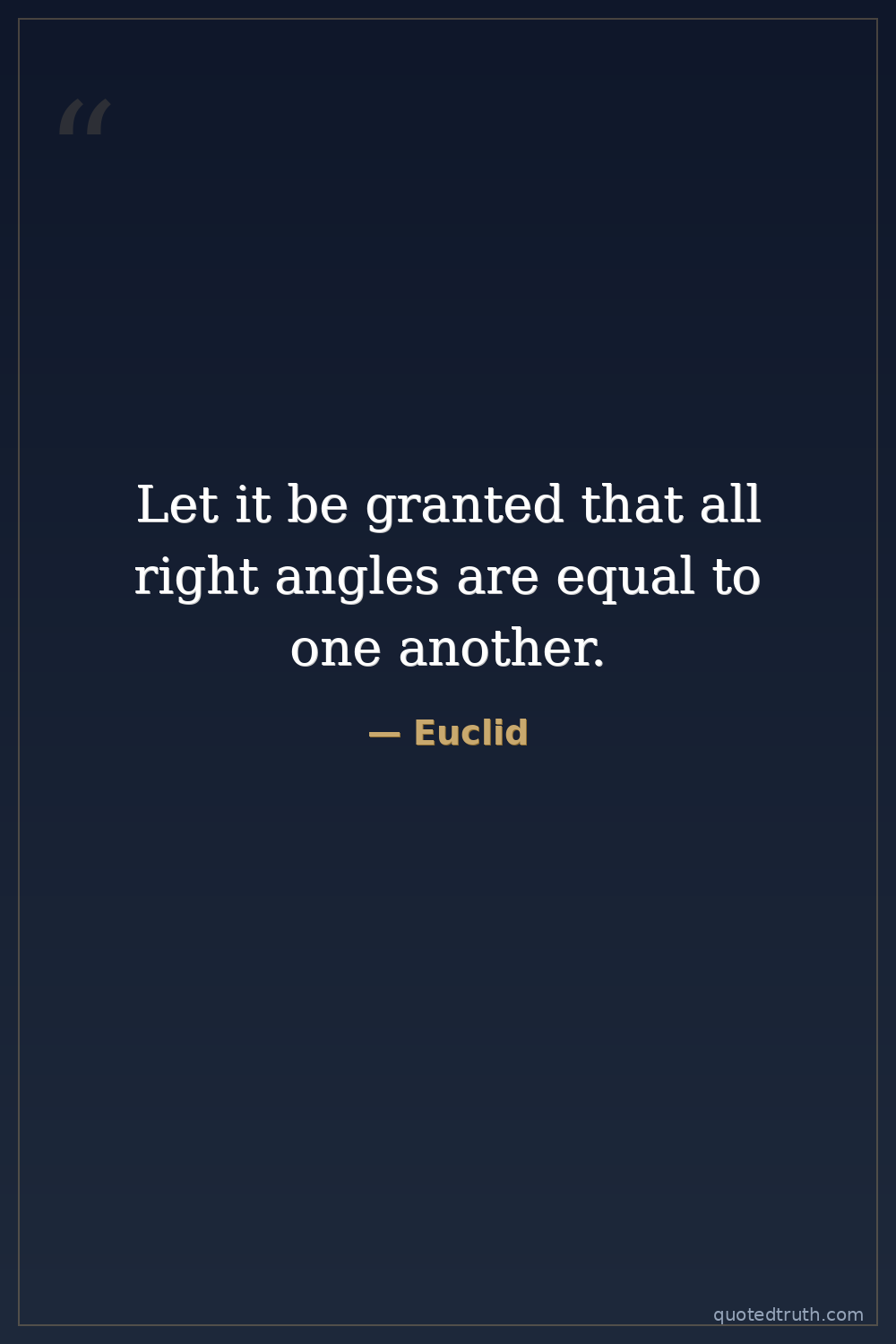
Euclid — "Let it be granted that all right angles are equal to one another."
Let it be granted that all right angles are equal to one another.
Let it be granted that all right angles are equal to one another.
Click any product to generate a realistic preview. Up to 3 at a time.
* Initial load can take up to 90 seconds — revising the preview in another color is nearly instant.
"A point is that which has no part."
"A diameter of the circle is any straight line drawn through the center and terminated in both directions by the circumference of the circle, and such a straight line also bisects the circle."
"If a straight line be cut in extreme and mean ratio, the greater segment is also cut in extreme and mean ratio by the lesser segment."
"A semicircle is the figure contained by the diameter and the circumference cut off by it. And the center of the semicircle is the same as that of the circle."
"If two triangles have two sides equal to two sides respectively, and have the angles contained by the equal straight lines equal, they will also have the base equal to the base, the triangle will be e…"
Found in 2 providers: grok,gemini
2 sources checked
This is one of Euclid's five foundational postulates — a starting assumption, not a proven fact. It declares that a right angle is universally constant: 90 degrees is the same regardless of where, when, or how you draw it. Rather than proving this obvious truth, Euclid acknowledged it must simply be accepted as given. This idea — that logical systems require unprovable starting assumptions — is now foundational to all mathematics and formal reasoning.
Euclid built all of geometry on just five postulates and five common notions — this is the fourth. His career was devoted to showing that rigorous knowledge could be constructed from minimal, self-evident truths through pure deduction. Teaching at Alexandria's Museum under Ptolemy I, he famously told the king there is no royal road to geometry. This postulate embodies his uncompromising intellectual honesty: name your assumptions plainly before claiming to prove anything.
Around 300 BCE, Alexandria was the intellectual capital of the Hellenistic world, blending Greek philosophy with Egyptian scholarship. Aristotle had recently formalized deductive logic; Plato's Academy debated the nature of mathematical truth. Greek thinkers were pushing geometry from intuitive drawing toward rigorous proof. Euclid's postulates directly answered this moment — settling what must be assumed before proof begins, transforming centuries of informal mathematical practice into a permanent, universal logical foundation.
AI-generated insights based on extensive research and information for context. Factual errors? Email [email protected].
Your cart is empty