Euclid — "If a straight line be cut in extreme and mean ratio, the greater segment is also…"
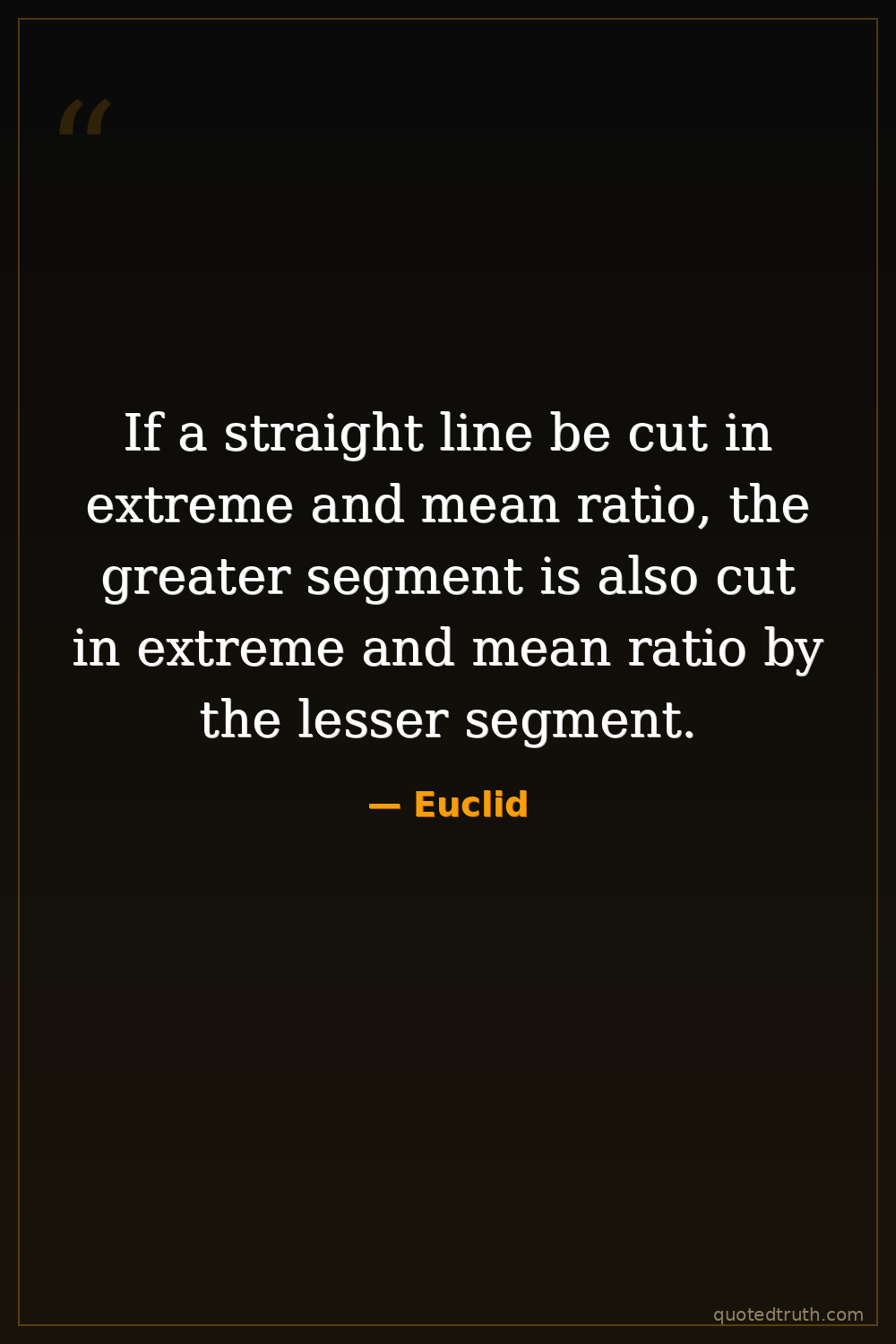
If a straight line be cut in extreme and mean ratio, the greater segment is also cut in extreme and mean ratio by the lesser segment.
If a straight line be cut in extreme and mean ratio, the greater segment is also cut in extreme and mean ratio by the lesser segment.
Click any product to generate a realistic preview. Up to 3 at a time.
* Initial load can take up to 90 seconds — revising the preview in another color is nearly instant.
"A line is breadthless length."
"And the point is called the center of the circle."
"In isosceles triangles the angles at the base are equal to one another, and, if the equal straight lines be produced further, the angles under the base will be equal to one another."
"If a number be the least that is measured by any prime numbers, it will not be measured by any other prime number except those originally measuring it."
"A semicircle is the figure contained by the diameter and the circumference cut off by it. And the center of the semicircle is the same as that of the circle."
From 'Elements', Book XIII, Proposition 3 (related to the golden ratio)
Date: c. 300 BCE
ShockingFound in 1 providers: grok
1 source checked
When you divide a line so that the ratio of the whole to the larger part equals the ratio of the larger part to the smaller — what we now call the golden ratio — that larger part can itself be divided the same way using the smaller segment. The golden ratio is self-replicating: cut it, and the bigger piece contains the same proportion all over again. This recursive property makes φ uniquely infinite in its self-similarity.
Euclid devoted Book XIII of the Elements entirely to constructions culminating in the Platonic solids — the dodecahedron requires the golden ratio at every turn. This theorem is structural scaffolding for his grandest geometric achievement, not decoration. Euclid never speculated; he proved. His life's work transformed scattered Greek mathematical insights into an unbroken chain of logical deduction, and this proposition exemplifies that discipline: one clean theorem unlocking an infinitely recursive geometric truth.
Around 300 BCE, Euclid worked in Alexandria under Ptolemy I, at the dawn of the Library of Alexandria. Greek philosophy had elevated the five Platonic solids to cosmic significance — Plato's Timaeus linked them to the elements of nature. Constructing a regular dodecahedron required mastering the golden ratio. Mathematics was not abstract hobby; it was the language of cosmic order. This theorem mattered because understanding φ meant understanding the geometry of the universe itself.
AI-generated insights based on extensive research and information for context. Factual errors? Email [email protected].
Your cart is empty