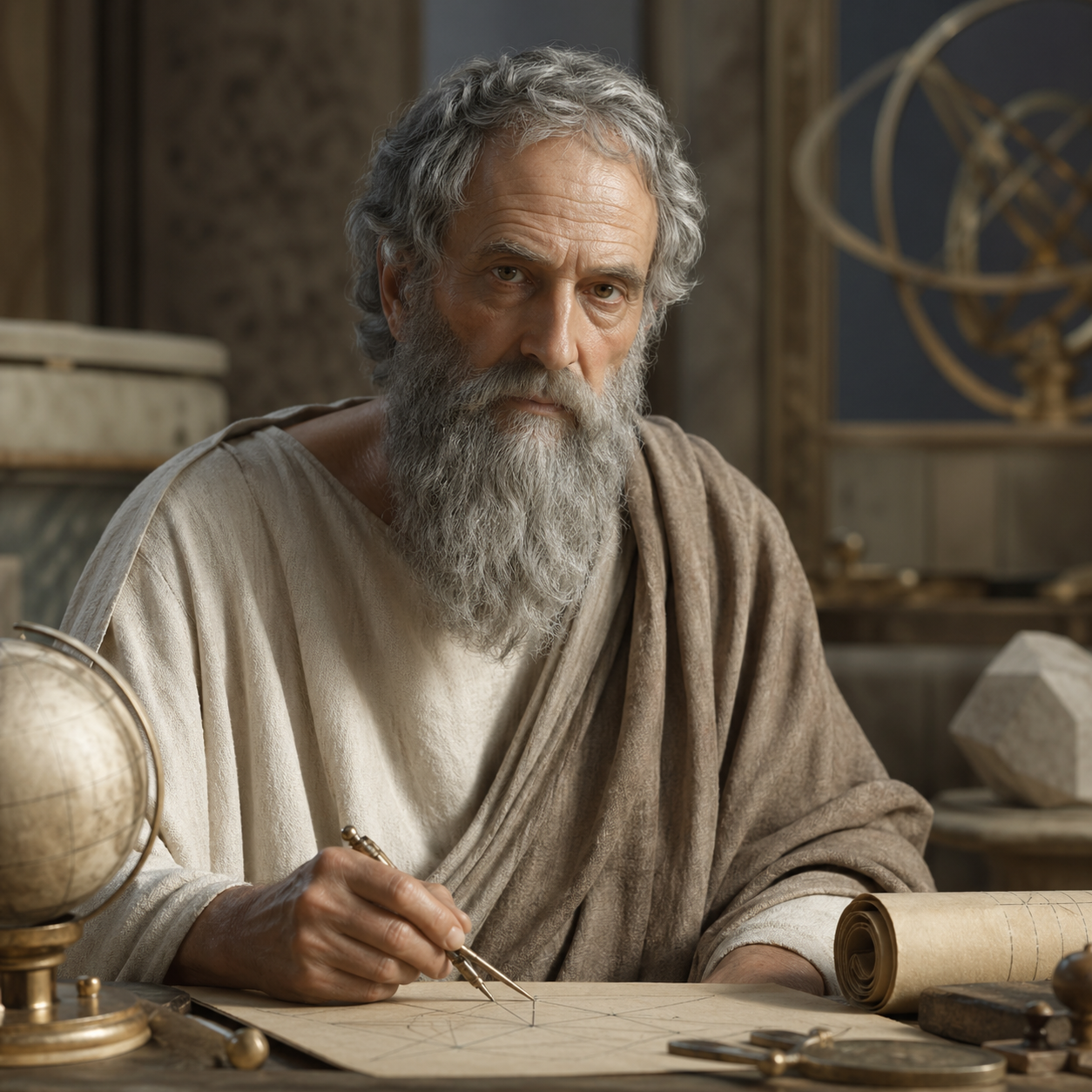
Euclid — "A plane surface is a surface which lies evenly with the straight lines on itself…"
A plane surface is a surface which lies evenly with the straight lines on itself.
A plane surface is a surface which lies evenly with the straight lines on itself.
Click any product to generate a realistic preview. Up to 3 at a time.
* Initial load can take up to 90 seconds — revising the preview in another color is nearly instant.
"In any triangle, if one of the sides be produced, the exterior angle is equal to the two interior and opposite angles, and the three interior angles of the triangle are equal to two right angles."
"A point is that which has no part."
"The greatest of the parts is called the antecedent, and the less the consequent."
"Things which are equal to the same thing are also equal to one another."
"A diameter of the circle is any straight line drawn through the center and terminated in both directions by the circumference of the circle, and such a straight line also bisects the circle."
Found in 1 providers: grok
1 source checked
A plane surface is simply a perfectly flat surface — no curves, no bumps. If you pick any two points on it and draw a straight line between them, that line stays entirely on the surface. This is Euclid's precise way of defining flatness: the surface and straight lines on it are in complete agreement. Modern geometry still relies on this concept, now expressed as a surface with zero curvature.
This is Definition 7 from Book I of Euclid's Elements, written around 300 BCE. It perfectly mirrors his intellectual character: obsessive precision in laying foundations. Euclid's entire project was axiomatic — build geometry from irreducible definitions so nothing rests on assumption. As head of mathematics at Alexandria's great library, he believed geometry's power came from its logical architecture, not intuition. Every theorem had to trace back to bedrock definitions exactly like this one.
Around 300 BCE, Alexandria had become the Mediterranean world's intellectual capital under Ptolemy I. Greek philosophy — especially Plato's emphasis on ideal forms and Aristotle's logic — had primed scholars to seek universal truths through deductive reasoning. Geometry was scattered across Egyptian land-surveying traditions and Greek philosophical inquiry. Euclid's moment was a cultural inflection point: synthesizing practical measurement with abstract proof, producing the first fully rigorous mathematical framework the ancient world had seen.
AI-generated insights based on extensive research and information for context. Factual errors? Email [email protected].
Your cart is empty