Carl Linnaeus — "If a tree were to be a god, it would be a god of solitude."
If a tree were to be a god, it would be a god of solitude.
If a tree were to be a god, it would be a god of solitude.
Click any product to generate a realistic preview. Up to 3 at a time.
* Initial load can take up to 90 seconds — revising the preview in another color is nearly instant.
"There are as many species as the infinite being created diverse forms in the beginning, which, following the laws of generation, produced many others, but always similar to them: therefore there are a…"
"The European is inventive, governed by laws, and wears tight clothing."
"The greatest joy is to be useful to one's fellow men."
"I have done more for the advancement of natural history than anyone else."
"A world without names is a world without knowledge."
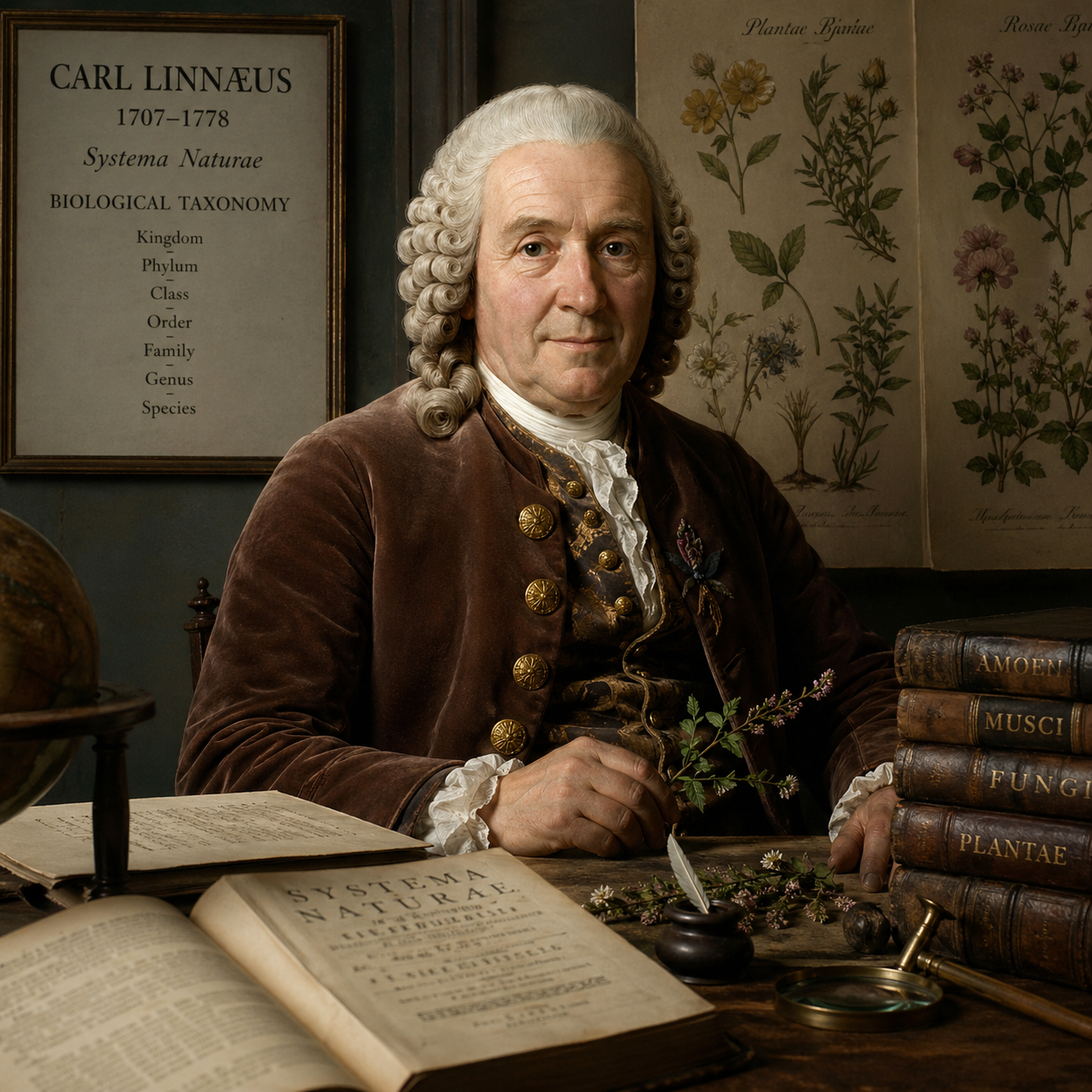
Swedish botanist and the father of modern taxonomy whose Systema Naturae (1735) introduced binomial nomenclature for naming all species. Closely associated with Joseph Banks (British naturalist who carried Linnaean classification on Cook's voyages). For an intellectual contrast, see Comte de Buffon, French naturalist and Histoire Naturelle author (1749-1788) — Buffon explicitly attacked Linnaean fixed-categories taxonomy as artificial and rejected the binomial system; his gradualist, environment-shaped natural history was the explicit alternative. Anticipates the fixed-species-vs-evolution debate Darwin would later resolve.
A poetic reflection on trees and solitude, attributed.
Date: Uncertain (attributed)
BiblicalFound in 1 providers: gemini
1 source checked
A tree, if elevated to divinity, would embody isolation rather than community. It stands rooted, silent, unmoving, watching seasons pass without companionship. The image suggests that true grandeur and longevity come paired with separation from the bustle of ordinary life. Greatness, in this view, requires stillness and distance, a willingness to endure alone while everything else moves, speaks, and passes by.
Linnaeus spent enormous stretches alone cataloging plants, walking Lapland wilderness, and classifying specimens in quiet study. His life's work demanded patient, solitary observation of individual organisms, especially trees and flora he named across kingdoms. As a devout Lutheran who saw nature as divine handiwork, reverence for a tree mirrors his worship-through-science approach. The solitary-god image matches a man who found holiness in single specimens rather than crowds.
In the early modern 1700s, European naturalists were racing to name and order the living world as colonial expeditions flooded home with unknown species. Enlightenment thinkers increasingly saw nature itself, rather than scripture alone, as a path to understanding God. Romantic reverence for wilderness was emerging, and solitary forests symbolized both scientific frontier and spiritual refuge from crowded, disease-ridden cities. Linnaeus's Sweden prized disciplined lone study of creation.
AI-generated insights based on extensive research and information for context. Factual errors? Email [email protected].
Your cart is empty