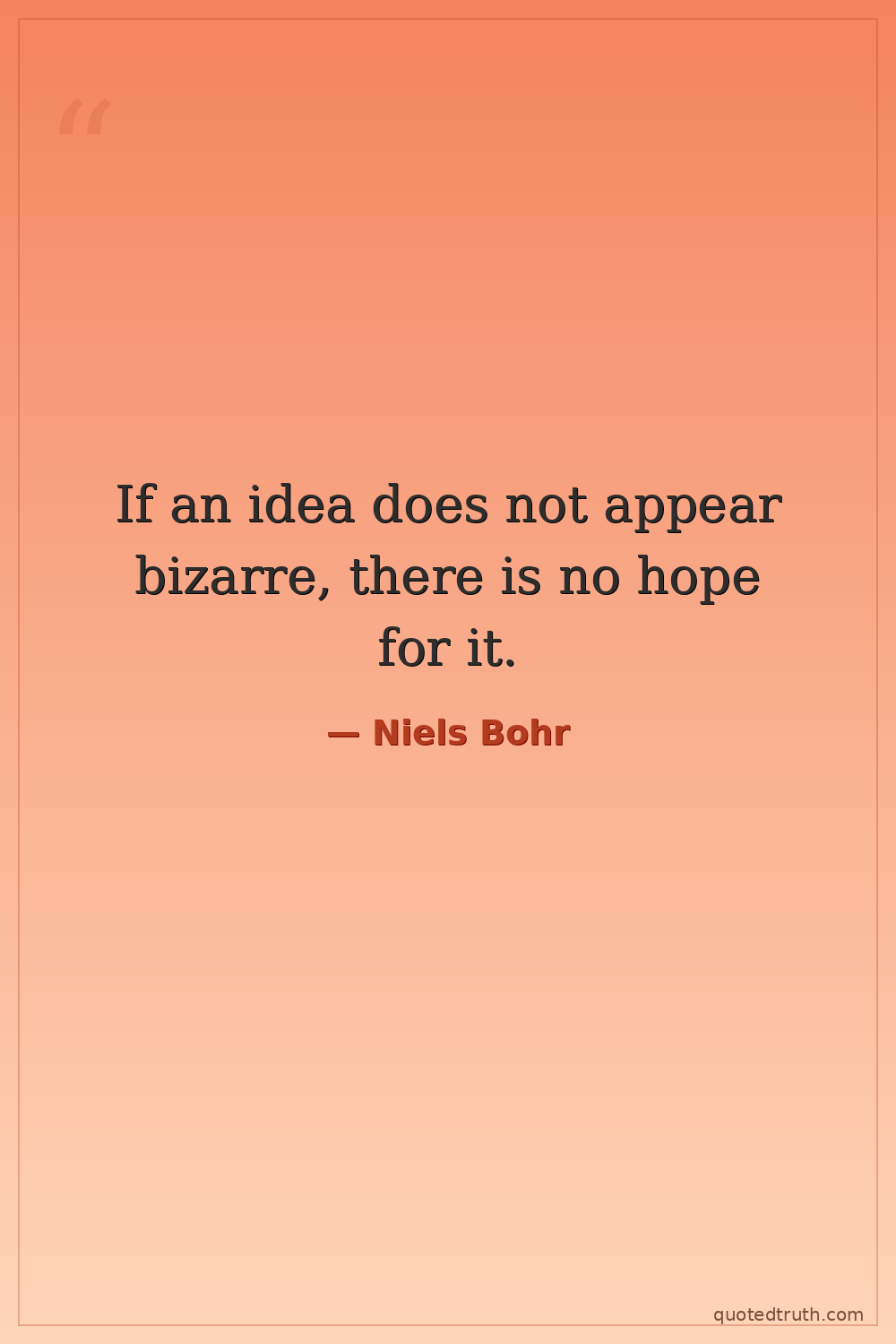
Niels Bohr — "If an idea does not appear bizarre, there is no hope for it."
If an idea does not appear bizarre, there is no hope for it.
If an idea does not appear bizarre, there is no hope for it.
Click any product to generate a realistic preview. Up to 3 at a time.
* Initial load can take up to 90 seconds — revising the preview in another color is nearly instant.
"I often say that there is no quantum world. There is only an abstract quantum physical description. It is wrong to think that the task of physics is to find out how nature is. Physics concerns what we…"
"The most important thing is to never stop questioning."
"How wonderful that we have met with a paradox. Now we have some hope of making progress."
"The very act of observing changes the observed."
"The very existence of the atom is a miracle."
Found in 1 providers: gemini
1 source checked
Genuinely revolutionary ideas always seem strange or impossible at first because they contradict established thinking. Conventional wisdom represents the limits of current understanding, so any idea truly breaking new ground will appear outlandish to contemporaries. Normalcy signals the idea fits within existing frameworks and therefore cannot fundamentally change anything. Only the bizarre stands a chance of being genuinely transformative.
Bohr proposed that electrons occupy discrete energy levels and jump between them instantaneously — a concept physicists initially found deeply strange. His Copenhagen interpretation of quantum mechanics, arguing reality is probabilistic until observed, horrified even Einstein. Bohr built his career defending counterintuitive ideas against classical physicists who found them absurd, making this quote a direct reflection of his professional experience.
Early twentieth-century physics was experiencing violent upheaval as quantum theory dismantled Newtonian certainties. Relativity, wave-particle duality, and uncertainty principles contradicted centuries of established science. Physicists debated whether mathematics describing electrons had physical meaning at all. In this climate of radical reconception, Bohr recognized that scientific progress required abandoning comfortable, familiar frameworks entirely — bizarreness was evidence of genuine novelty.
AI-generated insights based on extensive research and information for context. Factual errors? Email [email protected].
Your cart is empty