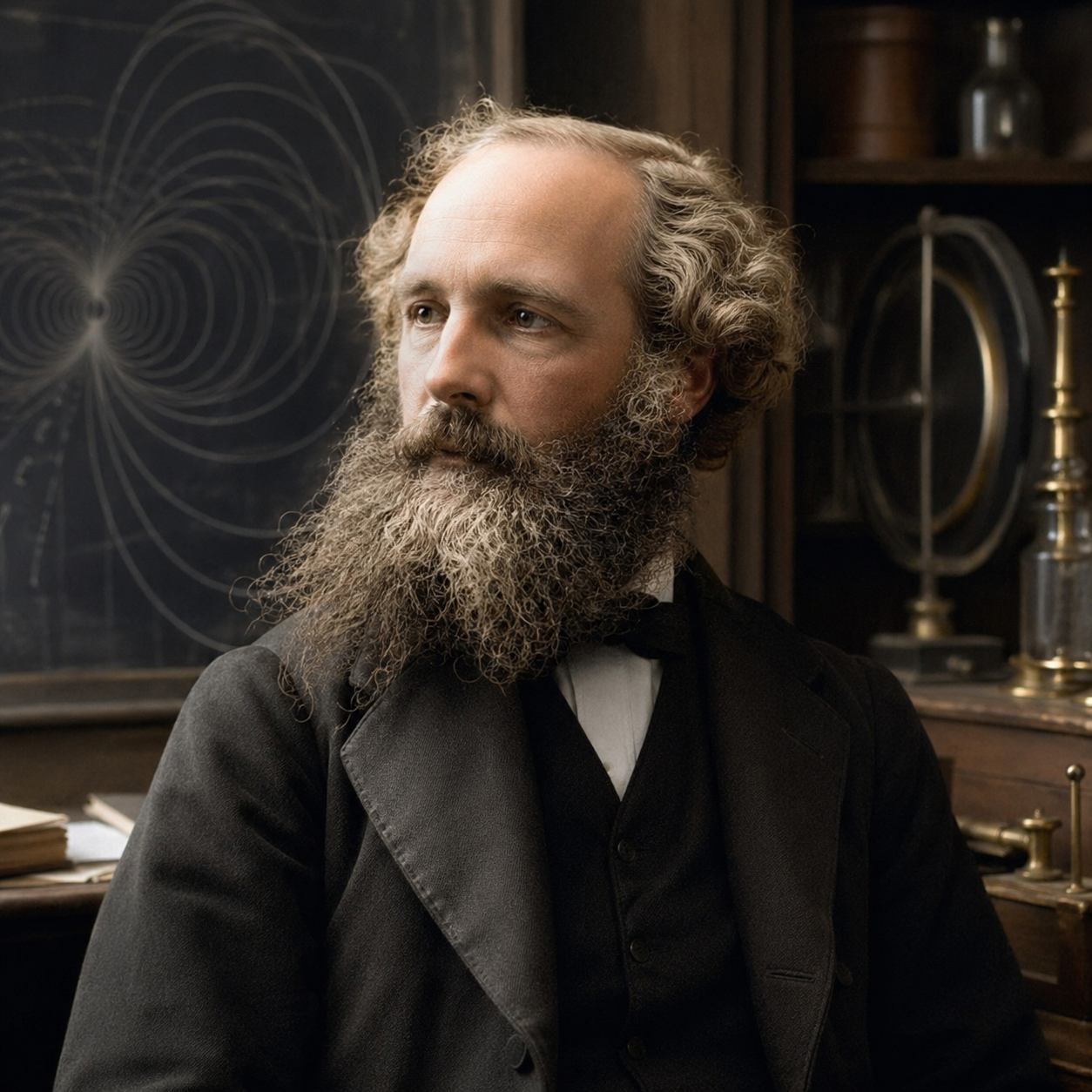
James Clerk Maxwell — "If I am not mistaken, there is a good deal of nonsense in the world."
If I am not mistaken, there is a good deal of nonsense in the world.
If I am not mistaken, there is a good deal of nonsense in the world.
Click any product to generate a realistic preview. Up to 3 at a time.
* Initial load can take up to 90 seconds — revising the preview in another color is nearly instant.
"The first thing that I always do is to try to understand the problem."
"I have been battering away at Saturn, returning to the charge every now and then. I have effected several breaches in the solid ring, and now I am splash into the fluid one, amid a clash of symbols tr…"
"In the present state of science, it would be a rash thing to assert that any one physical constant is absolutely constant."
"The mathematical difficulties of the subject are so enormous that it is only by great patience and perseverance that we can hope to overcome them."
"The only laws of matter are those which our minds must fabricate, and the only laws of mind are fabricated for it by matter."
Found in 1 providers: grok
1 source checked
The speaker is observing, with understated humor, that much of what people say and believe lacks real substance or truth. It's a dry acknowledgment that confusion, empty claims, and poorly reasoned ideas fill everyday discourse. Rather than a harsh condemnation, the tone is measured and slightly amused, suggesting the speaker has seen enough to feel certain about this while still leaving polite room for being wrong.
Maxwell built his career on replacing vague notions with precise mathematics, unifying electricity, magnetism, and light into four equations. A devout Presbyterian with a sharp wit, he prized rigorous thinking and detested sloppy reasoning, whether in physics, philosophy, or popular pseudoscience. His understated Scottish humor and intellectual humility show in the cautious 'if I am not mistaken,' paired with a quietly devastating judgment on intellectual sloppiness.
Maxwell lived from 1831 to 1879, when Victorian Britain was awash in competing claims: spiritualism, mesmerism, phrenology, and table-rapping séances coexisted with genuine scientific revolutions in thermodynamics, evolution, and electromagnetism. Public lectures drew crowds but also charlatans. Amid this mixture of real discovery and fashionable nonsense, working scientists like Maxwell frequently had to distinguish rigorous evidence from confident speculation, making the remark both a personal observation and a cultural diagnosis.
AI-generated insights based on extensive research and information for context. Factual errors? Email [email protected].
Your cart is empty