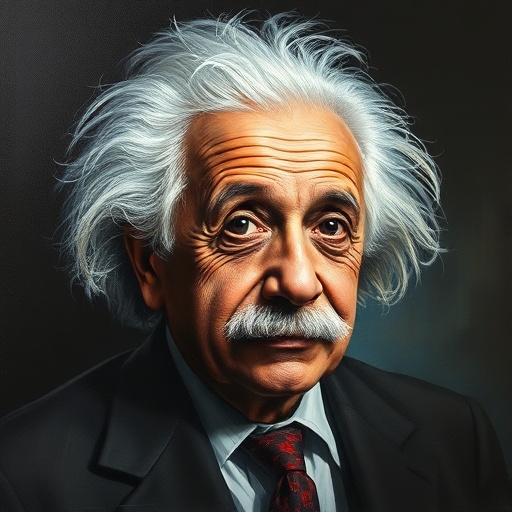
Albert Einstein — "If I were not a physicist, I would probably be a musician. I often think in musi…"
If I were not a physicist, I would probably be a musician. I often think in music. I live my daydreams in music.
If I were not a physicist, I would probably be a musician. I often think in music. I live my daydreams in music.
Click any product to generate a realistic preview. Up to 3 at a time.
* Initial load can take up to 90 seconds — revising the preview in another color is nearly instant.
"Nationalism is an infantile disease. It is the measles of mankind."
"I believe in intuitions and inspirations. I sometimes feel that I am right. I do not know that I am."
"If A is a success in life, then A equals x plus y plus z. Work is x; y is play; and z is keeping your mouth shut."
"Marriage is the unsuccessful attempt to make something lasting out of an incident."
"The problems that exist in the world today cannot be solved by the level of thinking that created them."
Found in 1 providers: deepseek
1 source checked
Music wasn't a hobby for Einstein—it was an alternate cognitive language. He's saying imagination and pattern-recognition, the same faculties driving physics, also power music. He processed abstract thought through rhythm and melody, not just equations. His daydreaming—the mental wandering where breakthrough ideas form—happened inside music. Physics and music weren't separate disciplines for him; both were expressions of the same underlying search for structure, harmony, and beauty in the universe.
Einstein began violin lessons at age six and played throughout his life, favoring Mozart and Bach. He often paused scientific work to improvise at the piano, and friends noted he would play violin mid-thought, then return to equations with new clarity. He credited musical intuition with shaping his scientific instincts. His intuitive, almost aesthetic approach to physics—arriving at relativity through thought experiments rather than raw data—mirrored how a composer listens for what a melody demands next.
Einstein's adult life spanned early 20th-century Europe, when classical music held enormous cultural prestige and chamber music was a staple of educated middle-class life. Germany and Switzerland, where he lived and worked, were centers of serious musical culture. Simultaneously, physics was undergoing revolutionary upheaval as relativity and quantum theory dismantled Newtonian certainty. That the scientist at the center of this upheaval declared music his alternate identity reflected the broader European ideal of the scientist-as-humanist, bridging art and rigorous inquiry.
AI-generated insights based on extensive research and information for context. Factual errors? Email [email protected].
Your cart is empty