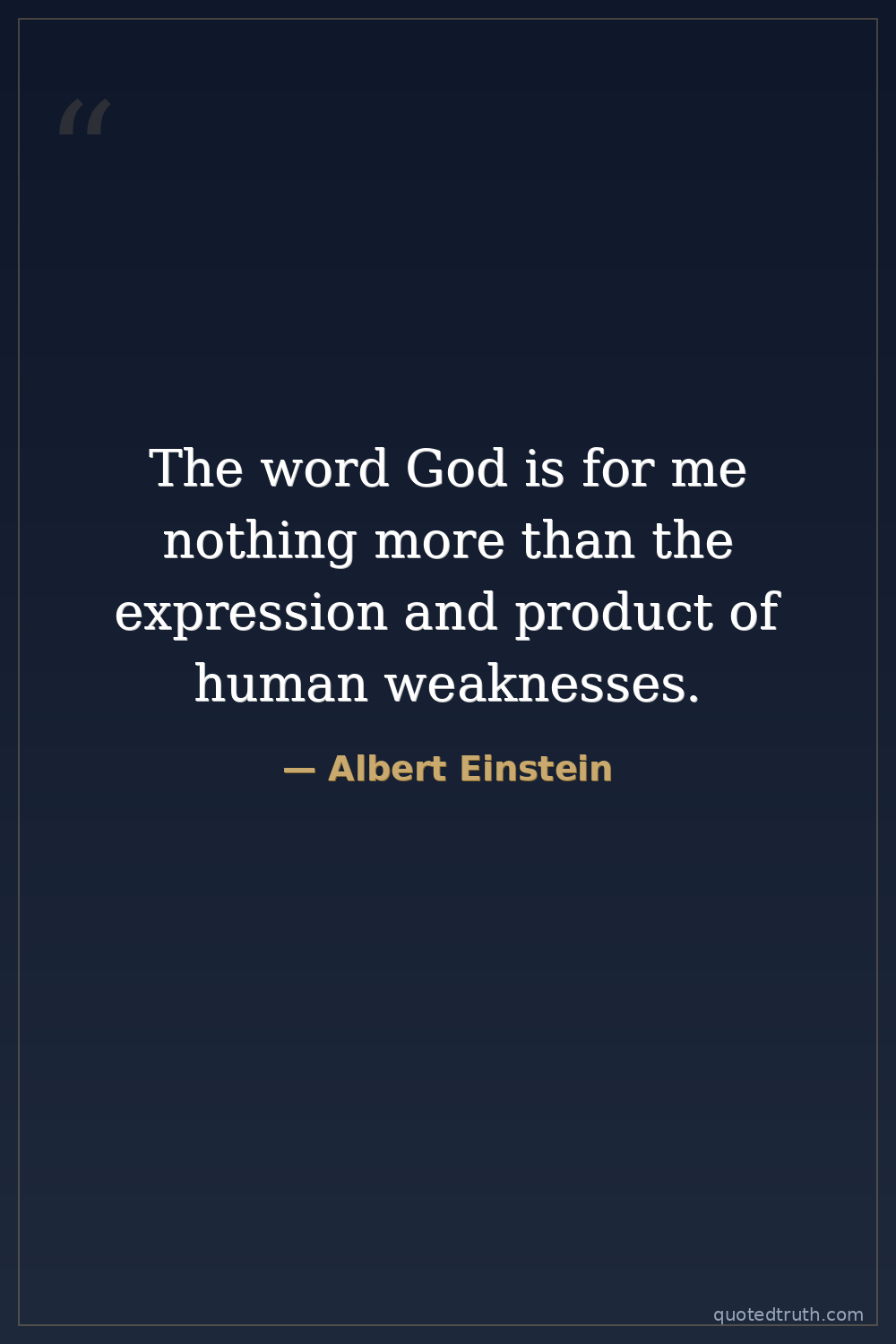
Albert Einstein — "The word God is for me nothing more than the expression and product of human wea…"
The word God is for me nothing more than the expression and product of human weaknesses.
The word God is for me nothing more than the expression and product of human weaknesses.
Click any product to generate a realistic preview. Up to 3 at a time.
* Initial load can take up to 90 seconds — revising the preview in another color is nearly instant.
"I am against any form of violence, for I know that violence only leads to more violence."
"The only way to do great work is to love what you do."
"I do not believe in the God of theology who rewards good and punishes evil."
"The human mind has first to construct forms, independently, before we can find them in things."
"The Negroes are certainly more primitive than us, but not in a negative sense."
Found in 1 providers: deepseek
1 source checked
Einstein argues that "God" is not a real external being but a concept humans invented to cope with fear, ignorance, and vulnerability. Where people cannot explain suffering, death, or the universe's origins, they reach for divine language. The word itself, he says, reveals more about human psychology and limitation than about any actual higher power or cosmic reality.
Einstein was raised Jewish but rejected personal theism early. He believed in Spinoza's God — the rational harmony of nature, not an intervening deity. He wrote this in his 1954 "God Letter" to philosopher Eric Gutkind, one year before his death. His lifelong pursuit of unified physical laws reinforced his view that anthropomorphic God-concepts were projections, incompatible with scientific understanding of an orderly, impersonal universe.
Written in 1954, as the post-WWII world confronted the Holocaust, nuclear weapons, and existential dread. The Cold War hardened ideological lines, and religious faith was invoked constantly against communist atheism. Yet scientific advances — many built on Einstein's own work — increasingly explained phenomena once attributed to God. His statement challenged the dominant Western religious consensus at the peak of Cold War religiosity in America.
AI-generated insights based on extensive research and information for context. Factual errors? Email [email protected].
Your cart is empty