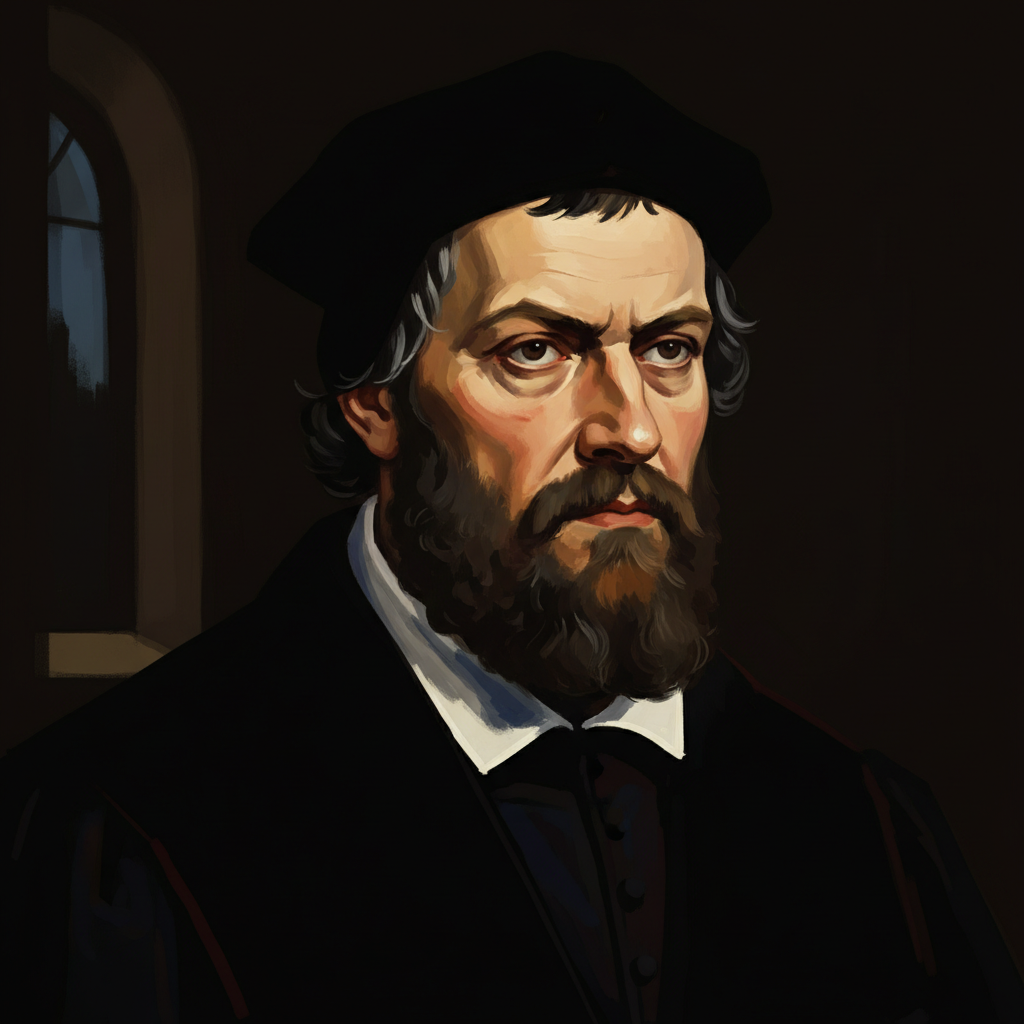
Martin Luther — "If they can bear to live among us Christians and Jews, then they should be force…"
If they can bear to live among us Christians and Jews, then they should be forced to work like women in childbirth.
If they can bear to live among us Christians and Jews, then they should be forced to work like women in childbirth.
Click any product to generate a realistic preview. Up to 3 at a time.
* Initial load can take up to 90 seconds — revising the preview in another color is nearly instant.
"I feel much freer now that I am certain the pope is the Antichrist."
"I would rather be ruled by a wise Turk than by a foolish Christian."
"To be a Christian without prayer is no more possible than to be alive without breathing."
"Seventhly, let the young and strong Jews and Jewesses be given flail, axe, spade, and spindle, and let them earn their bread in the sweat of their brow, as was imposed on Adam's children."
"These are the Scriptures which make fools of all the wise and understanding, and are open only to the small and simple, as Christ says in Matthew 11:25."
German theologian whose 95 Theses (1517) launched the Protestant Reformation and broke the Catholic Church's monopoly on Western Christianity. Closely associated with Philipp Melanchthon (Lutheran systematizer) and John Calvin (later Reformer who built on Luther's break). For an intellectual contrast, see Pope Leo X, Renaissance pope (1513-1521) — Leo X's indulgence sales triggered Luther's break and Leo excommunicated him in 1521 — Luther's entire Reformation is structured as a direct answer to the indulgence-funded Vatican Leo represented.
Found in 1 providers: deepseek
1 source checked
This statement argues that if Jews are permitted to remain in Christian society, they should be subjected to grueling, forced labor comparable to the agony of childbirth. It frames tolerance as conditional on brutal exploitation, treating an entire religious group as deserving punishment simply for existing in the community. The phrasing dehumanizes its targets and justifies coercion through pain as a precondition for coexistence.
Luther, the German friar who launched the Protestant Reformation in 1517, initially courted Jewish conversion but turned viciously antisemitic late in life. His 1543 tract On the Jews and Their Lies urged burning synagogues, destroying homes, and imposing forced labor. This quote mirrors that treatise's program. Though celebrated for challenging papal authority and translating the Bible into German, his late writings cemented a darker legacy later exploited by Nazi propagandists.
Early modern Europe was convulsed by the Reformation, splitting Christendom and igniting religious wars. Jews lived precariously under expulsion edicts, ghettos, and blood libels across German lands. Printing presses spread polemics rapidly, and theological disputes carried life-or-death civic consequences. Rulers used religious minorities as scapegoats during plague, inflation, and peasant unrest. Luther's 1543 screed landed in this volatile climate, providing theological cover for centuries of persecution that shaped German Jewish history.
AI-generated insights based on extensive research and information for context. Factual errors? Email [email protected].
Your cart is empty