Neil deGrasse Tyson — "If you are scientifically literate, the world looks very different to you, and t…"
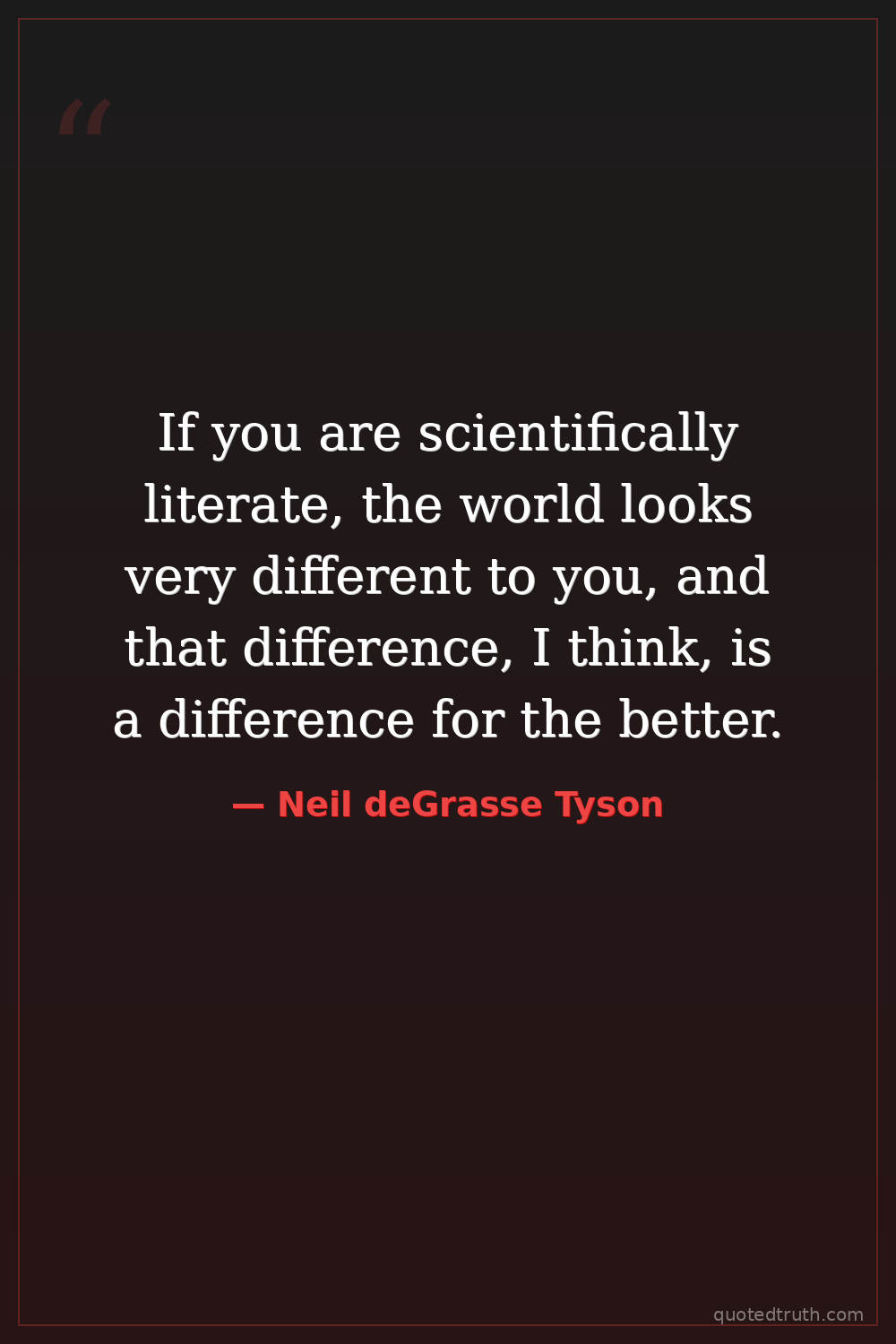
If you are scientifically literate, the world looks very different to you, and that difference, I think, is a difference for the better.
If you are scientifically literate, the world looks very different to you, and that difference, I think, is a difference for the better.
Click any product to generate a realistic preview. Up to 3 at a time.
* Initial load can take up to 90 seconds — revising the preview in another color is nearly instant.
"My goal is to get people to think — to understand that the universe is larger than them and their problems."
"The universe is an amazing place, and it's full of surprises."
"The cosmic perspective not only embraces our genetic kinship with all life on Earth but also values our chemical kinship with any yet-to-be discovered life in the universe, as well as our atomic kinsh…"
"My goal is to get people to think about the universe, not just about themselves."
"I don't have a problem with people believing in God. I have a problem with people believing in things that are demonstrably false."
American astrophysicist, Hayden Planetarium director, and Cosmos: A Spacetime Odyssey host who carries the Carl Sagan public-science mantle. Closely associated with Bill Nye (fellow science communicator) and Brian Greene (theoretical physicist and string-theory popularizer). For an intellectual contrast, see Ken Ham, founder of Answers in Genesis and the Creation Museum — Ham's career has been organized around defending biblical 6-day creationism — exactly the science-education position Tyson's mainstream-science communication is structured to refute.
Found in 1 providers: grok
1 source checked
Scientific literacy changes how you perceive reality — you see patterns, causes, and evidence where others see mystery or randomness. Understanding how things actually work, from disease to climate to the cosmos, makes you better equipped to navigate the world, make decisions, and recognize misinformation. It is not just knowing facts but developing a way of thinking that filters noise from signal.
Tyson built his career on making science accessible to the public through books, podcasts, and television like StarTalk and Cosmos. As director of the Hayden Planetarium, he consistently argued that science education is a civic necessity, not a luxury. This quote reflects his lifelong mission: closing the gap between expert knowledge and public understanding, believing informed citizens make better decisions for society.
Tyson rose to prominence in an era of escalating science denial — climate change skepticism, anti-vaccine movements, and flat-earth communities proliferated through social media. Simultaneously, STEM education gaps widened globally while policy decisions increasingly required scientific understanding. His advocacy for scientific literacy responded directly to a culture where misinformation spreads as fast as data, making the ability to evaluate evidence a survival skill.
AI-generated insights based on extensive research and information for context. Factual errors? Email [email protected].
Your cart is empty