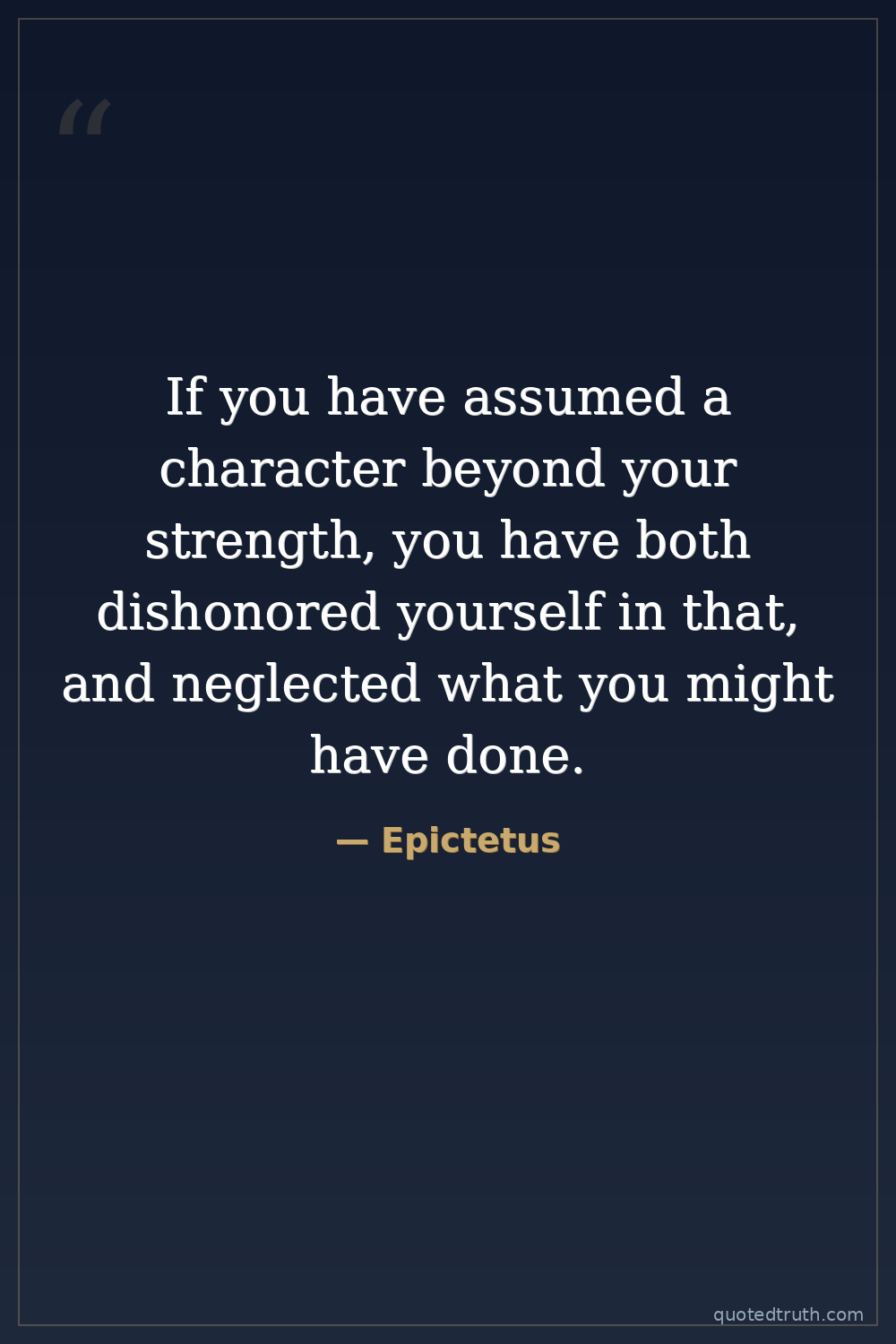
Epictetus — "If you have assumed a character beyond your strength, you have both dishonored y…"
If you have assumed a character beyond your strength, you have both dishonored yourself in that, and neglected what you might have done.
If you have assumed a character beyond your strength, you have both dishonored yourself in that, and neglected what you might have done.
Click any product to generate a realistic preview. Up to 3 at a time.
* Initial load can take up to 90 seconds — revising the preview in another color is nearly instant.
"As long as you are a human being, you are a member of a great whole, and you have a part to play. If you play it badly, you will be hissed off the stage; if well, applauded."
"The reason why we have two ears and only one mouth is that we may listen the more and talk the less."
"If a man has a bad character, he is bad for himself; if he has a good character, he is good for himself."
"Remember that if you are doing something for your own good, you must not be ashamed of it, even if the mob is going to misinterpret it."
"What is the result of all this? To be free, serene, and happy."
Greek Stoic philosopher and former slave whose Discourses (recorded by his student Arrian) shaped Marcus Aurelius and the modern Stoic revival. Closely associated with Seneca (earlier Roman Stoic) and Marcus Aurelius (his student-by-text on the imperial throne). For an intellectual contrast, see Epicurus, Greek philosopher of pleasure-as-tranquility — the Stoic-Epicurean rivalry was the central philosophical debate of the Hellenistic and Roman world for 400 years — Epicurean materialist hedonism is the precise alternative the Stoic discipline-of-acceptance was built against.
The standard scholarly entry points to Epictetus's work: A.A. Long (UC Berkeley, Classics) — Epictetus: A Stoic and Socratic Guide to Life (2002); Pierre Hadot (Collège de France) — Philosophy as a Way of Life (1995); Anthony R. Birley (Manchester, Roman historian) — Marcus Aurelius (1987) — the standard biography of Epictetus's most famous student. These are the works graduate seminars cite when teaching Epictetus.
Found in 1 providers: grok
1 source checked
Your cart is empty