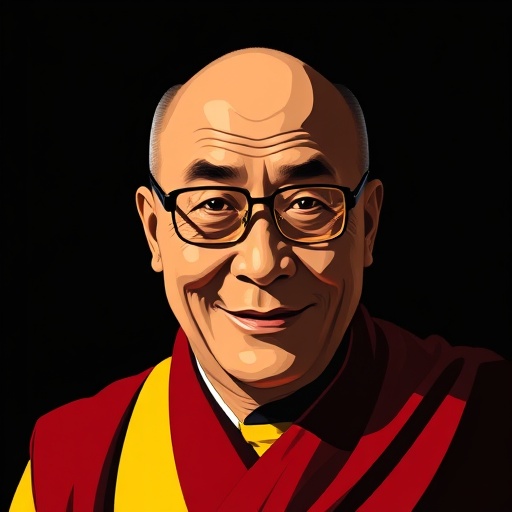
Dalai Lama (14th) — "If you have fear, you don't have peace."
If you have fear, you don't have peace.
If you have fear, you don't have peace.
Click any product to generate a realistic preview. Up to 3 at a time.
* Initial load can take up to 90 seconds — revising the preview in another color is nearly instant.
"I have no special talent. I am only passionately curious."
"Every day, think as you wake up, today I am fortunate to be alive, I have a precious human life, I am not going to waste it."
"My main interest is to make people happy. If they are happy, I am happy."
"I am a simple person. I don't have many possessions. I just have my robes and my beads."
"Anger is the ultimate destroyer of your own peace of mind."
Found in 1 providers: grok
1 source checked
Fear and inner peace cannot coexist. When your mind is gripped by fear — of loss, failure, death, or the unknown — it stays in a state of agitation. Peace is not just the absence of external conflict; it is a settled, undisturbed quality of mind. To experience genuine peace, you must work through or release fear, because a fearful mind is, by definition, an unsettled one.
Tenzin Gyatso has lived this truth personally. Forced into exile from Tibet in 1959 after China's military occupation, he lost his homeland, monastery, and political authority — conditions that could breed permanent fear. Instead, he built a life around compassion and non-violence, earning the 1989 Nobel Peace Prize. His Buddhist practice teaches that attachment and fear generate suffering, while equanimity produces liberation. His own life is the demonstration of the principle.
The Dalai Lama came of age during the Cold War's nuclear standoff and lived through Tibet's violent occupation. His contemporary era has been defined by compounding fears — terrorism after 9/11, climate anxiety, economic collapse, pandemic, and political authoritarianism. He has watched governments and media weaponize fear to control populations. His teaching that fear destroys peace speaks to both personal psychology and geopolitical reality, with unusual credibility from a man who has every reason to feel it.
AI-generated insights based on extensive research and information for context. Factual errors? Email [email protected].
Your cart is empty