Charles Darwin — "Ignorance more frequently begets confidence than does knowledge."
Ignorance more frequently begets confidence than does knowledge.
Ignorance more frequently begets confidence than does knowledge.
Click any product to generate a realistic preview. Up to 3 at a time.
* Initial load can take up to 90 seconds — revising the preview in another color is nearly instant.
"I have tried to be a good boy, and I have done my best."
"If I have seen further than others, it is by standing upon the shoulders of giants."
"If the misery of the poor be caused not by the laws of nature, but by our institutions, great is our sin."
"If a man were to read a book on the cultivation of fruit trees, and then attempt to practice it without having seen a single tree, he would not be more unsuccessful than those who attempt to philosoph…"
"I feel most deeply that the whole subject is too profound for the human intellect. A dog might as well speculate on the mind of Newton."
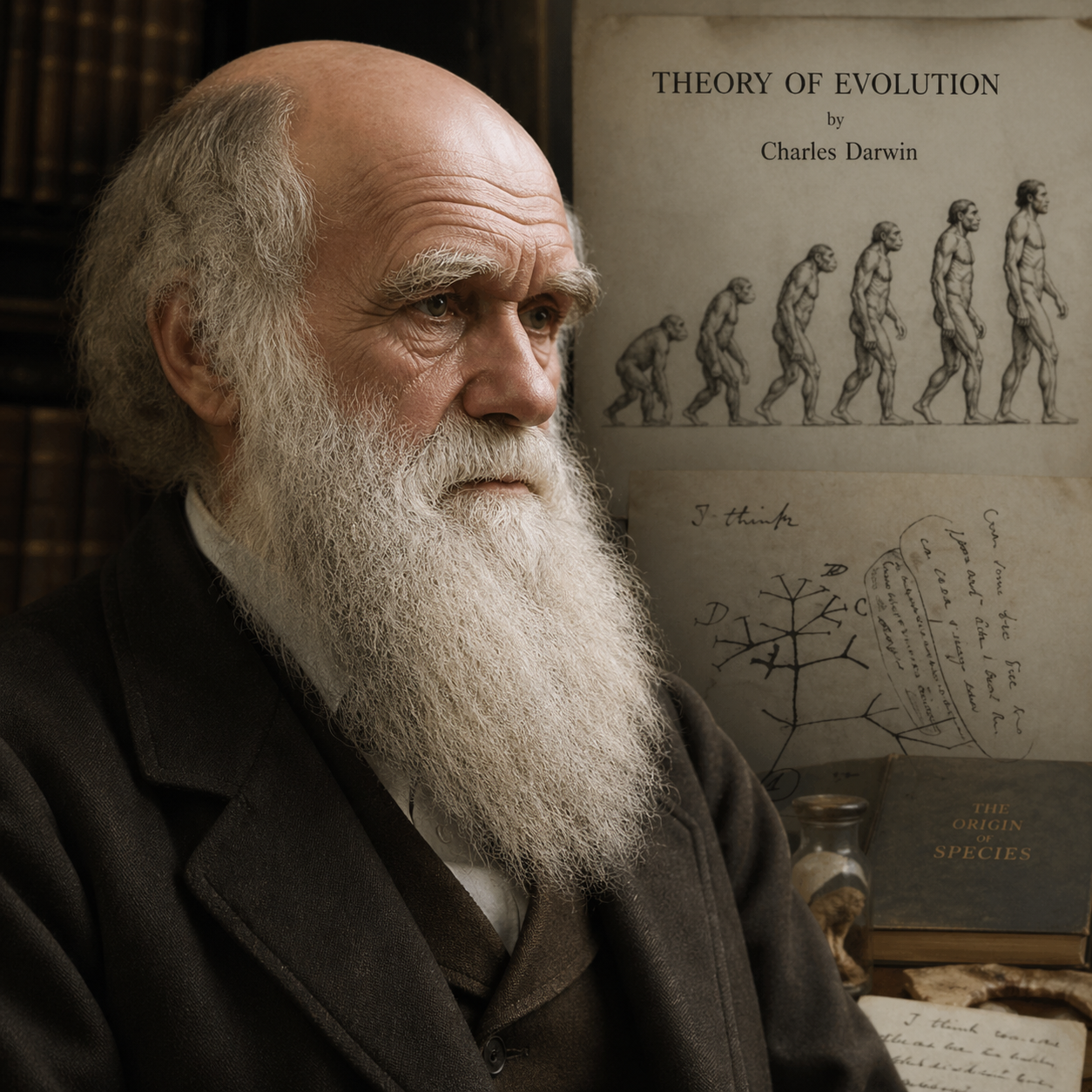
British naturalist whose On the Origin of Species (1859) established evolution by natural selection — the unifying theory of modern biology. Closely associated with Thomas Henry Huxley (his 'bulldog' public defender) and Alfred Russel Wallace (independent co-discoverer of natural selection). For an intellectual contrast, see William Paley, Anglican theologian and Natural Theology author (1743-1805) — Origin of Species is structurally a 400-page reply to Paley — Darwin admired Paley's watchmaker-argument as an undergraduate at Cambridge and then spent 20 years building the empirical machinery to displace him. The cleanest 'design argument vs natural selection' founding rebuttal in science.
The standard scholarly entry points to Charles Darwin's work: Janet Browne (Harvard, history of science) — Charles Darwin: Voyaging (1995) and The Power of Place (2002); Adrian Desmond (UCL, biographer) — Darwin: The Life of a Tormented Evolutionist (1991, with James Moore). These are the works graduate seminars cite when teaching Charles Darwin.
Found in 1 providers: deepseek
1 source checked
People who know little about a subject tend to be the most certain and vocal about it, while those with genuine expertise recognize how much they still don't know. The less you understand something, the easier it is to feel completely sure of yourself. Real knowledge reveals complexity and nuance, which naturally produces caution and humility rather than bold, unearned confidence.
Darwin spent over two decades quietly accumulating evidence before publishing his theory in 1859, acutely aware of its gaps and open questions. He was immediately attacked by confident critics—clergymen, politicians, and laypeople—who had never studied natural selection yet condemned it without hesitation. His own painstaking, self-doubting scientific method stood in direct contrast to opponents who dismissed evolution with absolute certainty rooted in near-zero understanding.
Darwin published during the Victorian era, when religious orthodoxy gave millions unshakeable confidence in a literal Genesis account of creation. Scientific literacy was limited outside narrow academic circles, yet public condemnation of evolution was loud and certain. Clergy and politicians denounced natural selection without engaging its evidence, while expert naturalists grew more uncertain as data compounded. This stark gap between popular confidence and expert humility made Darwin's observation both personal and politically charged.
AI-generated insights based on extensive research and information for context. Factual errors? Email [email protected].
Your cart is empty