Neil deGrasse Tyson — "I'm a big believer in the power of curiosity. It's what drives us to explore, to…"
I'm a big believer in the power of curiosity. It's what drives us to explore, to discover, to learn.
I'm a big believer in the power of curiosity. It's what drives us to explore, to discover, to learn.
Click any product to generate a realistic preview. Up to 3 at a time.
* Initial load can take up to 90 seconds — revising the preview in another color is nearly instant.
"If you're scientifically illiterate, you're a danger to yourself and society."
"If you are scientifically literate, the world looks very different to you, and that difference, I think, is a difference for the better."
"The claim that the universe was made for us is a human vanity."
"My life goal is to be a source of wonder and curiosity for others. If I can achieve that, I've done my job."
"The universe is a place of wonder. And we are all part of that wonder."
American astrophysicist, Hayden Planetarium director, and Cosmos: A Spacetime Odyssey host who carries the Carl Sagan public-science mantle. Closely associated with Bill Nye (fellow science communicator) and Brian Greene (theoretical physicist and string-theory popularizer). For an intellectual contrast, see Ken Ham, founder of Answers in Genesis and the Creation Museum — Ham's career has been organized around defending biblical 6-day creationism — exactly the science-education position Tyson's mainstream-science communication is structured to refute.
Found in 1 providers: grok
1 source checked
Curiosity is a fundamental engine of human progress — it compels us to ask questions, venture into unknown territory, and build knowledge. Rather than passive acceptance of what we already know, curiosity demands engagement, pushes boundaries, and ultimately transforms ignorance into understanding. It is not a luxury but a driving force that separates stagnation from advancement in every domain of human endeavor.
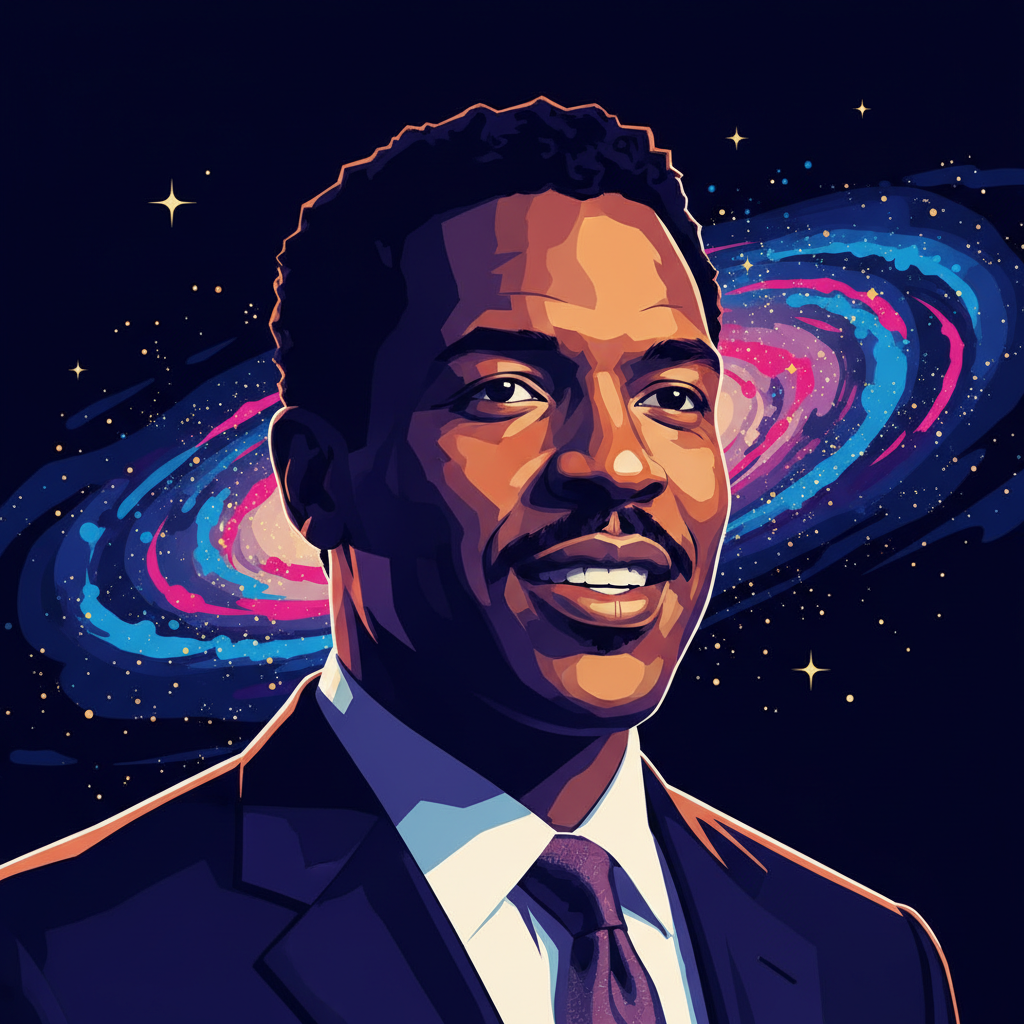
Tyson built his career communicating science to mass audiences precisely by modeling and celebrating curiosity. As director of the Hayden Planetarium and host of Cosmos: A Spacetime Odyssey, he consistently argued that wonder is the foundation of scientific thinking. His own trajectory — a Bronx kid captivated by the night sky at age nine who became America's most prominent astrophysicist — embodies curiosity as a life-organizing principle.
Tyson rose to cultural prominence in an era of science skepticism, declining STEM enrollment concerns, and debates over evolution and climate change in public education. His emphasis on curiosity as a value was a deliberate counter-narrative — arguing that innate human inquisitiveness, properly nurtured, could reverse anti-intellectualism. The digital age simultaneously democratized access to scientific knowledge while also spreading misinformation, making curiosity's cultivation more urgent.
AI-generated insights based on extensive research and information for context. Factual errors? Email [email protected].
Your cart is empty