Neil deGrasse Tyson — "I'm not an atheist. I'm an agnostic. I don't know what's out there, and neither …"
I'm not an atheist. I'm an agnostic. I don't know what's out there, and neither do you.
I'm not an atheist. I'm an agnostic. I don't know what's out there, and neither do you.
Click any product to generate a realistic preview. Up to 3 at a time.
* Initial load can take up to 90 seconds — revising the preview in another color is nearly instant.
"I'm not a fan of people who think they have all the answers. The universe is too vast and complex for anyone to have all the answers."
"If you are not in awe of the universe, you are not living."
"My biggest problem with flat-Earthers is that they're not asking good questions. They're starting with the answer and working backward."
"I'm not trying to be controversial. I'm just trying to be honest."
"I don't have a problem with people believing in God. I have a problem with people believing in things that are demonstrably false."
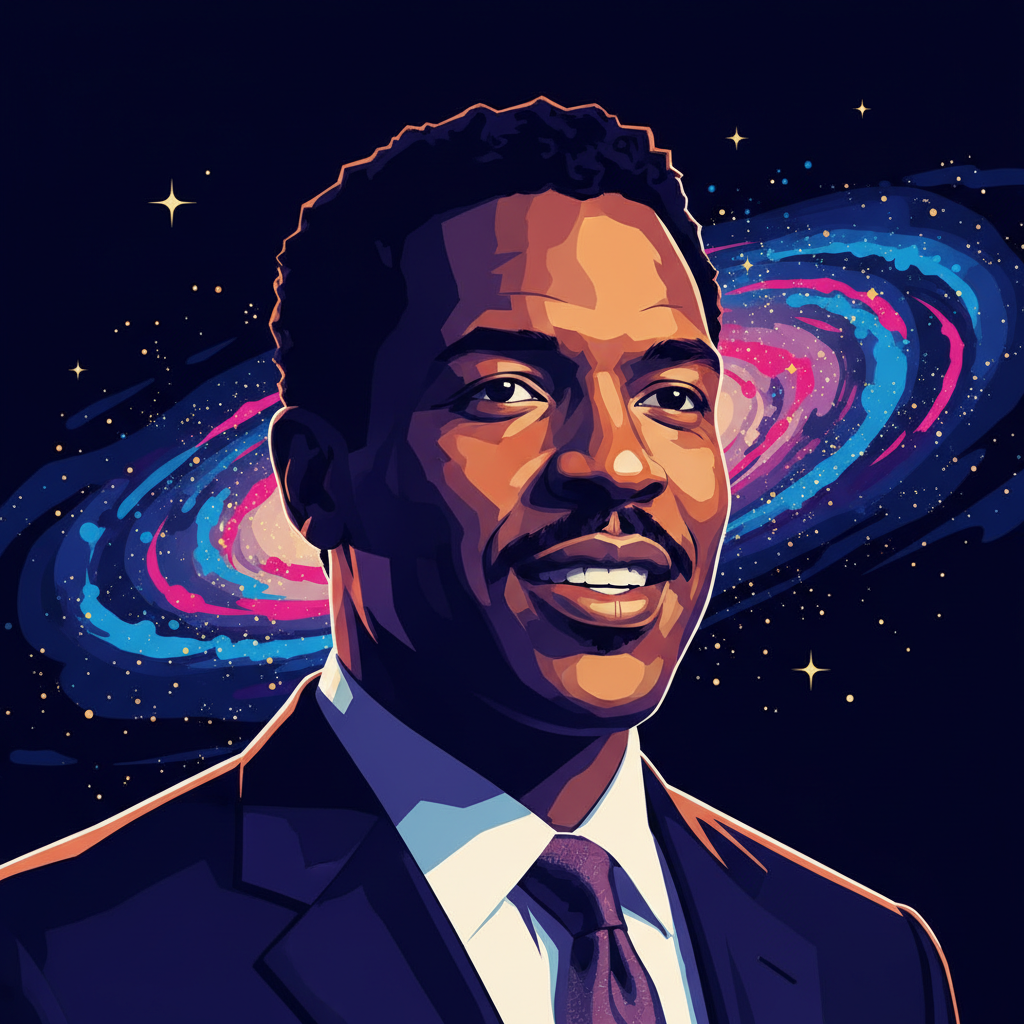
American astrophysicist, Hayden Planetarium director, and Cosmos: A Spacetime Odyssey host who carries the Carl Sagan public-science mantle. Closely associated with Bill Nye (fellow science communicator) and Brian Greene (theoretical physicist and string-theory popularizer). For an intellectual contrast, see Ken Ham, founder of Answers in Genesis and the Creation Museum — Ham's career has been organized around defending biblical 6-day creationism — exactly the science-education position Tyson's mainstream-science communication is structured to refute.
Found in 1 providers: grok
1 source checked
The speaker refuses to claim certainty about whether God or supernatural forces exist. Agnosticism acknowledges the limits of human knowledge rather than asserting definitive belief or disbelief. The pointed 'neither do you' challenges anyone who claims absolute certainty on either side, positioning intellectual humility as more honest than confident declarations about questions that remain fundamentally beyond current human verification or proof.
Tyson built his career on empirical evidence and scientific rigor at the American Museum of Natural History and through shows like Cosmos. As an astrophysicist who studies the universe's vast unknowns, he embodies epistemic humility professionally. He has repeatedly clashed with both religious dogmatists and militant atheists, insisting science demands acknowledging what we genuinely do not know rather than filling gaps with convenient certainty.
Tyson operates in an era of sharp culture-war battles between organized religion and the New Atheist movement, whose figures like Richard Dawkins and Christopher Hitchens dominated public discourse from the mid-2000s onward. His refusal to join either camp resonated in a polarized media landscape where nuanced positions get drowned out. Simultaneously, cosmology was revealing genuinely humbling mysteries: dark matter, dark energy, and cosmic inflation remained unexplained.
AI-generated insights based on extensive research and information for context. Factual errors? Email [email protected].
Your cart is empty