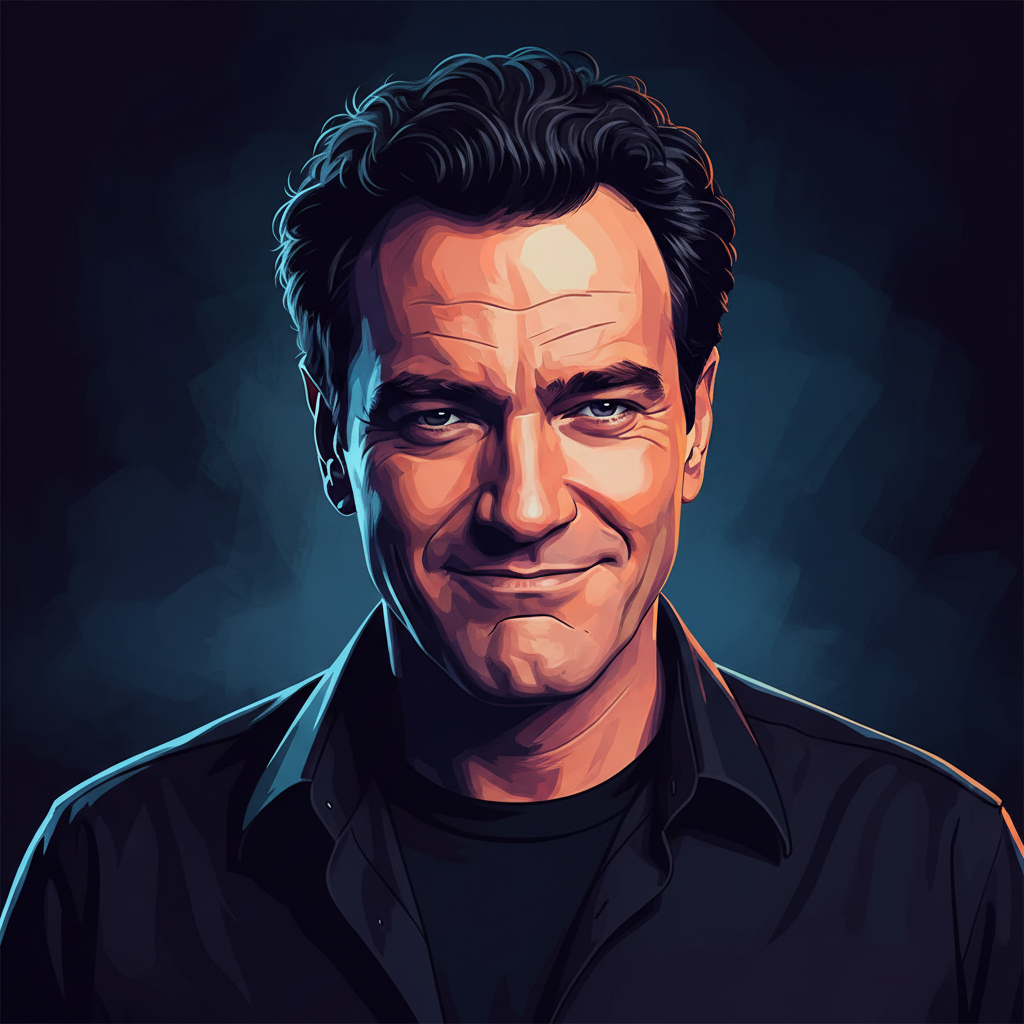
Quentin Tarantino — "I'm a big fan of the B-movie, I'm a big fan of the exploitation film. I like the…"
I'm a big fan of the B-movie, I'm a big fan of the exploitation film. I like the trashy stuff. I like the stuff that's not supposed to be good.
I'm a big fan of the B-movie, I'm a big fan of the exploitation film. I like the trashy stuff. I like the stuff that's not supposed to be good.
Click any product to generate a realistic preview. Up to 3 at a time.
* Initial load can take up to 90 seconds — revising the preview in another color is nearly instant.
"Filmmaking can be a democratic process. In which other people, other than rich white men, can make movies."
"If you've made money being a critic in black culture in the last 20 years you have to deal with me. You must have an opinion of me. You must deal with what I'm saying and deal with the consequences."
"I just want the same rights that a novelist has... you can write a novel about a bastard, but he can be totally interesting."
"It's not that I'm on this big crusade against linear storytelling, but the thing is it's not the only game in town. A novel can do that no problem. Novelist have always had complete freedom to pretty …"
"I get a kick out of violence in movies. I don't get a kick out of badly done violence or action scenes in movies. It's like, 'How far is too far?' Well, if they do it well, there shouldn't be, 'How fa…"
American filmmaker (Pulp Fiction, Kill Bill, Inglourious Basterds) whose intertextual genre-collage redefined 1990s independent cinema. Closely associated with Robert Rodriguez (frequent collaborator (From Dusk Till Dawn, Sin City)) and Paul Thomas Anderson (1990s indie-auteur peer). For an intellectual contrast, see Stanley Kubrick, meticulous formalist filmmaker (1928-1999) — Kubrick's films erase influences into singular monolithic vision through year-long shoots and 100-take perfectionism; Tarantino's foreground every reference as a deliberate tribute — the two opposite ways auteurist cinema can be made.
Your cart is empty