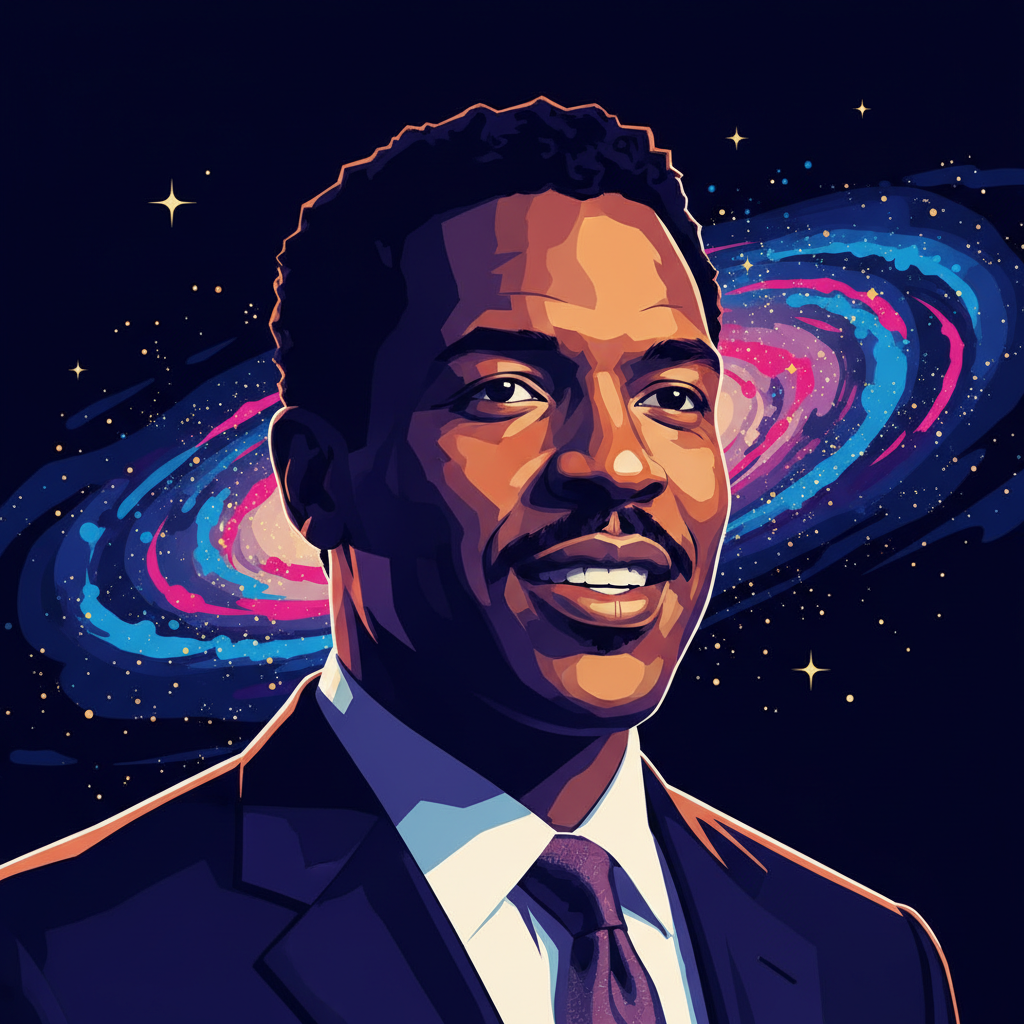
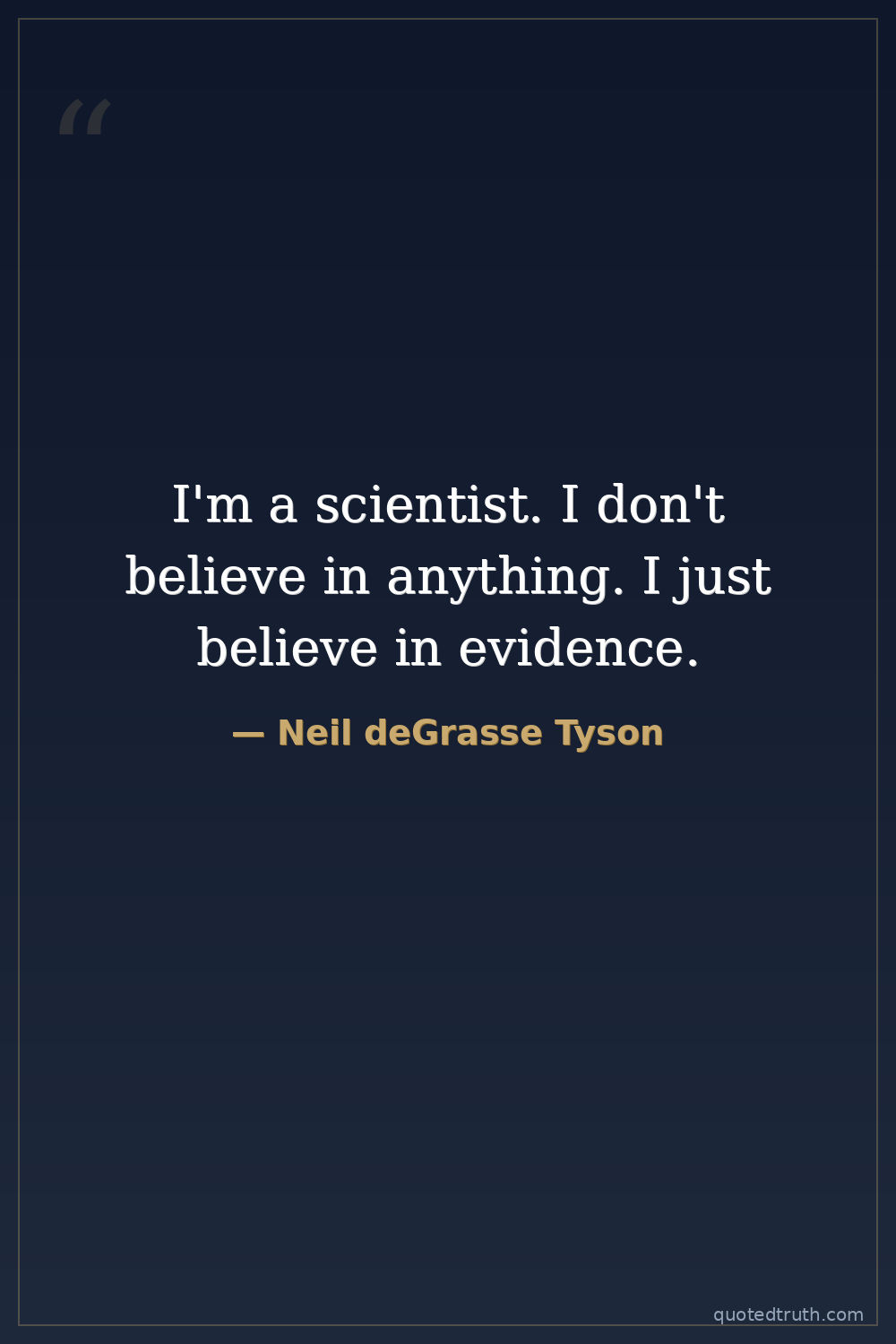
Neil deGrasse Tyson — "I'm a scientist. I don't believe in anything. I just believe in evidence."
I'm a scientist. I don't believe in anything. I just believe in evidence.
I'm a scientist. I don't believe in anything. I just believe in evidence.
Click any product to generate a realistic preview. Up to 3 at a time.
* Initial load can take up to 90 seconds — revising the preview in another color is nearly instant.
"Curiosity and the urge to solve problems are the great forces of human nature."
"My brain is too big for my head. I have to wear a special hat."
"The cosmic perspective not only embraces our genetic kinship with all life on Earth but also values our chemical kinship with any yet-to-be discovered life in the universe, as well as our atomic kinsh…"
"I'm glad to be alive to see the universe unfold."
"I would say, if you're not failing, you're not trying hard enough."
American astrophysicist, Hayden Planetarium director, and Cosmos: A Spacetime Odyssey host who carries the Carl Sagan public-science mantle. Closely associated with Bill Nye (fellow science communicator) and Brian Greene (theoretical physicist and string-theory popularizer). For an intellectual contrast, see Ken Ham, founder of Answers in Genesis and the Creation Museum — Ham's career has been organized around defending biblical 6-day creationism — exactly the science-education position Tyson's mainstream-science communication is structured to refute.
Found in 1 providers: grok
1 source checked
Science operates on evidence, not faith. This quote separates scientific reasoning from belief systems — scientists accept conclusions only when data supports them, and abandon those conclusions when better evidence arrives. Unlike belief, which can persist without proof, scientific conclusions are always provisional and testable. Admitting you don't 'believe' anything is actually a stronger epistemic position than certainty built on assumption rather than demonstration.
Tyson directs the Hayden Planetarium and earned his PhD from Columbia, but his greatest impact comes through science communication — StarTalk podcast, television, bestselling books. He has spent decades publicly defending evolution, climate science, and the scientific method against politically motivated denial. This quote captures his core identity: not as a crusader for ideology, but as someone who follows evidence wherever it leads, even when the conclusion is uncomfortable.
Tyson rose to prominence during intense science-versus-faith conflict in America — early 2000s intelligent design court battles, accelerating climate change denial, and the anti-vaccine movement. Social media amplified misinformation and allowed pseudoscience to spread rapidly. In this environment, a prominent scientist explicitly rejecting belief as a framework and insisting only evidence counts was a direct, necessary intervention in deeply polarized public discourse over scientific authority.
AI-generated insights based on extensive research and information for context. Factual errors? Email [email protected].
Your cart is empty