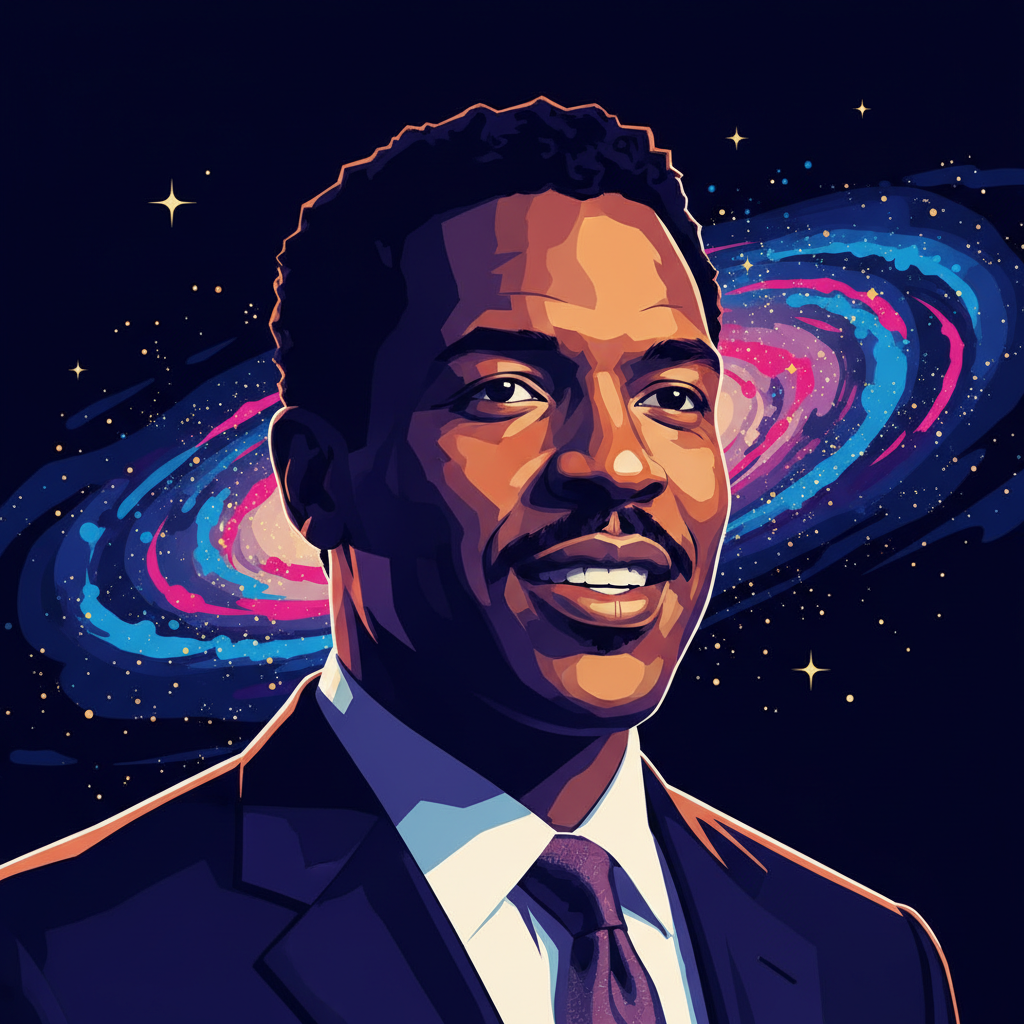
Neil deGrasse Tyson — "My goal is to get people to think about the universe, not just about themselves."
My goal is to get people to think about the universe, not just about themselves.
My goal is to get people to think about the universe, not just about themselves.
Click any product to generate a realistic preview. Up to 3 at a time.
* Initial load can take up to 90 seconds — revising the preview in another color is nearly instant.
"I think the greatest gift you can give someone is the gift of knowledge."
"The universe is a hostile place. It will kill you if you're not careful."
"The greatest discovery is to find something you love to do and then figure out how to get paid for it."
"My biggest problem with flat-Earthers is that they're not asking good questions. They're starting with the answer and working backward."
"The universe is a symphony, and we are the audience."
American astrophysicist, Hayden Planetarium director, and Cosmos: A Spacetime Odyssey host who carries the Carl Sagan public-science mantle. Closely associated with Bill Nye (fellow science communicator) and Brian Greene (theoretical physicist and string-theory popularizer). For an intellectual contrast, see Ken Ham, founder of Answers in Genesis and the Creation Museum — Ham's career has been organized around defending biblical 6-day creationism — exactly the science-education position Tyson's mainstream-science communication is structured to refute.
Found in 1 providers: grok
1 source checked
Tyson is expressing a desire to shift human focus outward—away from personal concerns and toward the vastness of the cosmos. When people grasp the scale of the universe, petty divisions shrink in comparison. Understanding our place among billions of galaxies fosters humility, curiosity, and a broader sense of shared humanity rather than narrow self-interest.
As director of the Hayden Planetarium and host of Cosmos: A Spacetime Odyssey, Tyson has dedicated his career to public science education. His books, podcasts, and media appearances consistently aim to make astrophysics accessible and emotionally resonant, reflecting his belief that cosmic perspective transforms how people treat each other and prioritize what matters.
Tyson rose to prominence during a period of rising science skepticism, political polarization, and culture-war battles over climate change and evolution. His mission to inspire cosmic perspective was a direct counterweight to tribalism and shortsightedness, occurring alongside the 2014 Cosmos reboot, the social media era, and renewed debates about science's role in public life.
AI-generated insights based on extensive research and information for context. Factual errors? Email [email protected].
Your cart is empty