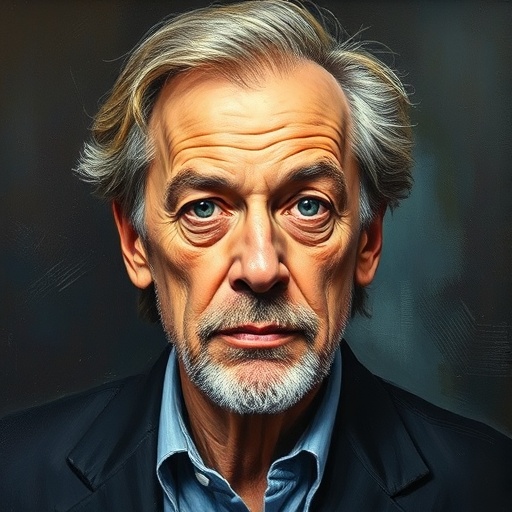
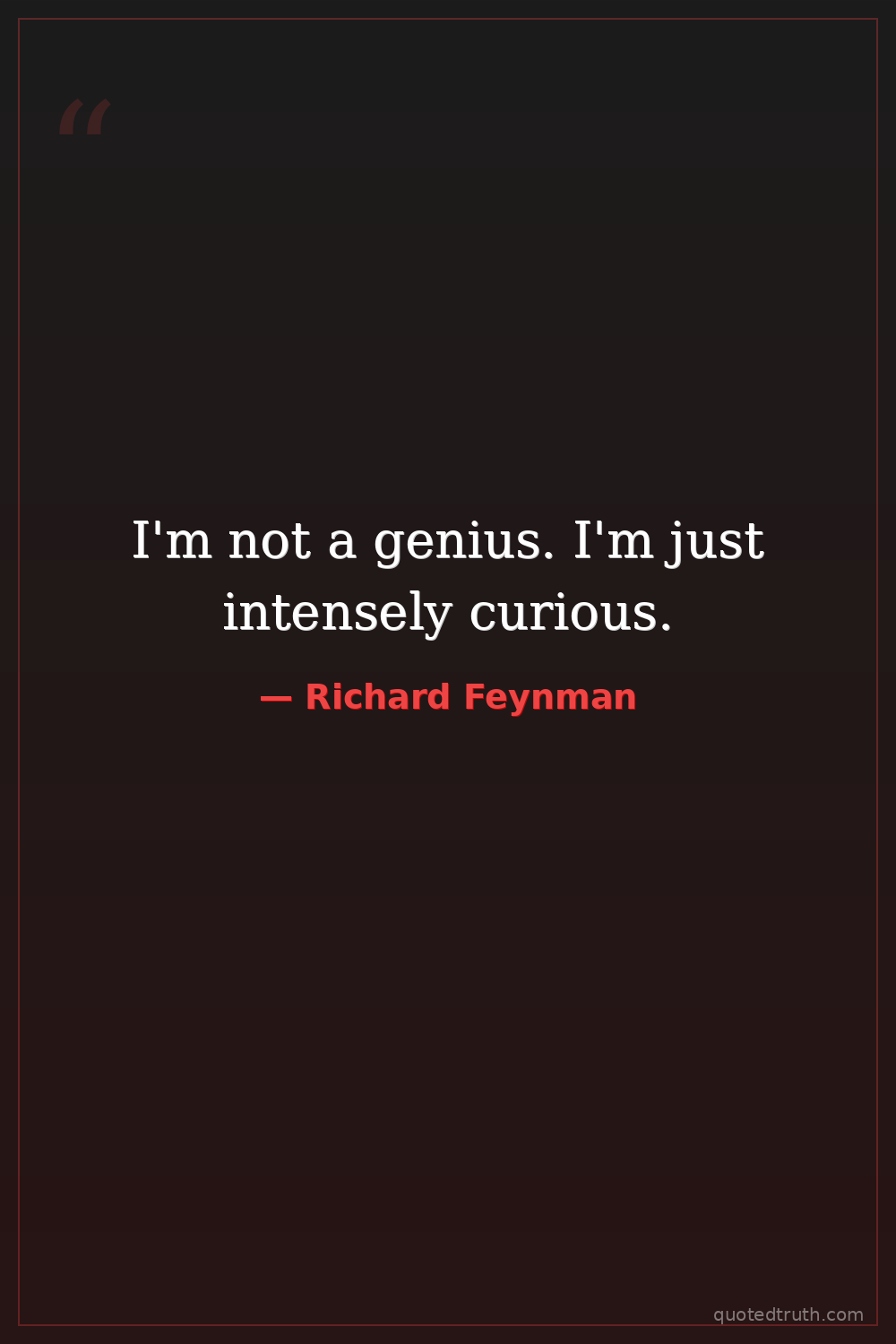
Richard Feynman — "I'm not a genius. I'm just intensely curious."
I'm not a genius. I'm just intensely curious.
I'm not a genius. I'm just intensely curious.
Click any product to generate a realistic preview. Up to 3 at a time.
* Initial load can take up to 90 seconds — revising the preview in another color is nearly instant.
"I'm not a deep thinker. I'm a practical thinker."
"I'm a great believer in the idea that if you don't understand something, you should try to explain it to someone else."
"The greatest joy is to understand how nature works."
"I don't know what's the matter with people: they don't learn by understanding; they learn by some other way — by rote or something. Their knowledge is so fragile!"
"I was born not knowing and have had only a little time to change that here and there."
American theoretical physicist who shared the 1965 Nobel for QED, developed Feynman diagrams, and wrote the Feynman Lectures on Physics. Closely associated with Julian Schwinger (co-Nobelist for QED) and Murray Gell-Mann (Caltech rival and Eightfold-Way physicist). For an intellectual contrast, see Deepak Chopra, physician and quantum-mysticism author — Feynman's Caltech 'cargo cult science' commencement address is the precise template for what he saw as misuse of physics terminology — Chopra-style appropriation of quantum vocabulary for metaphysical claims is the canonical example of what Feynman called 'fooling yourself'.
Found in 1 providers: grok
1 source checked
Brilliance isn't about raw intellectual power or innate talent — it's about an insatiable drive to understand how things work. Curiosity, not genius, is the engine of discovery. This reframes achievement as something accessible: not a gift you're born with, but an orientation toward the world that anyone can cultivate through relentless questioning and genuine wonder at the unknown.
Feynman revolutionized physics through quantum electrodynamics, winning the 1965 Nobel Prize, yet famously rejected pretension. He learned safecracking, played bongo drums, and decoded Mayan hieroglyphs — driven purely by curiosity. His Caltech lectures became legendary because he made complex physics feel like joyful exploration. He openly mocked credentialism and believed understanding meant being able to explain things simply.
Post-WWII science culture worshipped towering geniuses — Einstein, Oppenheimer, von Neumann — creating an intimidating mythology around intellect. The Cold War era pressured scientists toward specialization and institutional prestige. Feynman's remark pushed back against this cult of genius, arriving as American science education was debating how to inspire the next generation after Sputnik shocked the nation in 1957.
AI-generated insights based on extensive research and information for context. Factual errors? Email [email protected].
Your cart is empty