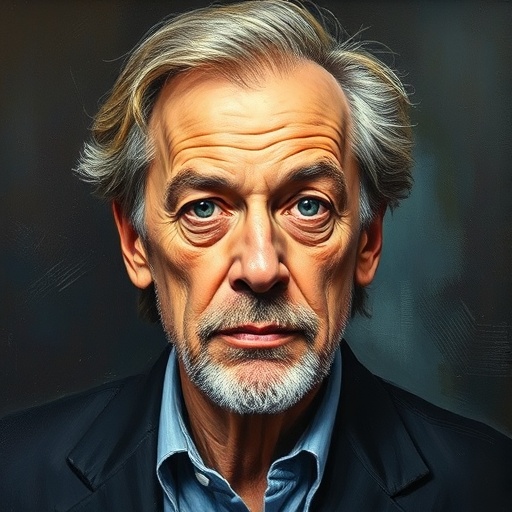
Richard Feynman — "The world is a stage, but the play is badly cast."
The world is a stage, but the play is badly cast.
The world is a stage, but the play is badly cast.
Click any product to generate a realistic preview. Up to 3 at a time.
* Initial load can take up to 90 seconds — revising the preview in another color is nearly instant.
"I have a friend who is an artist and has some pictures which he thinks are very good... and he says, 'I am a value-free man. I don't believe in values.' And I say, 'Oh, really? Then why are your pictu…"
"I don't like to be called a genius. I just like to think."
"I bet you anything that if you asked a hundred physicists, they would all say that the most beautiful equation in physics is Maxwell's equations."
"The easiest way to fool yourself is to believe something because you want it to be true."
"The thing about science is that it's all about discovery. It's all about trying to find out what's going on."
American theoretical physicist who shared the 1965 Nobel for QED, developed Feynman diagrams, and wrote the Feynman Lectures on Physics. Closely associated with Julian Schwinger (co-Nobelist for QED) and Murray Gell-Mann (Caltech rival and Eightfold-Way physicist). For an intellectual contrast, see Deepak Chopra, physician and quantum-mysticism author — Feynman's Caltech 'cargo cult science' commencement address is the precise template for what he saw as misuse of physics terminology — Chopra-style appropriation of quantum vocabulary for metaphysical claims is the canonical example of what Feynman called 'fooling yourself'.
Widely attributed, but specific source is elusive. Possibly an informal quip.
Date: Approx. 1960s-1980s
GeneralFound in 1 providers: grok
1 source checked
The quote borrows Shakespeare's metaphor of life as theater, then delivers a cynical twist: not only are we all performing roles, but the wrong people have the starring parts. Power, prestige, and prominence are distributed absurdly—the incompetent lead while the capable stand in the wings. It's a sharp critique of how poorly merit and position align in human society.
Feynman spent his career exposing bad casting—bureaucrats who couldn't explain basic physics running nuclear programs, NASA managers who ignored engineers' O-ring warnings until Challenger exploded, and academics dressing empty ideas in impenetrable jargon. He believed you truly understand something only when you can explain it simply. His life was a running argument that credentials and competence rarely occupy the same body.
Feynman worked through the Cold War, the Manhattan Project, and the space race—eras defined by institutional authority wielding enormous power. The 1986 Challenger disaster epitomized badly cast leadership: NASA's decision chain suppressed dissenting engineers. Post-WWII science became entangled with government bureaucracy and political theater, where social rank rather than intellectual rigor determined who held the microphone and shaped consequential decisions.
AI-generated insights based on extensive research and information for context. Factual errors? Email [email protected].
Your cart is empty