Grace Hopper — "You manage things, you lead people. We went overboard on management and forgot a…"
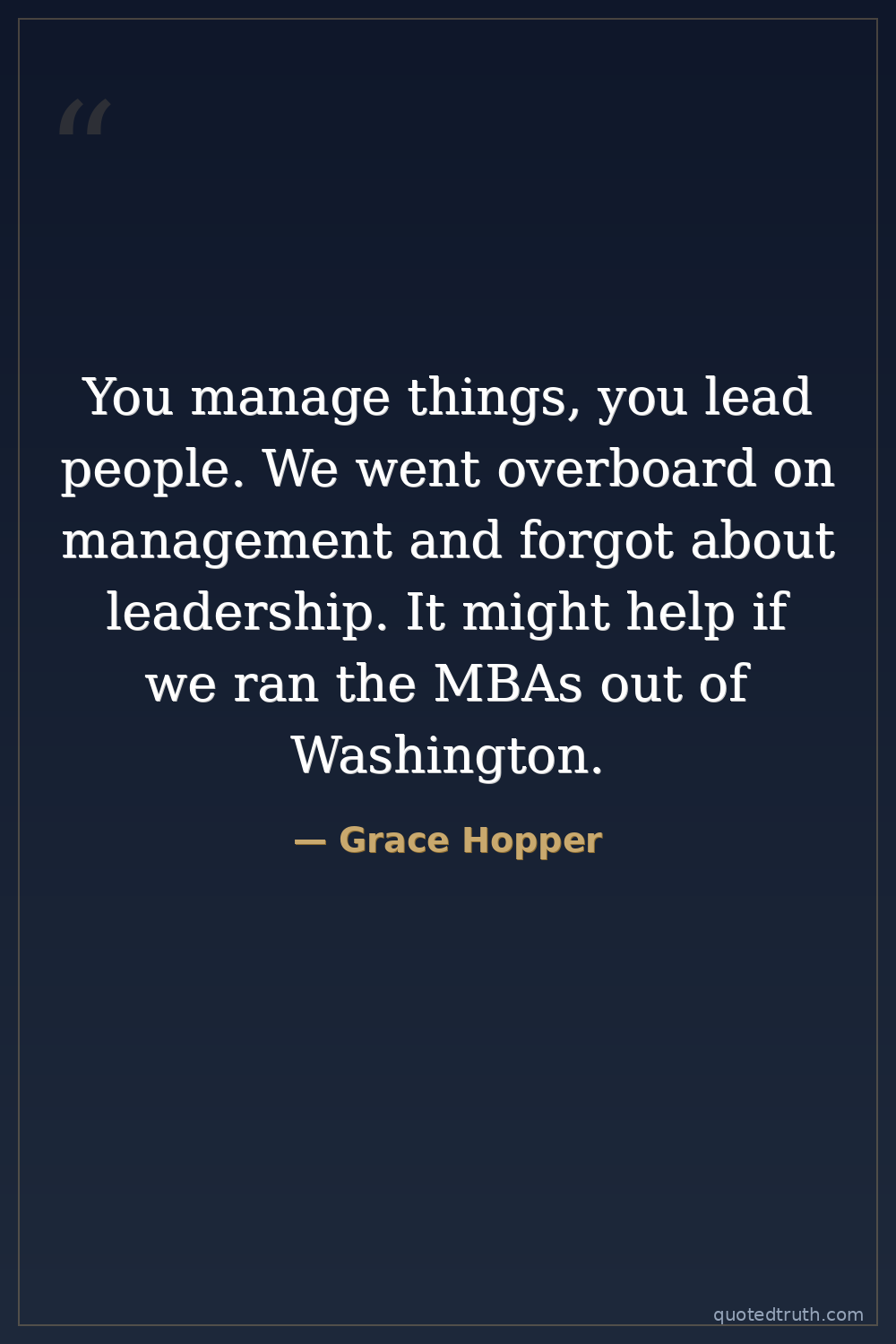
You manage things, you lead people. We went overboard on management and forgot about leadership. It might help if we ran the MBAs out of Washington.
You manage things, you lead people. We went overboard on management and forgot about leadership. It might help if we ran the MBAs out of Washington.
Click any product to generate a realistic preview. Up to 3 at a time.
* Initial load can take up to 90 seconds — revising the preview in another color is nearly instant.
"At any given moment, there is always a line representing what your boss will believe. If you step over it, you will not get your budget. Go as close to that line as you can."
"That's why I'm still here. I enjoy it."
"I'm not afraid of anything. I'm too old for that."
"Life was simple before World War II. After that, we had systems."
"I had a running compiler and nobody would touch it. They told me computers could only do arithmetic."
Advice to the young on the distinction between management and leadership, with a witty jab at bureaucracy.
Date: 1987 (OCLC Newsletter, March/April)
Life & AgingFound in 1 providers: gemini
1 source checked
The quote draws a hard line between management and leadership: you apply process to objects and systems, but you must inspire and guide humans. Hopper argues that over-reliance on MBA-trained administrators has flooded government with people skilled at optimizing systems but incapable of genuinely leading people. The provocative MBA quip captures frustration with technocratic governance that prizes metrics and procedures over vision, trust, and human motivation.
Hopper spent decades as both a Naval officer and computing pioneer, commanding teams that built COBOL and the first compiler. She led by example and trusted people over process — famously saying 'It's easier to ask forgiveness than permission.' As a Rear Admiral navigating military bureaucracy while pushing technological frontiers, she experienced firsthand how rigid management culture stifled progress, making her distrust of process-obsessed administrators deeply personal and earned.
Hopper was most vocal during the 1970s and 1980s, when MBA enrollment surged and business-school thinking colonized government agencies. The post-Vietnam, post-Watergate era saw Washington doubling down on administrative systems and oversight structures. Management by objective, top-down hierarchy, and cost-efficiency frameworks dominated. Meanwhile, the early computing revolution demanded exactly the opposite — visionary, adaptive, people-first leadership willing to take risks on entirely unproven technology.
AI-generated insights based on extensive research and information for context. Factual errors? Email [email protected].
Your cart is empty