Galileo Galilei — "In questions of science, the authority of a thousand is not worth the humble rea…"
In questions of science, the authority of a thousand is not worth the humble reasoning of a single individual.
In questions of science, the authority of a thousand is not worth the humble reasoning of a single individual.
Click any product to generate a realistic preview. Up to 3 at a time.
* Initial load can take up to 90 seconds — revising the preview in another color is nearly instant.
"I cannot but be astonished that Sarsi should persist in trying to prove by means of witnesses something that I may see for myself at any time by means of experiment. Witnesses are examined in doubtful…"
"It is not in the power of any created being to make things true or false, but only to discover what is true or false."
"The greatest wisdom is to know oneself."
"I do not believe that the same God who has given us senses, reason and intellect would have us abandon their use."
"It is surely harmful to souls to make it a heresy to believe what has been proved."
Found in 2 providers: grok,deepseek
2 sources checked
Scientific truth is determined by evidence and logical reasoning, not by how many people believe something or how powerful those people are. One person with careful observation and sound argument can overturn centuries of consensus. Numbers, status, and tradition carry no weight against demonstrated reality. What matters is the quality of the reasoning and the evidence behind it, not the quantity or authority of those who disagree.
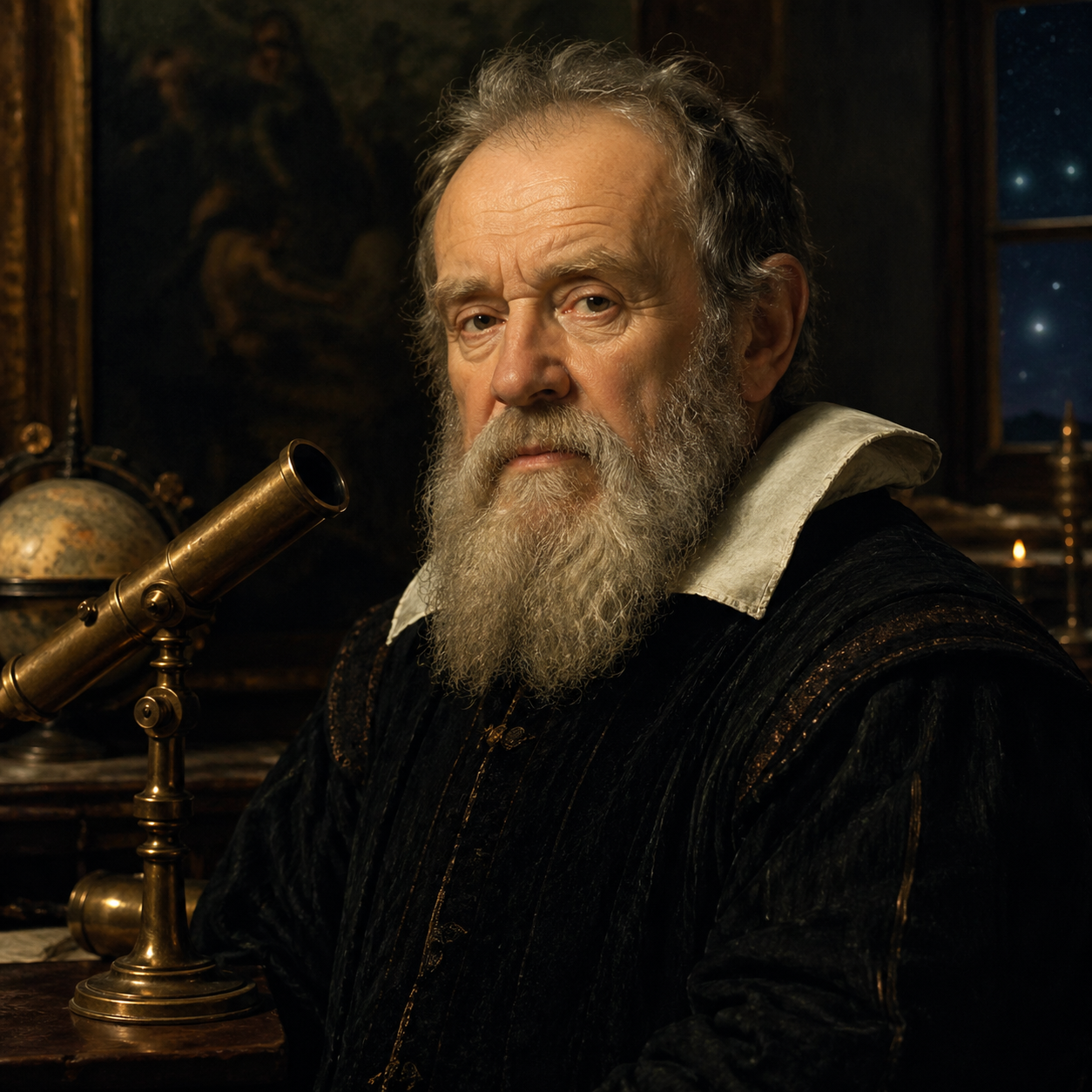
Galileo lived this principle directly — he contradicted Aristotle, the Catholic Church, and virtually all established academic authority by insisting the Earth moves around the Sun. Using his telescope, he gathered observational evidence that overturned two millennia of geocentric consensus. Tried by the Inquisition in 1633 and forced to recant, he nonetheless reportedly muttered 'and yet it moves.' His entire career was a battle of one man's evidence against institutional authority.
The early modern period saw the Catholic Church and Aristotelian scholasticism controlling what counted as legitimate knowledge. Challenging established doctrine risked heresy charges and ruin. Galileo wrote during the Scientific Revolution, when figures like Copernicus, Kepler, and Newton were dismantling ancient cosmology. The printing press was spreading ideas faster than institutions could suppress them, creating the first genuine tension between empirical inquiry and theological authority in European intellectual life.
AI-generated insights based on extensive research and information for context. Factual errors? Email [email protected].
Your cart is empty