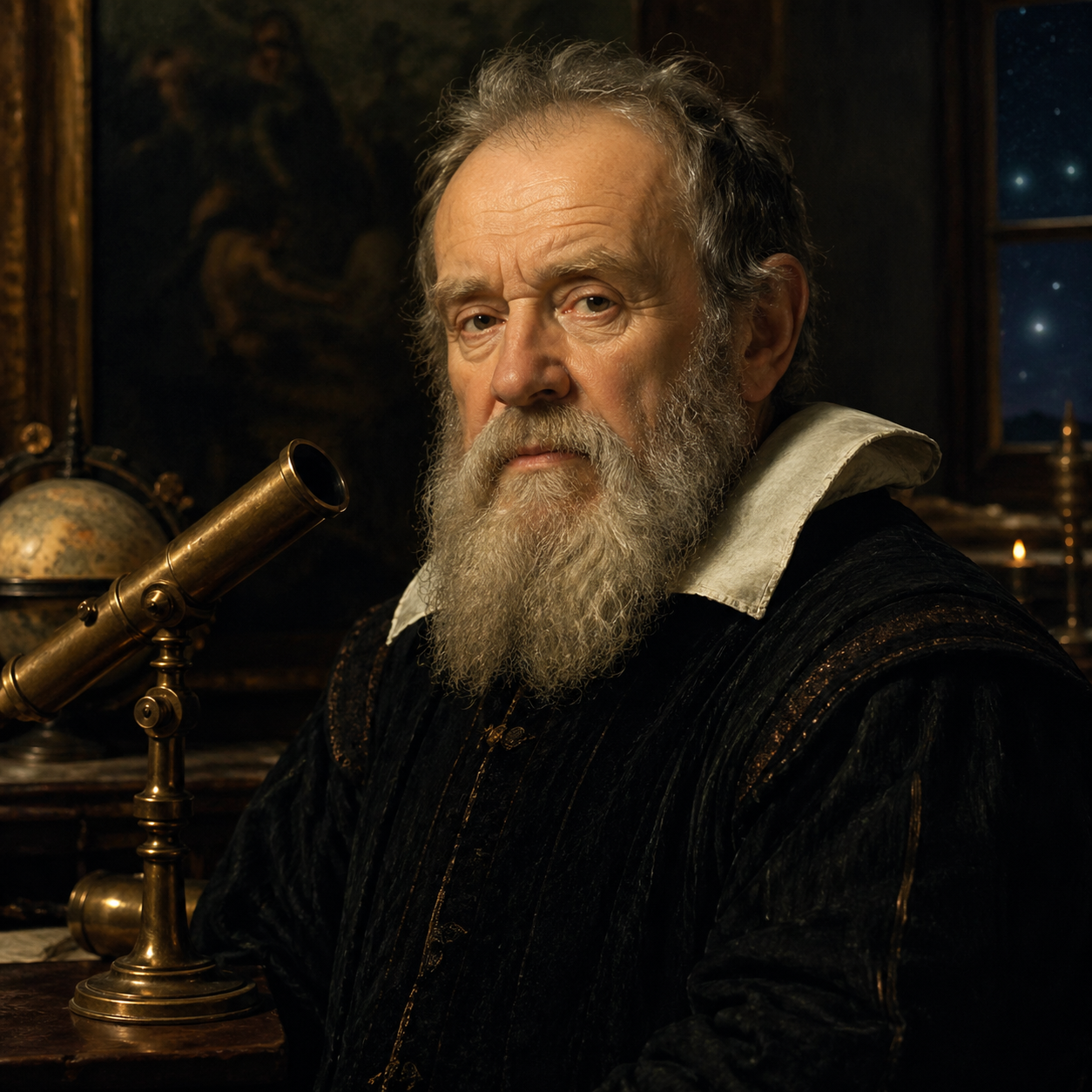
Galileo Galilei — "The motion of the earth is a fact, not a theory."
The motion of the earth is a fact, not a theory.
The motion of the earth is a fact, not a theory.
Click any product to generate a realistic preview. Up to 3 at a time.
* Initial load can take up to 90 seconds — revising the preview in another color is nearly instant.
"I have loved the stars too fondly to be fearful of the night."
"You cannot teach a man anything; you can only help him find it within himself."
"Eppur si muove! (And yet it moves!)"
"I cannot without great astonishment — I might say without great insult to my intelligence — hear it attributed as a prime perfection and nobility of the natural and integral bodies of the universe tha…"
"The two books from which I draw my knowledge are the book of the created world and the book of the Holy Scripture."
This sentiment is clearly expressed in his writings, though the exact phrasing may vary slightly across translations or specific contexts.
Date: 1613-1632
EducationalFound in 1 providers: grok
1 source checked
Earth genuinely moves through space — orbiting the sun and rotating on its axis — rather than sitting stationary at the universe's center. This is an established observable reality supported by evidence, not a speculative idea open to casual dismissal. Galileo insists the distinction between demonstrated fact and untested hypothesis matters enormously, and that evidence-based conclusions deserve to be treated as settled truth regardless of who finds them uncomfortable.
Galileo spent decades building telescopic and mathematical evidence for heliocentrism, confirming what Copernicus had proposed theoretically. His observations of Jupiter's moons, Venus's phases, and sunspots all pointed to a moving Earth. The Inquisition forced him to publicly recant in 1633, yet he famously refused to abandon the underlying truth privately. This statement captures his core conviction that empirical demonstration supersedes authority, scripture, or tradition.
In early modern Europe, the Catholic Church held that Earth stood motionless at creation's center — a doctrine fusing Aristotelian cosmology with biblical interpretation. Challenging it risked heresy charges. Copernicus had published heliocentrism in 1543 but framed it cautiously. Galileo lived through the Counter-Reformation's tightening grip on intellectual life, making his insistence on treating Earth's motion as demonstrated fact — not mere mathematical convenience — a genuinely dangerous and revolutionary stance.
AI-generated insights based on extensive research and information for context. Factual errors? Email [email protected].
Your cart is empty