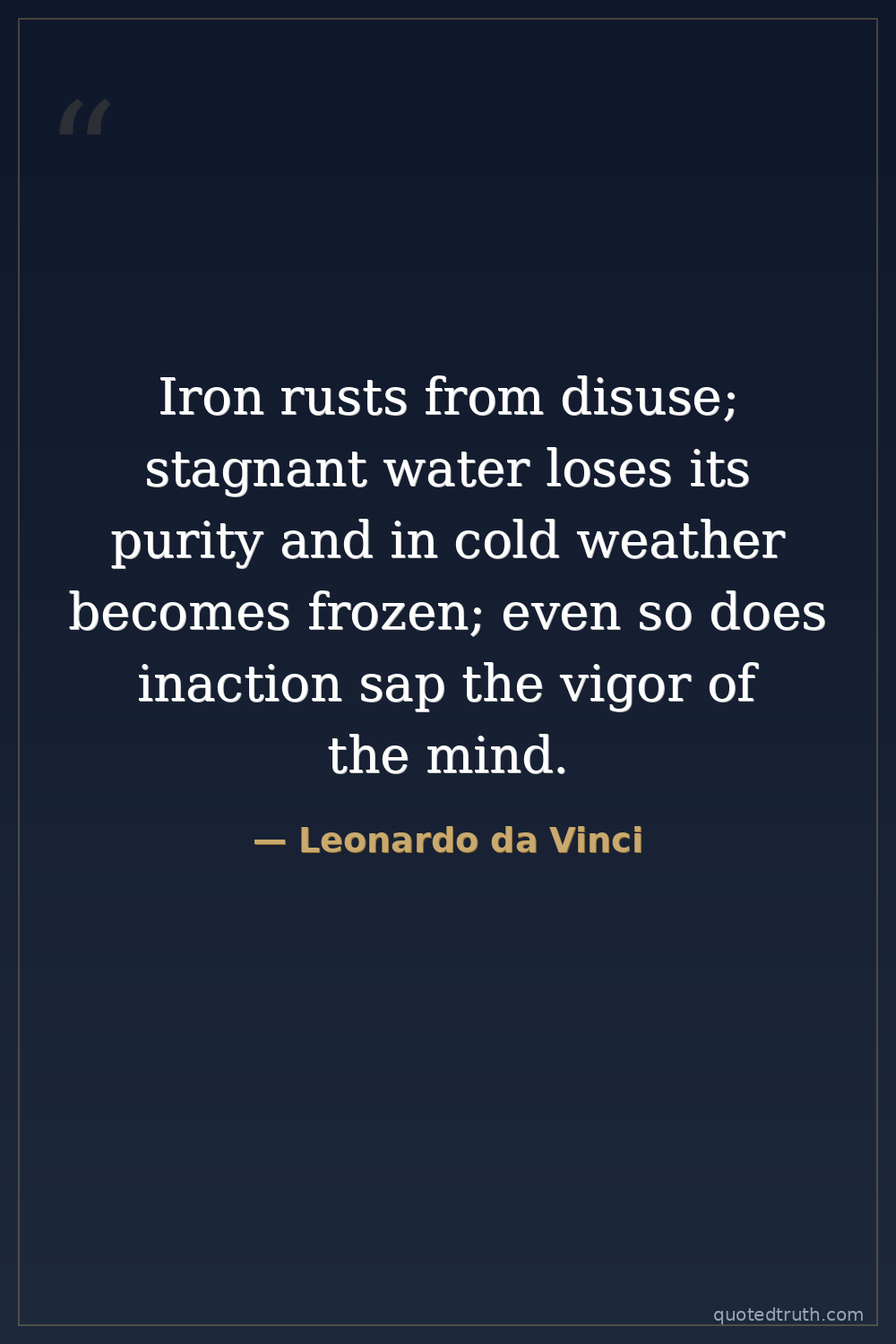
Leonardo da Vinci — "Iron rusts from disuse; stagnant water loses its purity and in cold weather beco…"
Iron rusts from disuse; stagnant water loses its purity and in cold weather becomes frozen; even so does inaction sap the vigor of the mind.
Iron rusts from disuse; stagnant water loses its purity and in cold weather becomes frozen; even so does inaction sap the vigor of the mind.
Click any product to generate a realistic preview. Up to 3 at a time.
* Initial load can take up to 90 seconds — revising the preview in another color is nearly instant.
"One can have no smaller or greater mastery than mastery of oneself."
"Experience does not err. Only your judgments err by expecting from her what is not in her power."
"Reprove a friend in secret, but praise him openly."
"Poor is the pupil who does not surpass his master."
"It is an easy thing to praise and blame, but not so easy to know what to praise and what to blame."
Found in 1 providers: grok
1 source checked
Using iron, water, and ice as physical analogies, this quote warns that the mind degrades without continuous use. Just as metal corrodes when idle and water stagnates or freezes when motionless, mental capacity withers through inaction. The message is direct: sustained intellectual engagement is not optional — it is the condition that keeps the mind sharp, generative, and capable of growth.
Leonardo filled thousands of notebook pages with anatomy drawings, engineering schematics, botanical studies, and physics observations — often pursuing dozens of disciplines simultaneously. He dissected corpses to understand the body, designed flying machines, and painted masterworks, all driven by relentless curiosity. This quote mirrors his personal operating principle: to stop investigating was, for him, a form of decay. His restless, interdisciplinary output was the direct enactment of this belief.
Leonardo lived during the Italian Renaissance (1452–1519), an era redefining human potential after centuries of medieval scholasticism. Humanist thinkers championed active inquiry, individual achievement, and empirical observation over passive theological acceptance. The printing press was spreading knowledge rapidly. Patrons competed for brilliant minds. In this climate, intellectual productivity was not merely admired — it was the currency of reputation, making the fear of mental stagnation culturally resonant and personally urgent.
AI-generated insights based on extensive research and information for context. Factual errors? Email [email protected].
Your cart is empty