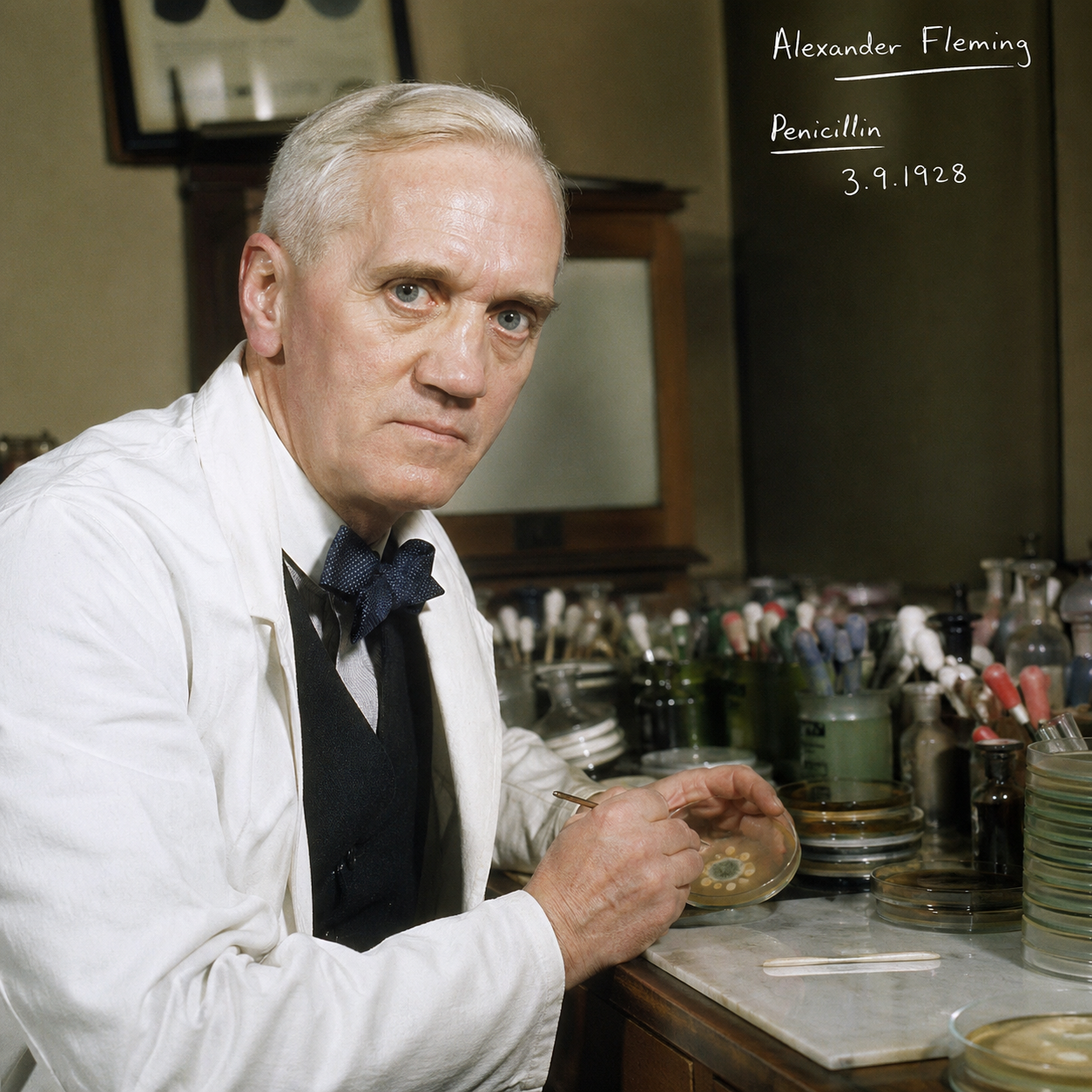
Alexander Fleming — "It has been said that I am a lucky man. I agree. I have been very lucky."
It has been said that I am a lucky man. I agree. I have been very lucky.
It has been said that I am a lucky man. I agree. I have been very lucky.
Click any product to generate a realistic preview. Up to 3 at a time.
* Initial load can take up to 90 seconds — revising the preview in another color is nearly instant.
"It is a wonderful thing to be able to save lives with a simple substance."
"The greatest joy of a scientist is to see his work used for the benefit of mankind."
"The story of penicillin has a certain romantic appeal, and I think that may be one of the reasons it has attracted so much attention. But the real story is much more prosaic."
"I am just a simple bacteriologist who got lucky."
"It is the lone worker who makes the first advance in a subject; the details may be worked out by a team, but the prime idea is due to enterprise, thought, and perception of an individual."
Found in 1 providers: grok
1 source checked
Luck isn't weakness — it's honesty. Fleming is acknowledging that chance played a genuine role in his most famous moment. The quote strips away false modesty and false pride alike: he neither dismisses fortune nor claims pure genius. In plain modern terms, it means great outcomes often involve circumstances beyond our control, and admitting that takes more courage than pretending every success was entirely earned through skill alone.
Fleming discovered penicillin in 1928 when a contaminated petri dish — a rogue Penicillium mold spore — destroyed the bacterial colonies he was studying. Most researchers would have discarded it as spoiled. Fleming noticed and investigated instead. He'd earlier discovered lysozyme in 1923 through similar chance observation. His career was built on recognizing accidents others ignored. His acknowledgment of luck wasn't false modesty; it was precise scientific memory of how his breakthroughs actually unfolded.
Fleming worked during the pre-antibiotic era, when bacterial infections — pneumonia, sepsis, infected wounds — killed routinely. World War I had shown infection killed more soldiers than enemy fire. His 1928 discovery, developed into medicine by Florey and Chain, became mass-produced in time for World War II, saving hundreds of thousands of lives. Winning the 1945 Nobel Prize, Fleming understood that a single chance observation had permanently altered humanity's relationship with infectious disease.
AI-generated insights based on extensive research and information for context. Factual errors? Email [email protected].
Your cart is empty