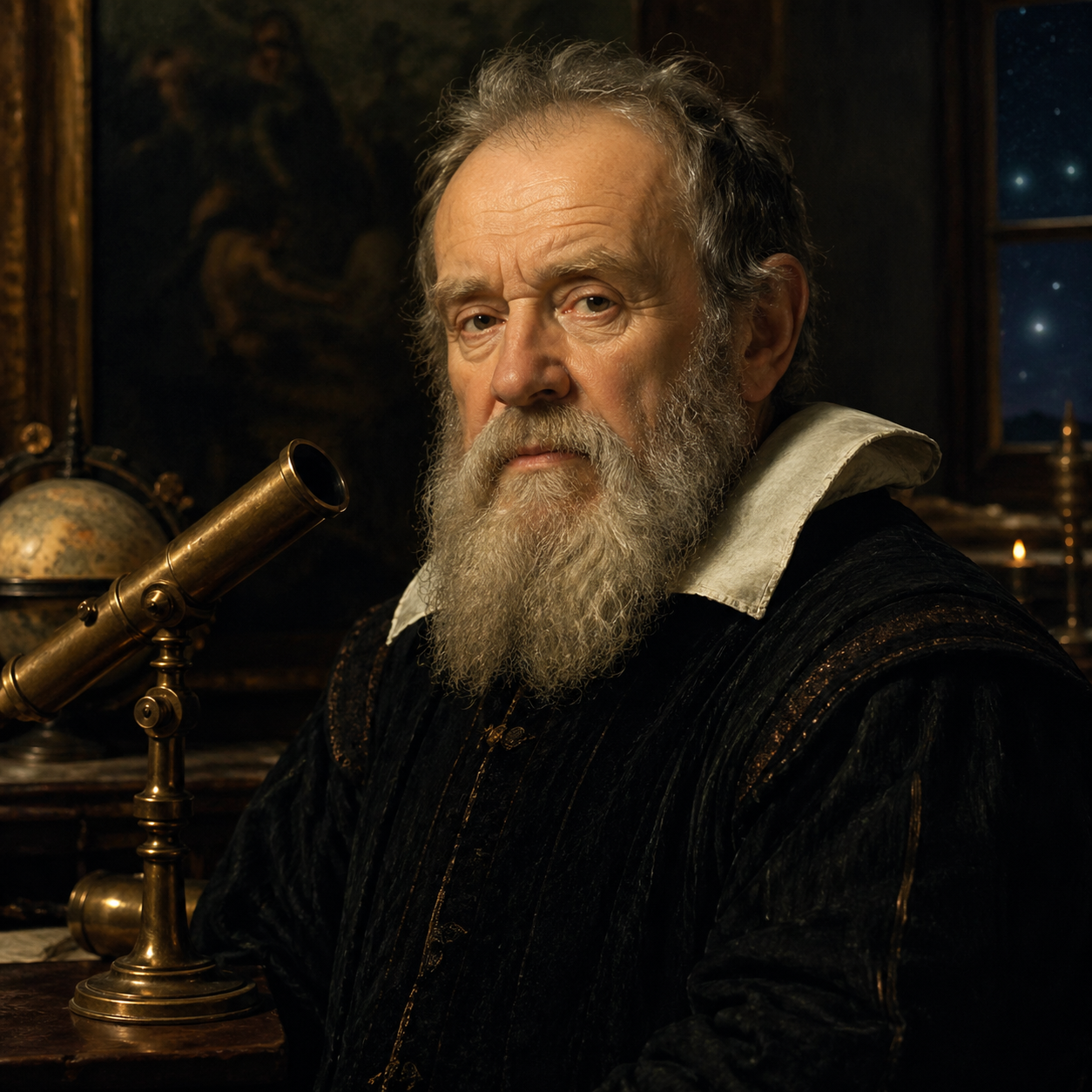
Galileo Galilei — "It is a beautiful and admirable thing to search out the causes of natural phenom…"
It is a beautiful and admirable thing to search out the causes of natural phenomena.
It is a beautiful and admirable thing to search out the causes of natural phenomena.
Click any product to generate a realistic preview. Up to 3 at a time.
* Initial load can take up to 90 seconds — revising the preview in another color is nearly instant.
"Where the senses fail us, reason must step in."
"It is not necessary to examine all the arguments against a position, but only the strongest."
"The deeper I go into the sciences, the more I am convinced that the world is the work of an all-wise Creator."
"The greater the number of people who believe a proposition, the more likely it is to be false."
"To command the sun and moon, God must have given them motion."
Found in 1 providers: grok
1 source checked
Investigating why natural events occur — not just observing them — is worthwhile and even beautiful. It champions the human drive to uncover causal explanations behind what we see in the world, framing scientific curiosity as an inherently admirable pursuit. It pushes back against passive acceptance of how things are and elevates the act of asking why and how as one of humanity's finest endeavors, worthy of a lifetime's devotion.
Galileo built his career on exactly this — using telescopes, inclined planes, and careful measurement to uncover why planets move, why objects fall, why tides behave as they do. He championed empirical investigation over inherited Aristotelian doctrine at enormous personal cost, facing the Inquisition and lifetime house arrest. His foundational work in kinematics and observational astronomy was driven by this conviction that nature's causes are discoverable and worth any price to find.
In the early 1600s, Aristotelian scholasticism still dominated European universities — natural phenomena were explained through religious authority and inherited philosophy, not experiment. The Catholic Church controlled what could be asserted about the cosmos during the Counter-Reformation and Inquisition. Galileo's era witnessed the first genuine clash between dogmatic explanation and empirical inquiry, making the simple act of searching out natural causes a politically and spiritually dangerous proposition that could end in condemnation.
AI-generated insights based on extensive research and information for context. Factual errors? Email [email protected].
Your cart is empty