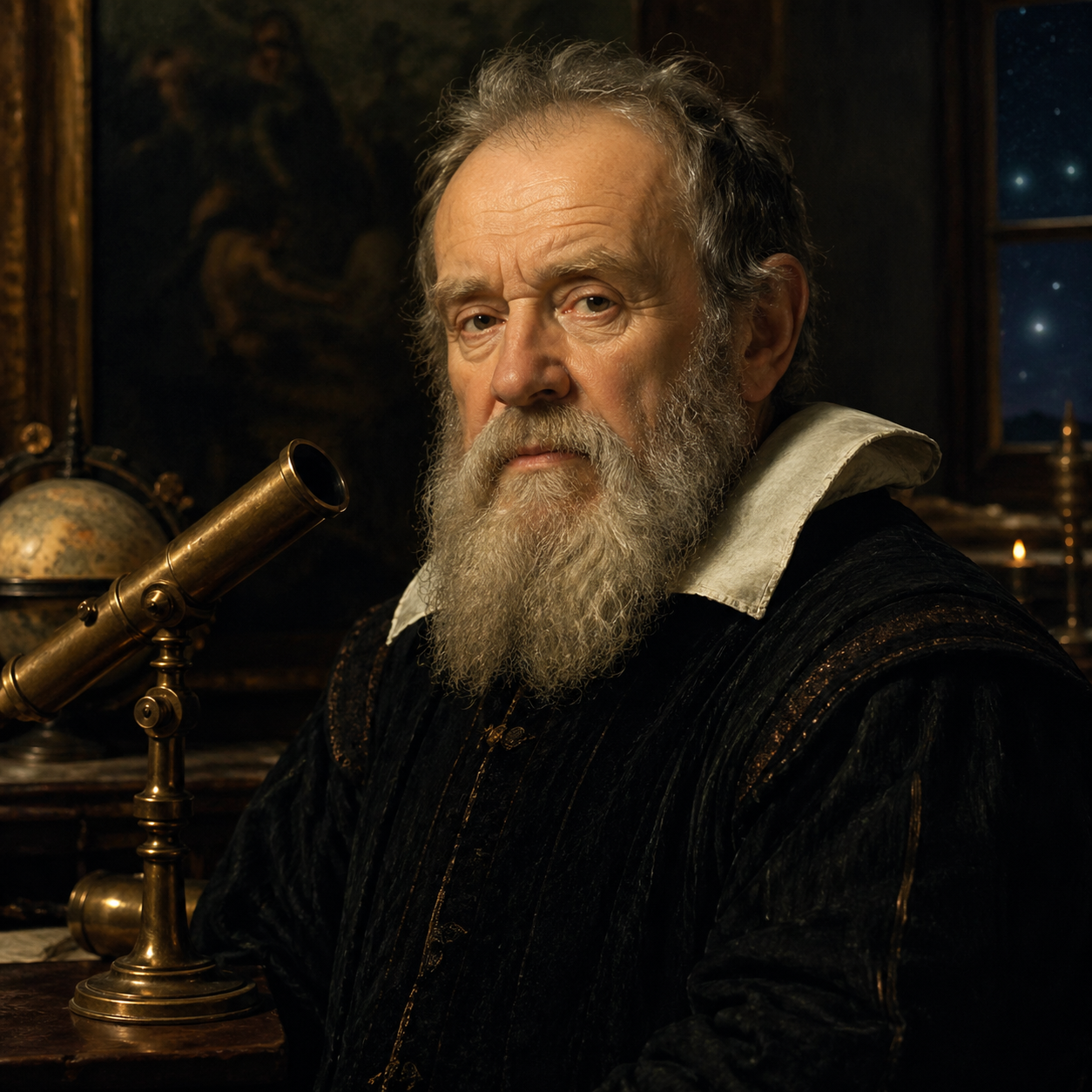
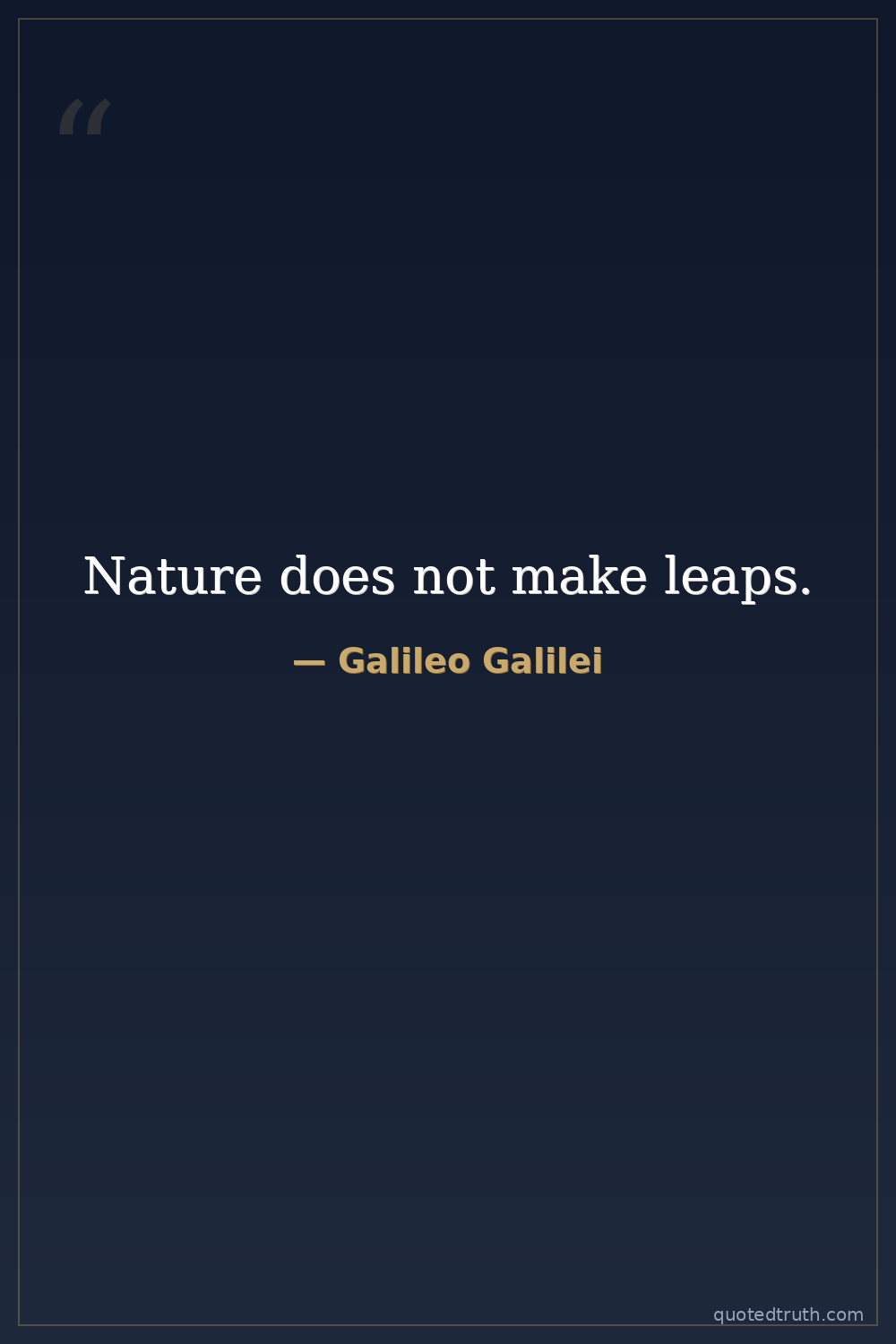
Galileo Galilei — "Nature does not make leaps."
Nature does not make leaps.
Nature does not make leaps.
Click any product to generate a realistic preview. Up to 3 at a time.
* Initial load can take up to 90 seconds — revising the preview in another color is nearly instant.
"It is not in the power of any created being to make things true or false, but only to discover what is true or false."
"The senses, though they are sometimes deceived, are not always so."
"I know that I am mortal, and that my life will pass away like a shadow; but I hope that my discoveries will live on."
"The universe is an immense, an incomparable, and an inexhaustible library."
"Mathematics is the language in which God has written the universe."
Attributed to various natural philosophers, including Aristotle and Leibniz. While consistent with Galileo's views on continuous motion, a direct quote from him is hard to pinpoint.
Date: Uncertain
Nature & WorldFound in 1 providers: grok
1 source checked
Change happens gradually, not in sudden jumps. The universe operates through continuous, incremental processes rather than abrupt shifts. Understanding any system requires tracing its step-by-step progression. There are no shortcuts in how reality unfolds — every transformation follows a chain of small, connected causes. This principle applies equally to physical motion, biological development, and the accumulation of scientific knowledge itself.
Galileo spent his career meticulously measuring incremental change — falling bodies, pendulum swings, planetary motion. His telescopic observations revealed gradual celestial mechanics, not divine caprice. As a mathematician turned astronomer, he believed nature obeyed continuous mathematical laws. This conviction drove his conflict with the Church, which favored miraculous discontinuity. His own scientific method embodied the principle: patient, step-by-step observation over sudden revelation.
In 17th-century Europe, natural philosophy was transitioning from Aristotelian doctrine and religious authority toward empirical science. The Scientific Revolution was itself a gradual process — Copernicus, Tycho Brahe, Kepler, then Galileo building incrementally. Meanwhile, the Church insisted on miraculous, discontinuous divine intervention in nature. Galileo's assertion that nature follows unbroken laws directly challenged theological frameworks and helped establish the foundation for Newtonian mechanics.
AI-generated insights based on extensive research and information for context. Factual errors? Email [email protected].
Your cart is empty