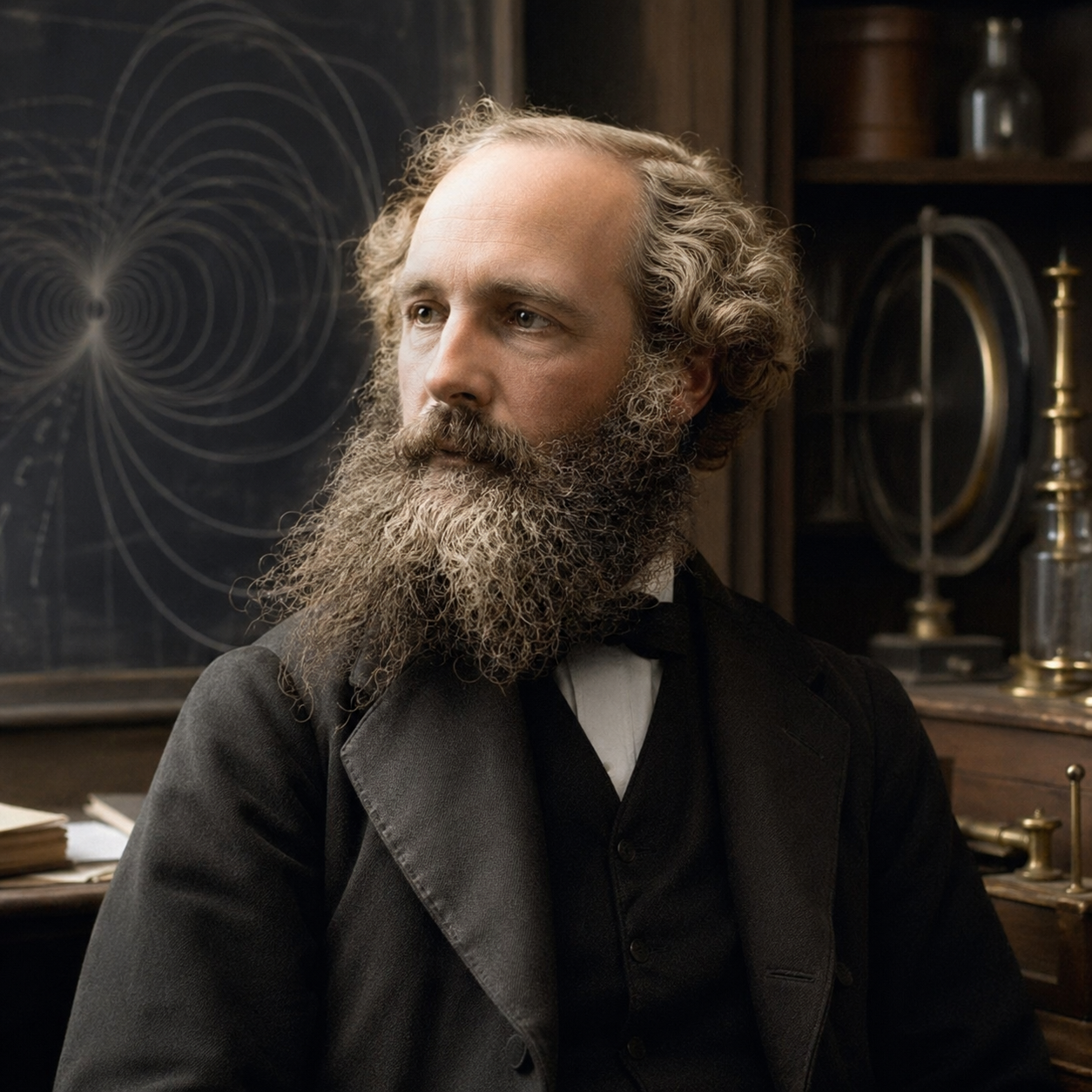
James Clerk Maxwell — "It is a good thing to have a great many ideas, and a great many of them bad."
It is a good thing to have a great many ideas, and a great many of them bad.
It is a good thing to have a great many ideas, and a great many of them bad.
Click any product to generate a realistic preview. Up to 3 at a time.
* Initial load can take up to 90 seconds — revising the preview in another color is nearly instant.
"Science is incompetent to reason upon the creation of matter itself out of nothing. We have reached the utmost limit of our thinking faculties when we have admitted that because matter cannot be etern…"
"I saw a rat today in the college garden, and I thought how much more pleasant it would be to be a rat than a professor."
"The only difference between a madman and me is that I am not mad."
"The only way of discovering the extent of the laws of nature is to try to transcend them."
"I have been battering away at Saturn, returning to the charge every now and then. I have effected several breaches in the solid ring, and now I am splash into the fluid one, amid a clash of symbols tr…"
Found in 1 providers: grok
1 source checked
Creativity works by volume, not by precision. You cannot generate only good ideas on demand, so the practical path is to produce many ideas knowing most will be wrong, weak, or unworkable. The bad ones are not waste; they are the raw material you sort through to find the rare good one. Judgment comes after generation, not before.
Maxwell built his breakthroughs, including unifying electricity, magnetism, and light into electromagnetic theory, by iterating through mechanical analogies, spinning-vortex models, and statistical arguments he later discarded. He treated Faraday's unconventional field pictures seriously when others dismissed them, and published Saturn's rings work and kinetic gas theory by testing many imperfect models. His willingness to entertain flawed ideas fueled his output.
Maxwell worked during the Victorian scientific revolution, when natural philosophy was splintering into specialized physics. Cambridge's Mathematical Tripos rewarded rigor, but the era's live problems, ether, thermodynamics, molecular motion, demanded speculative model-building. Darwin had just published, Kelvin and Helmholtz were debating energy, and experimental results arrived faster than theories could absorb them. Guessing productively, then pruning, was how nineteenth-century science actually advanced.
AI-generated insights based on extensive research and information for context. Factual errors? Email [email protected].
Your cart is empty