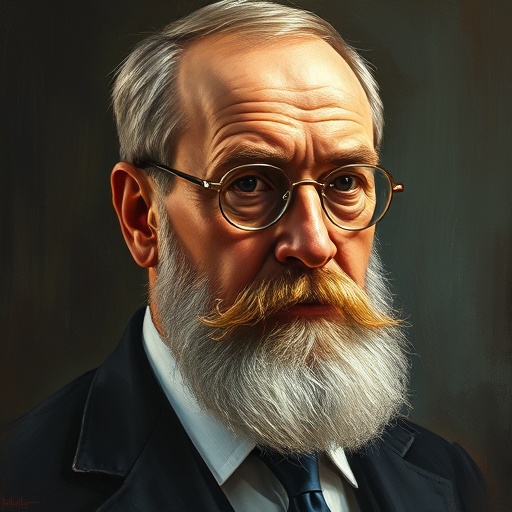
Robert Koch — "It is a great responsibility to be a physician, for upon us depends the health o…"
It is a great responsibility to be a physician, for upon us depends the health of the community.
It is a great responsibility to be a physician, for upon us depends the health of the community.
Click any product to generate a realistic preview. Up to 3 at a time.
* Initial load can take up to 90 seconds — revising the preview in another color is nearly instant.
"The fight against disease requires international cooperation."
"The ultimate goal of all research must be the prevention of disease."
"I have devoted my life to the study of bacteria, and I have found it to be a most rewarding pursuit."
"My work has shown that specific microorganisms cause specific diseases."
"I consider it probable that the tubercle bacillus is the actual cause of tuberculosis."
Found in 1 providers: grok
1 source checked
Being a doctor carries serious moral weight beyond treating individuals — your knowledge and decisions ripple outward to affect entire populations. Health is not purely personal; it is communal. Physicians hold power to contain disease, prevent outbreaks, and shape society's wellbeing. Medicine demands more than technical skill: it requires a sense of duty to the public good, because what a doctor does or fails to do reverberates far beyond the patient in front of them.
Koch lived this belief directly. He identified the bacteria causing tuberculosis, cholera, and anthrax — diseases killing millions across Europe — transforming medicine from guesswork into targeted science. He traveled to Egypt and India during active cholera outbreaks, placing himself at personal risk. Koch never framed his work as academic achievement; he consistently oriented it toward stopping mass death. His entire career embodied the conviction that a physician's obligation extends to protecting whole communities, not just individual patients.
Koch worked in the late 19th century when infectious disease was the leading cause of death globally. Tuberculosis killed roughly one in seven Europeans. Cholera swept repeatedly through industrializing cities lacking clean water infrastructure. Germ theory itself was still contested — many physicians dismissed bacterial causation. Rapid urbanization concentrated populations, amplifying epidemic risk dramatically. Public health as a formal discipline barely existed, leaving physicians as the de facto front line against societal-scale catastrophe, making communal responsibility newly urgent and consequential.
AI-generated insights based on extensive research and information for context. Factual errors? Email [email protected].
Your cart is empty