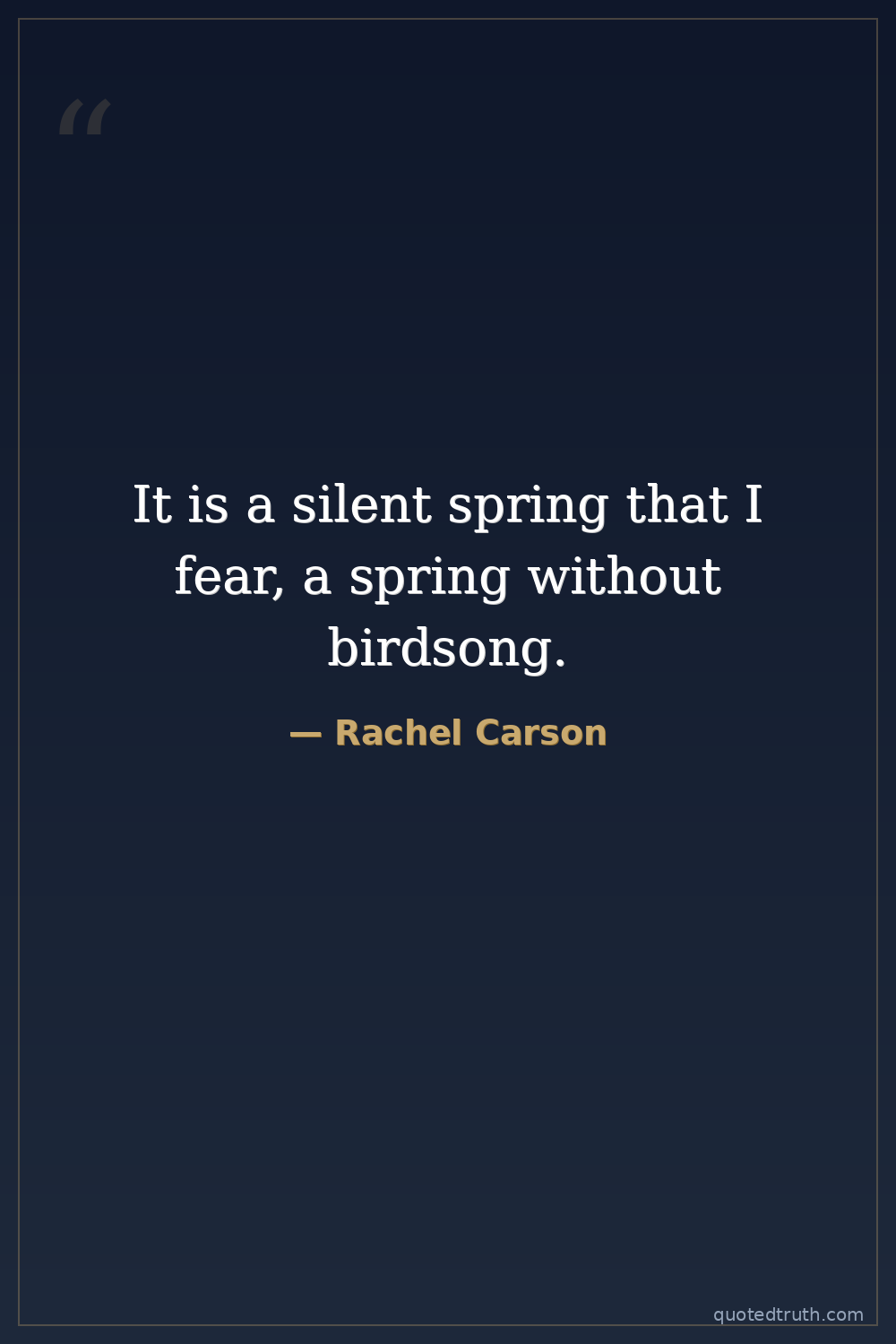
Rachel Carson — "It is a silent spring that I fear, a spring without birdsong."
It is a silent spring that I fear, a spring without birdsong.
It is a silent spring that I fear, a spring without birdsong.
Click any product to generate a realistic preview. Up to 3 at a time.
* Initial load can take up to 90 seconds — revising the preview in another color is nearly instant.
"We are surrounded by an infinite number of wonders, and yet we see so few of them."
"The sea, once it casts its spell, holds one in its net of wonder forever."
"The time has come for us to make peace with the earth."
"The most alarming of all man's assaults upon the environment is the contamination of air, earth, rivers, and sea with dangerous and even lethal materials."
"The public must decide whether it wishes to continue on the present road, and it can do so only when in full possession of the facts."
Found in 1 providers: grok
1 source checked
The quote warns that human activity — particularly reckless pesticide use — could strip the natural world of the wildlife that signals life itself. A spring without birdsong is not merely sad; it represents ecosystem collapse made visceral. Carson transforms an abstract environmental threat into something immediately sensed: the eerie absence of sound where abundance once existed. The fear is not hypothetical — it was already unfolding across American farmlands and suburbs.
Carson was a marine biologist and science writer who spent her career making ecology emotionally legible to ordinary people. Silent Spring (1962) documented how DDT bioaccumulated through food chains, killing robins that ate pesticide-laden earthworms. She wrote the book while battling breast cancer, knowing she might not survive to see its impact. Her dread of silence was not metaphor — it was grounded in years of field correspondence with ornithologists tracking real population crashes.
The 1950s and early 1960s were the peak of synthetic pesticide adoption in America. DDT, developed during World War II, was being aerially sprayed on crops, suburbs, and schoolyards with almost no regulatory oversight. The chemical industry was powerful and well-funded, and scientists who raised alarms were publicly dismissed as alarmists. Meanwhile, ornithologists were already documenting steep songbird declines. Carson's warning landed precisely as a generation began questioning whether postwar industrial progress carried hidden ecological costs.
AI-generated insights based on extensive research and information for context. Factual errors? Email [email protected].
Your cart is empty