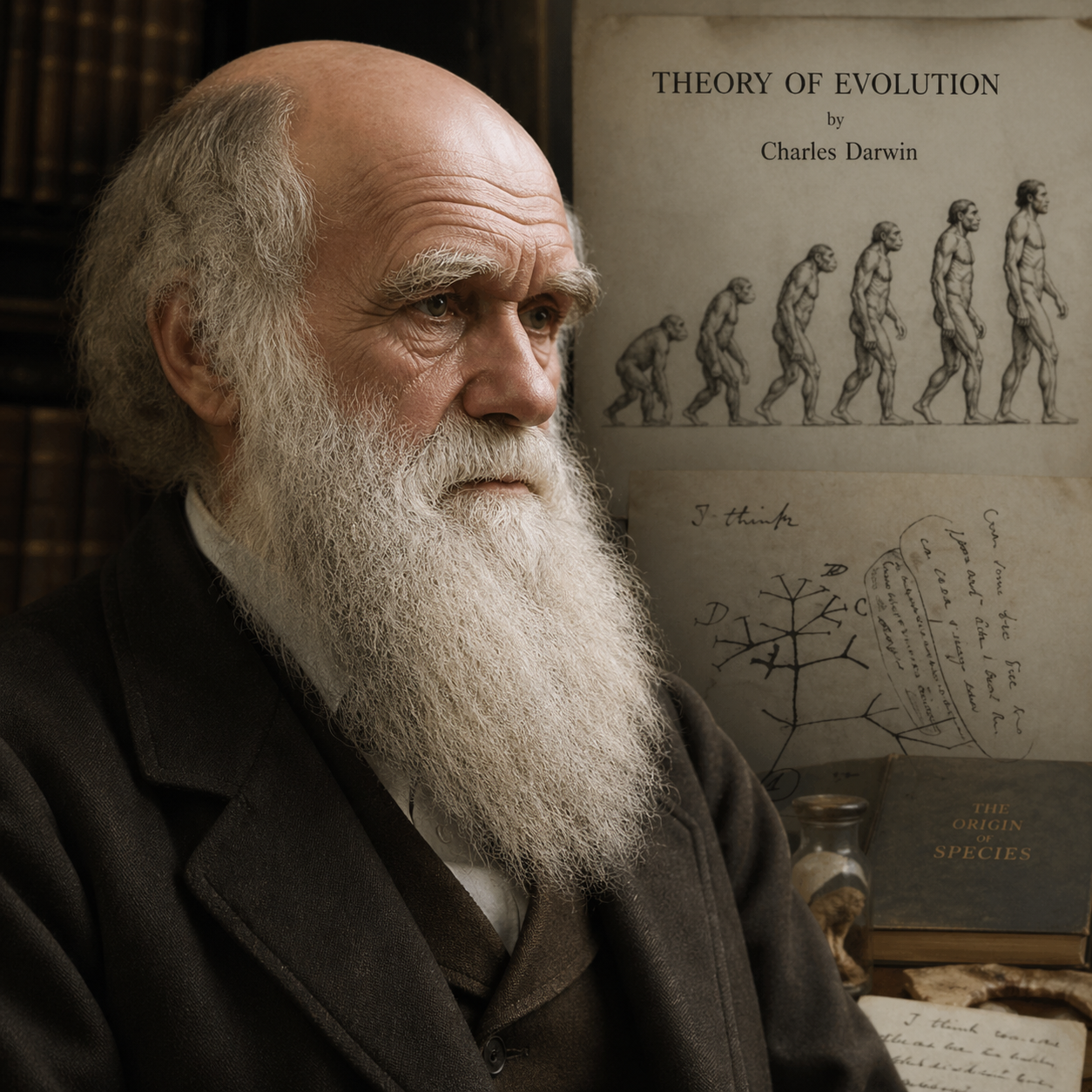
Charles Darwin — "It is a wonderful fact that we can understand so much."
It is a wonderful fact that we can understand so much.
It is a wonderful fact that we can understand so much.
Click any product to generate a realistic preview. Up to 3 at a time.
* Initial load can take up to 90 seconds — revising the preview in another color is nearly instant.
"A dog might as well speculate on the mind of Newton."
"I feel most deeply that the whole subject is too profound for the human intellect. A dog might as well speculate on the mind of Newton."
"The greatest discovery of all time is that a person can change his future by merely changing his attitude."
"Man is descended from a hairy, tailed quadruped, probably arboreal in its habits, and an inhabitant of the Old World."
"I own that I cannot see as plainly as others do, and as I should wish to do, evidence of design and beneficence on all sides of us. There seems to me too much misery in the world. I cannot persuade my…"
British naturalist whose On the Origin of Species (1859) established evolution by natural selection — the unifying theory of modern biology. Closely associated with Thomas Henry Huxley (his 'bulldog' public defender) and Alfred Russel Wallace (independent co-discoverer of natural selection). For an intellectual contrast, see William Paley, Anglican theologian and Natural Theology author (1743-1805) — Origin of Species is structurally a 400-page reply to Paley — Darwin admired Paley's watchmaker-argument as an undergraduate at Cambridge and then spent 20 years building the empirical machinery to displace him. The cleanest 'design argument vs natural selection' founding rebuttal in science.
The standard scholarly entry points to Charles Darwin's work: Janet Browne (Harvard, history of science) — Charles Darwin: Voyaging (1995) and The Power of Place (2002); Adrian Desmond (UCL, biographer) — Darwin: The Life of a Tormented Evolutionist (1991, with James Moore). These are the works graduate seminars cite when teaching Charles Darwin.
Found in 1 providers: grok
1 source checked
Human cognition is remarkable — finite minds, shaped by the same natural forces as every other organism, can nonetheless grasp deep truths about the cosmos. Darwin marvels not at specific facts we've learned, but at the sheer possibility of understanding itself. It fuses intellectual humility with genuine wonder: that we can observe, reason, and discover order in a universe we did not design and never expected to be legible.
Darwin spent decades observing barnacles, finches, earthworms, and fossils — building a unified theory from painstaking evidence. He knew firsthand how slow and counterintuitive genuine understanding is. His theory of natural selection revealed that life's staggering diversity emerges from simple, blind processes — a fact he found both humbling and astonishing. The wonder here echoes his lifelong posture: reverence for nature's complexity and gratitude that disciplined science could penetrate it at all.
Darwin published On the Origin of Species in 1859, igniting fierce conflict between scientific reasoning and religious doctrine. Victorian England was grappling with whether human reason — not scripture — could explain existence. Geology, physics, and biology were overturning centuries of received knowledge at breathtaking speed. Against that backdrop, marveling that we can understand so much carried both triumph and humility: science had cracked something vast, yet the universe remained far larger than any one theory.
AI-generated insights based on extensive research and information for context. Factual errors? Email [email protected].
Your cart is empty