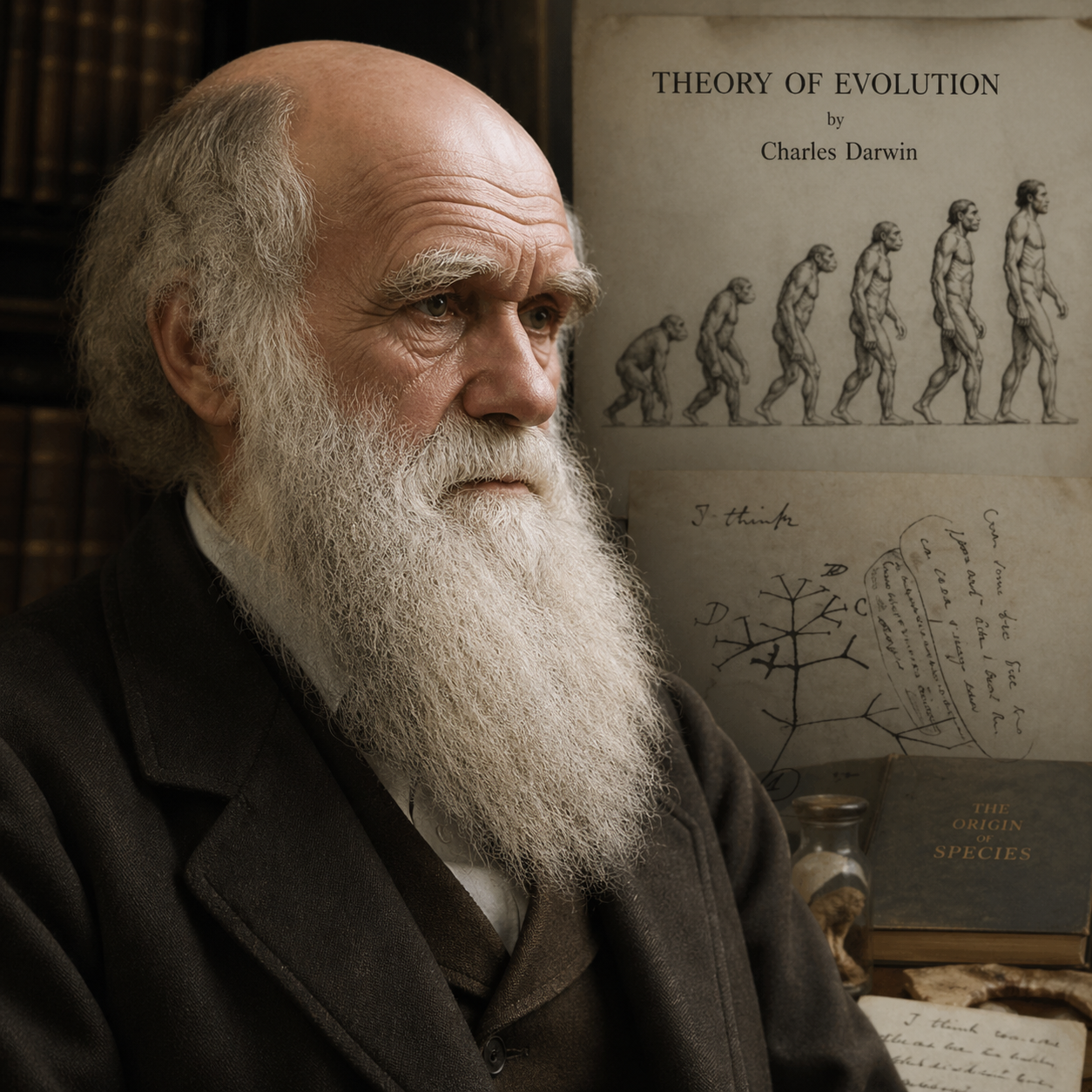
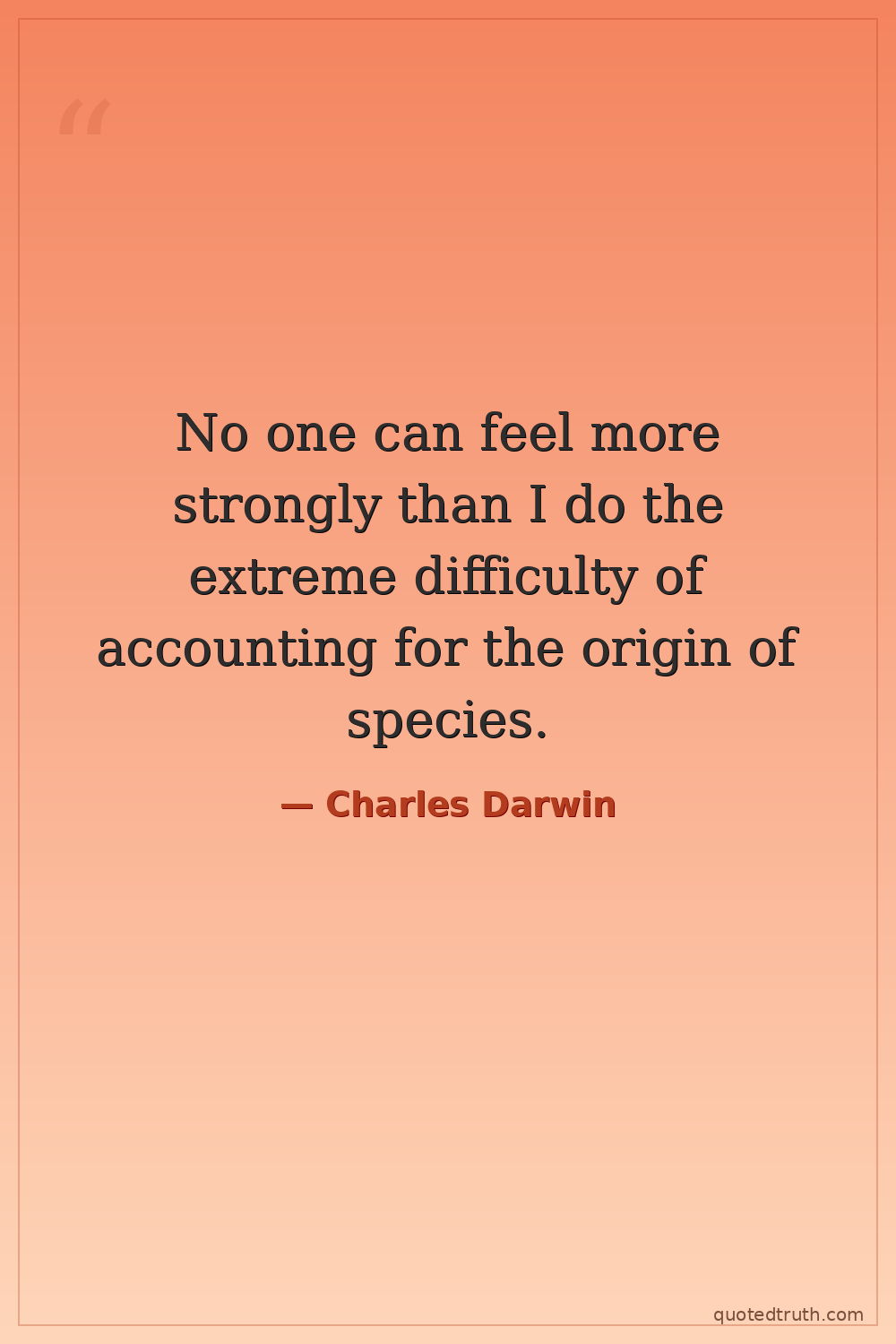
Charles Darwin — "No one can feel more strongly than I do the extreme difficulty of accounting for…"
No one can feel more strongly than I do the extreme difficulty of accounting for the origin of species.
No one can feel more strongly than I do the extreme difficulty of accounting for the origin of species.
Click any product to generate a realistic preview. Up to 3 at a time.
* Initial load can take up to 90 seconds — revising the preview in another color is nearly instant.
"I am almost convinced (quite contrary to opinion I started with) that species are not (it is like confessing a murder) immutable."
"But I am very poorly today & very stupid & I hate everybody & everything. One lives only to make blunders."
"A man who dares to waste one hour of time has not discovered the value of life."
"To kill an error is as good a service as to establish a new truth."
"False facts are highly injurious to the progress of science, for they often endure long; but false views, if supported by some evidence, do little harm, for every one takes a salutary pleasure in prov…"
British naturalist whose On the Origin of Species (1859) established evolution by natural selection — the unifying theory of modern biology. Closely associated with Thomas Henry Huxley (his 'bulldog' public defender) and Alfred Russel Wallace (independent co-discoverer of natural selection). For an intellectual contrast, see William Paley, Anglican theologian and Natural Theology author (1743-1805) — Origin of Species is structurally a 400-page reply to Paley — Darwin admired Paley's watchmaker-argument as an undergraduate at Cambridge and then spent 20 years building the empirical machinery to displace him. The cleanest 'design argument vs natural selection' founding rebuttal in science.
The standard scholarly entry points to Charles Darwin's work: Janet Browne (Harvard, history of science) — Charles Darwin: Voyaging (1995) and The Power of Place (2002); Adrian Desmond (UCL, biographer) — Darwin: The Life of a Tormented Evolutionist (1991, with James Moore). These are the works graduate seminars cite when teaching Charles Darwin.
From 'On the Origin of Species', acknowledging the immense challenge of his theory.
Date: 1859
GeneralFound in 1 providers: grok
1 source checked
Darwin openly admits that explaining how new species arise is extraordinarily difficult — and nobody feels that difficulty more acutely than he does. Rather than claiming triumph, he acknowledges the immense complexity of the problem he devoted his life to investigating. It is a declaration of intellectual honesty: genuine scientific understanding requires confronting hard truths rather than papering over gaps with convenient certainty.
Darwin spent over 20 years refining his theory before publishing On the Origin of Species in 1859, deliberately delaying because he feared gaps in his evidence. The Beagle voyage, eight years cataloguing barnacles, and thousands of letters to fellow naturalists fed his obsession with rigor. His private notebooks reveal constant self-doubt and revision. This quote captures the central tension of his life: he held the most consequential answer in biology yet never stopped feeling the full weight of the question.
Darwin published in 1859 when natural theology dominated Western thought and most scientists believed species were fixed, divinely created entities. Geology had only recently revealed Earth's vast age, the fossil record held enormous gaps, and genetics was unknown — Mendel's work would go unrecognized for decades. The idea that species transform through natural selection challenged both church doctrine and scientific orthodoxy, making Darwin's admission of difficulty a politically and intellectually charged confession, not mere modesty.
AI-generated insights based on extensive research and information for context. Factual errors? Email [email protected].
Your cart is empty