Martin Luther — "It is not a matter of choice for a woman to be a virgin or not; it is a matter o…"
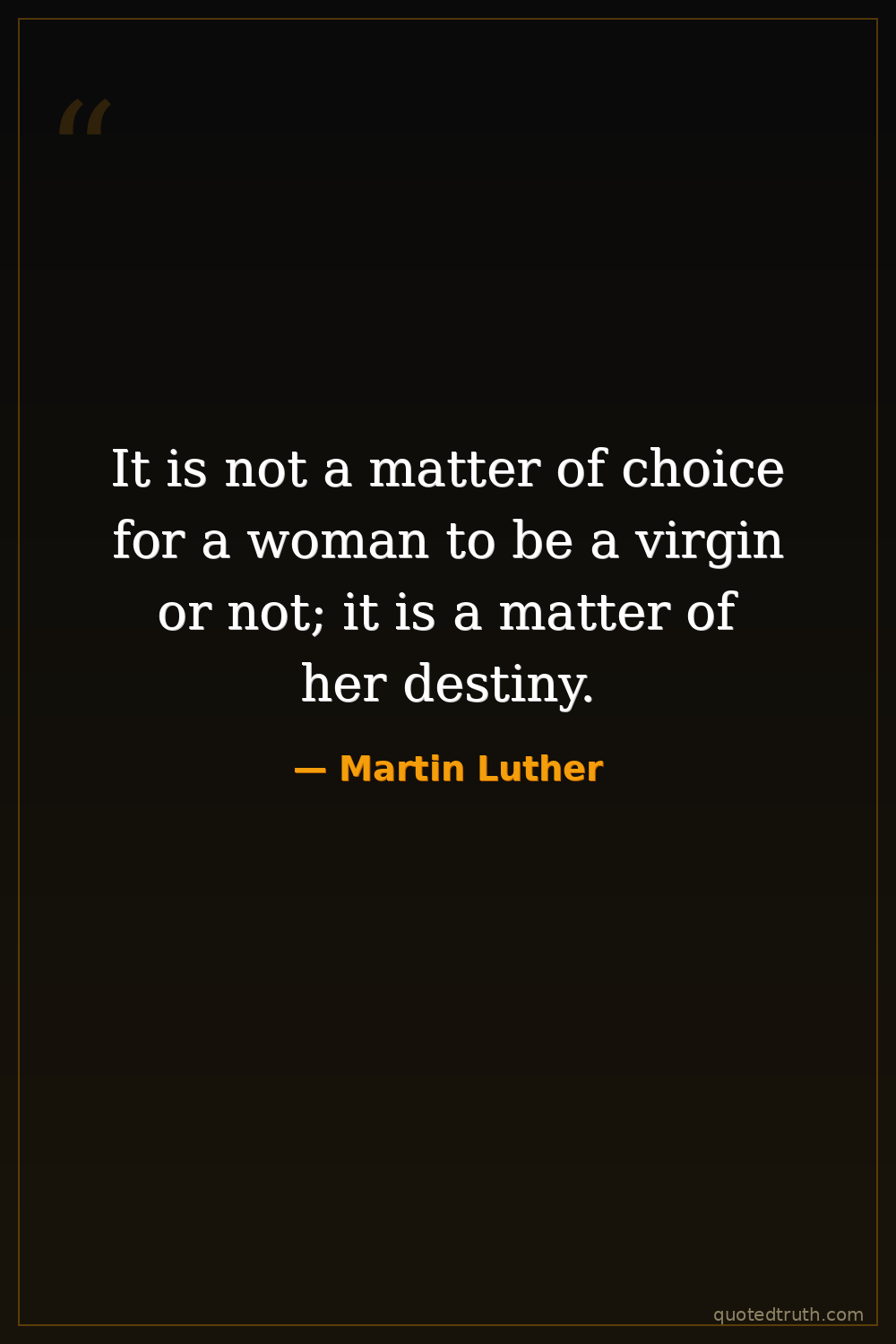
It is not a matter of choice for a woman to be a virgin or not; it is a matter of her destiny.
It is not a matter of choice for a woman to be a virgin or not; it is a matter of her destiny.
Click any product to generate a realistic preview. Up to 3 at a time.
* Initial load can take up to 90 seconds — revising the preview in another color is nearly instant.
"The hair is the finest ornament a woman has. If she be a virgin, let her wear it loose; if married, let her wear it up."
"The whole being of any Christian is faith and love."
"I would have been a saint if I had remained in the monastery, but I was forced to become a devil."
"I frankly confess that even if it were possible I should not wish to have free choice given to me, or to have anything left in my own hands by which I might strive for salvation."
"Let us therefore beware of the Jews, and their synagogues, and let us burn their synagogues, and let us destroy their houses, and let us take away their prayer-books and Talmuds, and let us forbid the…"
German theologian whose 95 Theses (1517) launched the Protestant Reformation and broke the Catholic Church's monopoly on Western Christianity. Closely associated with Philipp Melanchthon (Lutheran systematizer) and John Calvin (later Reformer who built on Luther's break). For an intellectual contrast, see Pope Leo X, Renaissance pope (1513-1521) — Leo X's indulgence sales triggered Luther's break and Leo excommunicated him in 1521 — Luther's entire Reformation is structured as a direct answer to the indulgence-funded Vatican Leo represented.
Found in 1 providers: grok
1 source checked
Luther argues that whether a woman remains a virgin or becomes a wife and mother is not something she freely picks like a hobby. It is shaped by her circumstances, her body, and what life hands her. In modern terms, he is saying that sexuality and family roles are determined more by fate and biology than by personal preference, so pretending it is a clean individual choice misses the reality.
Luther built his reformation partly by attacking mandatory clerical celibacy and monastic vows. He married former nun Katharina von Bora in 1525, fathered six children, and preached that marriage and childbearing were the God-ordained path for most women. This quote fits his view that nuns in convents were fighting nature, and that God had designed women primarily for wifehood and motherhood rather than vowed virginity.
In early modern Europe, the Catholic Church prized lifelong virginity and staffed convents with thousands of women, many placed there by families rather than by calling. Luther's Reformation in the 1520s shut monasteries across German lands and released nuns into marriage. Debate over whether virginity was a higher spiritual state or an unnatural denial of God's design for procreation was central, with Protestants pushing marriage as the normal Christian vocation.
AI-generated insights based on extensive research and information for context. Factual errors? Email [email protected].
Your cart is empty