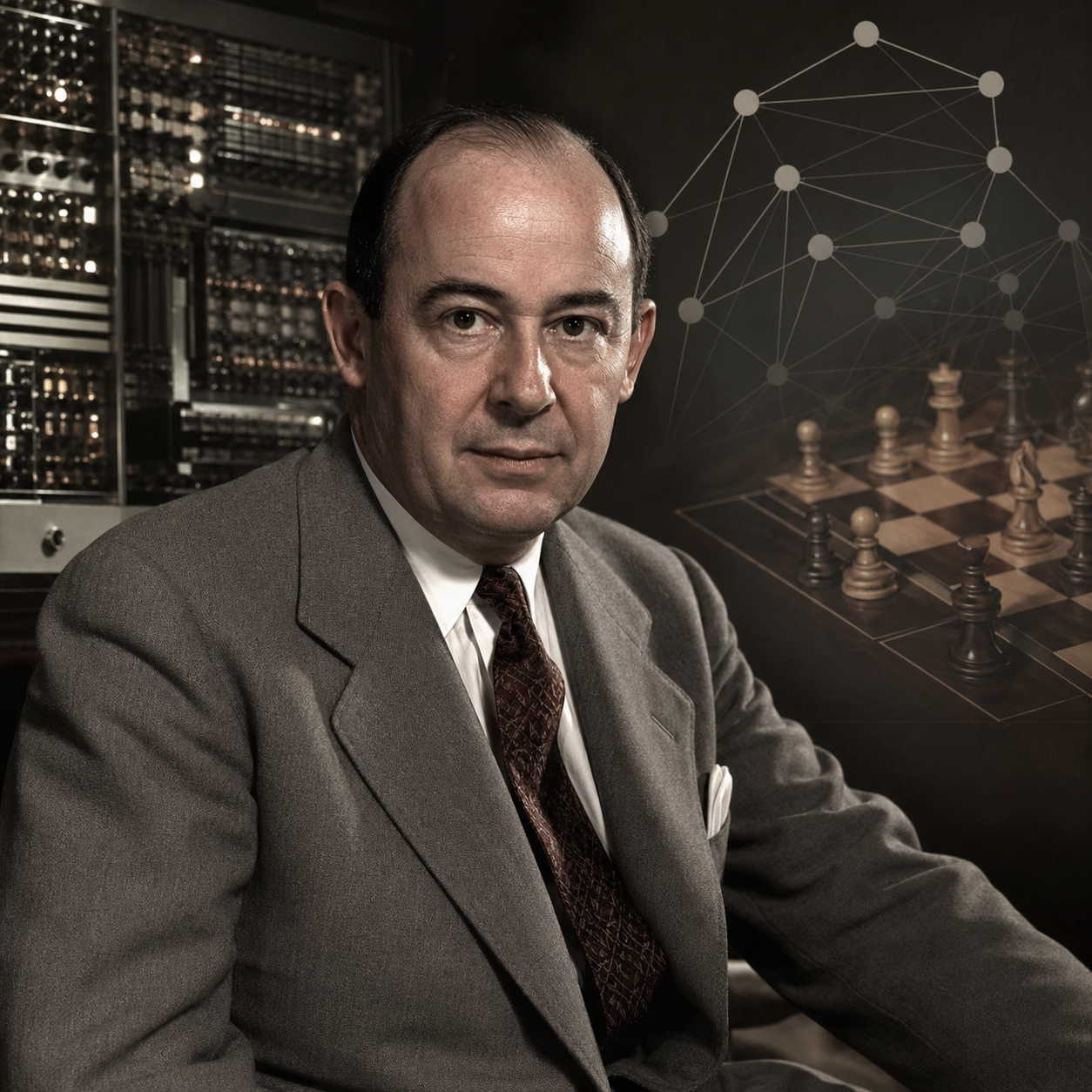
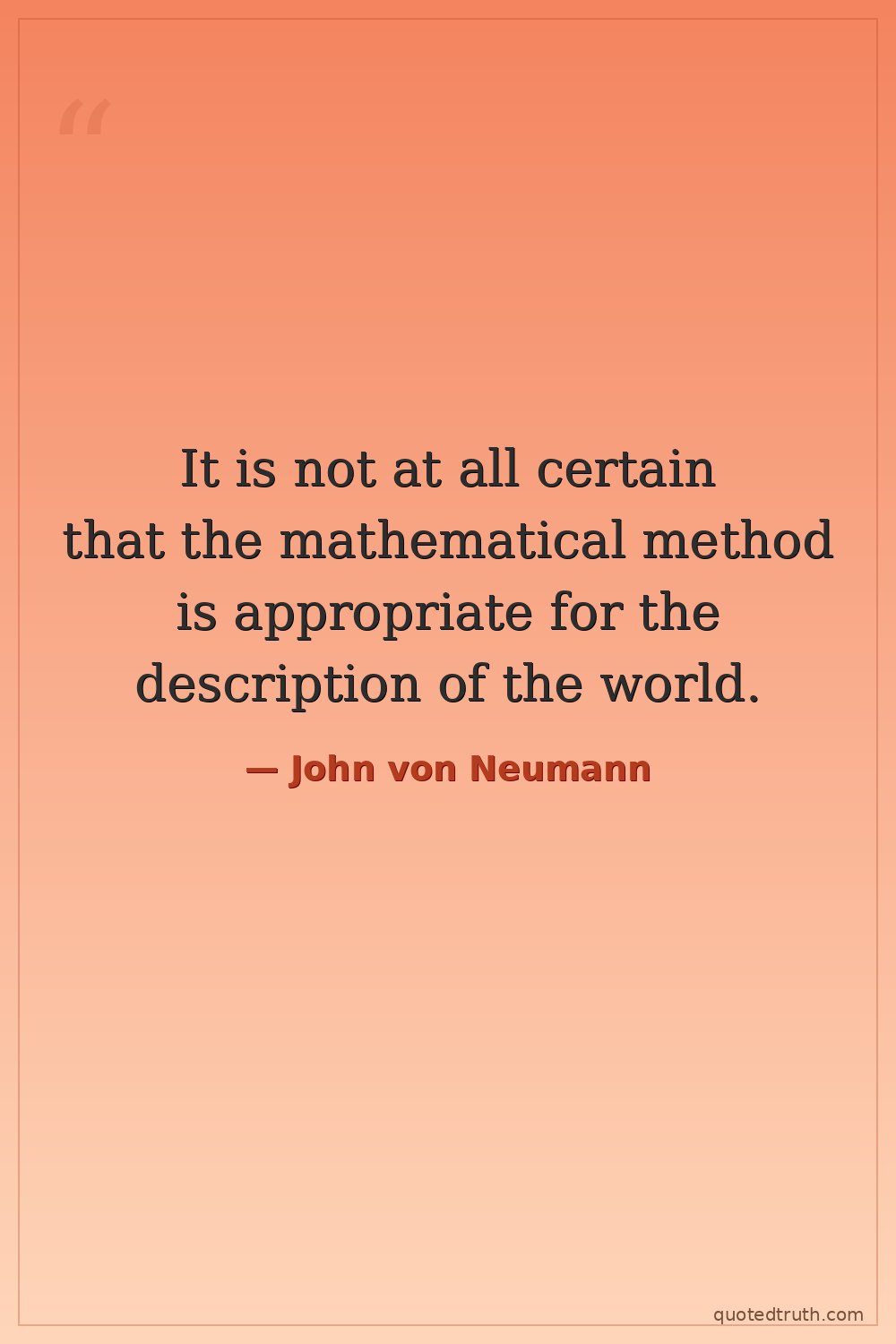
John von Neumann — "It is not at all certain that the mathematical method is appropriate for the des…"
It is not at all certain that the mathematical method is appropriate for the description of the world.
It is not at all certain that the mathematical method is appropriate for the description of the world.
Click any product to generate a realistic preview. Up to 3 at a time.
* Initial load can take up to 90 seconds — revising the preview in another color is nearly instant.
"Truth is much too complicated to allow anything but approximations."
"The more precisely the position is determined, the less precisely the momentum is known in this instant, and vice versa."
"Computers are like humans - they do everything except think."
"The atomic bomb is a great invention. It is also a great danger."
"The world is so complicated that it cannot be described in any other way than by itself."
A surprising statement from a mathematician, expressing a degree of humility.
Date: 1950s
GeneralFound in 1 providers: grok
1 source checked
Despite mathematics' extraordinary success at modeling physics, economics, and computation, it may not be the actual language of reality. Mathematics could be a powerful approximation tool rather than a true mirror of the world's structure. The statement challenges a common assumption among scientists — that because math works so well, it must fundamentally and correctly describe nature rather than merely predicting measurable outcomes within useful limits.
Von Neumann built the mathematical foundations of quantum mechanics and axiomatized game theory, yet witnessed firsthand how quantum reality defied classical mathematical intuition. His formalization of quantum mechanics exposed him to the measurement problem — where the formalism predicts correctly but what it actually describes remains philosophically unresolved. A man who lived deeper inside mathematics than nearly anyone could see its limits with rare clarity.
Von Neumann worked during profound scientific upheaval. Quantum mechanics (1920s–1930s) showed classical mathematical determinism failed at the subatomic scale. Gödel's incompleteness theorems (1931) proved mathematics contains truths it cannot prove, shaking foundationalist confidence. The Manhattan Project showed equations could describe atomic destruction while leaving the full nature of that reality philosophically opaque. These disruptions made questioning mathematics' descriptive completeness scientifically urgent, not merely philosophical.
AI-generated insights based on extensive research and information for context. Factual errors? Email [email protected].
Your cart is empty