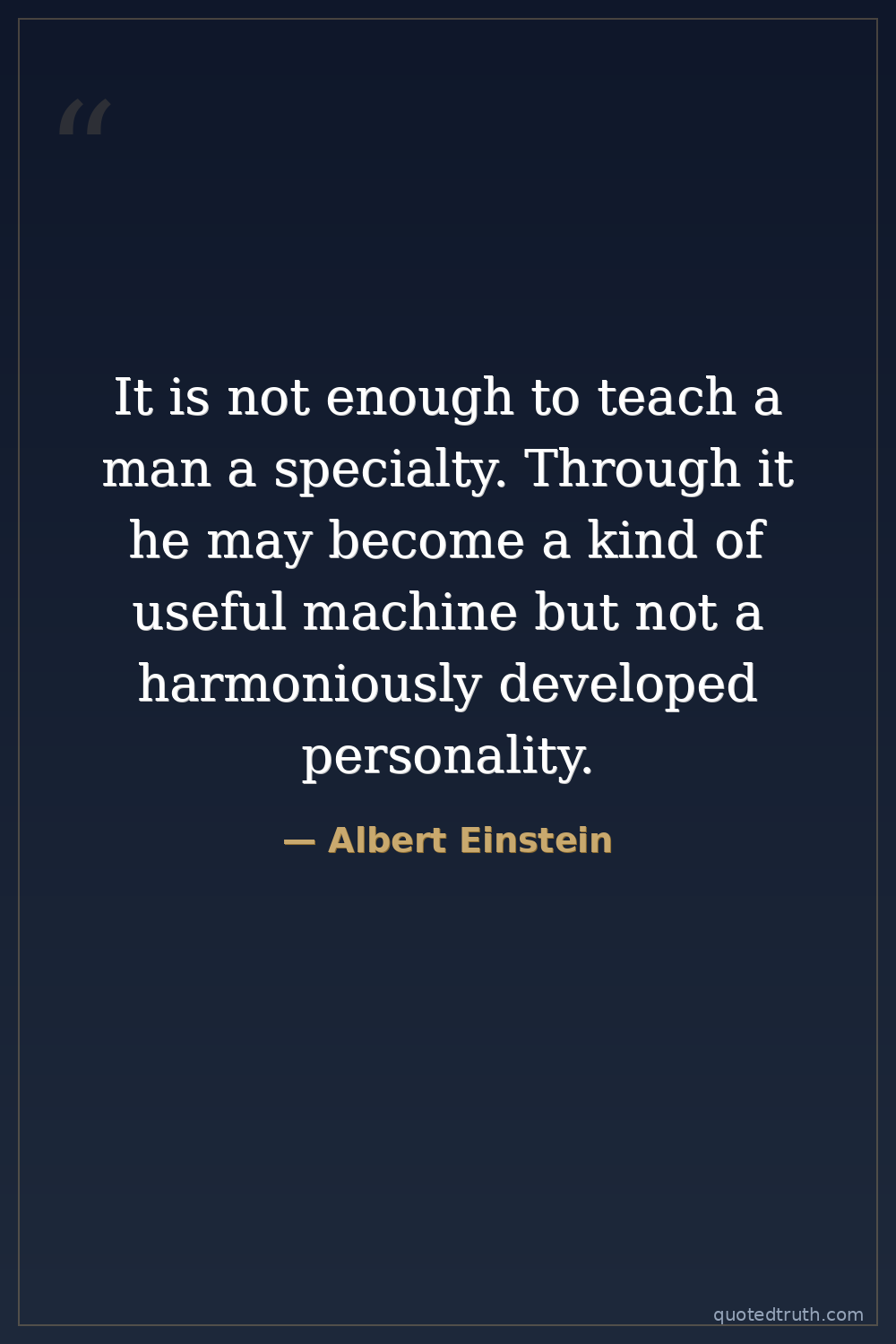
Albert Einstein — "It is not enough to teach a man a specialty. Through it he may become a kind of …"
It is not enough to teach a man a specialty. Through it he may become a kind of useful machine but not a harmoniously developed personality.
It is not enough to teach a man a specialty. Through it he may become a kind of useful machine but not a harmoniously developed personality.
Click any product to generate a realistic preview. Up to 3 at a time.
* Initial load can take up to 90 seconds — revising the preview in another color is nearly instant.
"I am against any form of violence, for I know that violence only leads to more violence."
"The problems that exist in the world today cannot be solved by the level of thinking that created them."
"I do not believe in the God of theology who rewards good and punishes evil."
"The Jews are a community bound together by ties of blood and tradition, not of religion only."
"The Chinese don't sit on benches while eating but squat like Europeans do when they relieve themselves out in the leafy woods."
Found in 1 providers: grok
1 source checked
Specialized training alone produces a functional worker, not a complete human being. True education must develop the whole person — moral reasoning, aesthetic sensibility, social awareness — not just technical competence. A person reduced to their professional function becomes merely a tool; genuine human flourishing requires breadth of understanding, the capacity for empathy, and the ability to engage thoughtfully with the full complexity of life.
Einstein, though himself a specialist in theoretical physics, was deeply committed to philosophy, violin, and humanist causes. He openly credited his musical sensibility and philosophical reading for shaping his scientific imagination. He repeatedly warned against narrow technical education, believing scientists who lacked ethical grounding were dangerous — a fear he lived after the atomic bomb, which his equations helped enable, underscored tragically.
Einstein wrote during rapid industrialization and the rise of mass technical education, when universities increasingly churned out engineers and specialists to feed growing industrial economies. The 20th century's two world wars demonstrated what technically brilliant but morally unformed specialists could do with their skills. His era saw the tension between Enlightenment humanism and utilitarian vocational training sharpen into a genuine civilizational question.
AI-generated insights based on extensive research and information for context. Factual errors? Email [email protected].
Your cart is empty