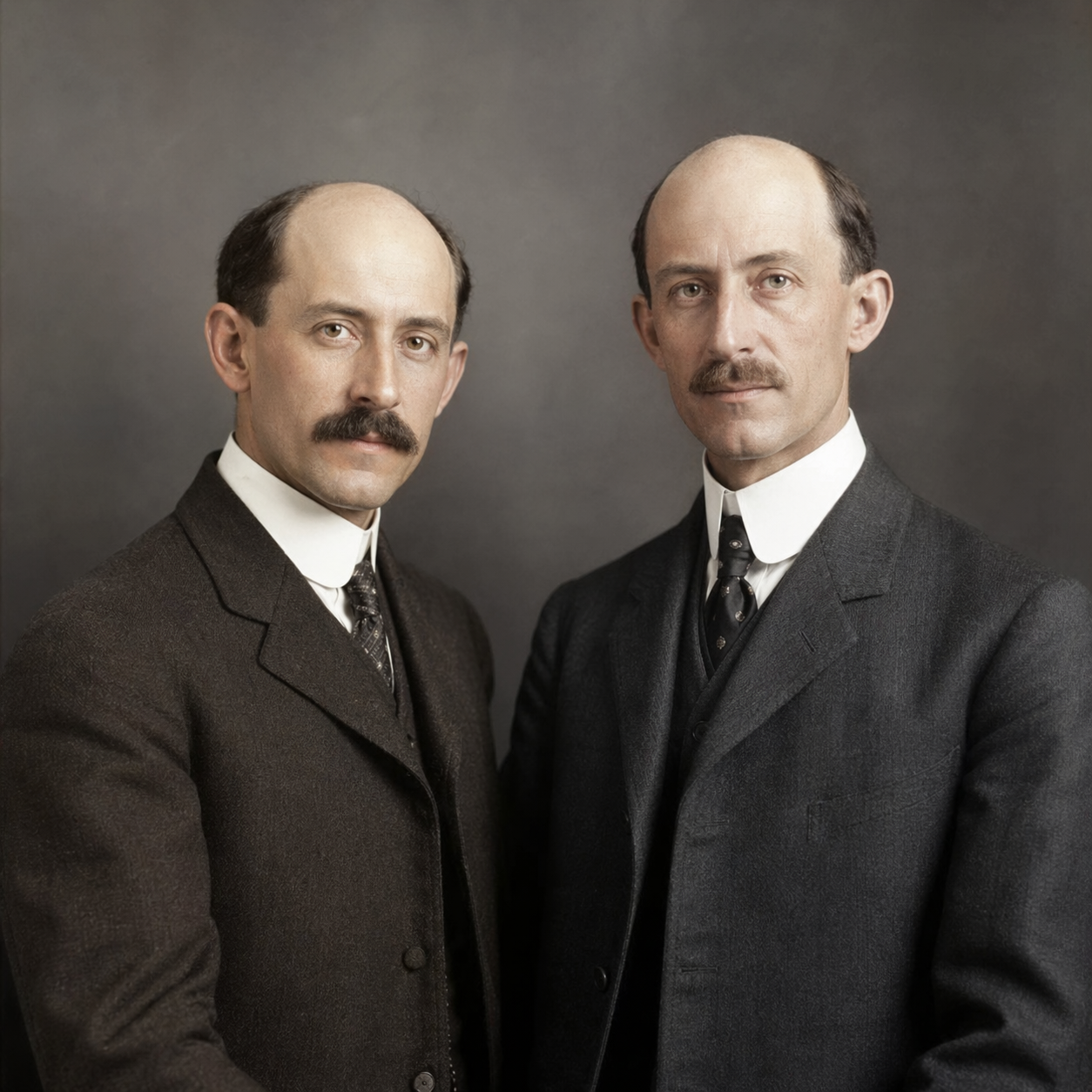
Wright Brothers (Orville & Wilbur) — "It is not necessary to be a genius to be an inventor."
It is not necessary to be a genius to be an inventor.
It is not necessary to be a genius to be an inventor.
Click any product to generate a realistic preview. Up to 3 at a time.
* Initial load can take up to 90 seconds — revising the preview in another color is nearly instant.
"The machine was not built for speed, but for stability."
"We had no idea of the amount of publicity that would follow our flights."
"The only difference between us and others is that we have made a more thorough study of the problem."
"We are trying to arrange a demonstration in Europe."
"The aeroplane is not an invention, but a discovery."
American aviation pioneers who achieved the first sustained powered controlled airplane flight at Kitty Hawk, NC, on December 17, 1903. Closely associated with Octave Chanute (their gliding mentor and aeronautical correspondent). For an intellectual contrast, see Samuel Pierpont Langley, Smithsonian Institution Secretary and government-funded aviation researcher — Langley's Aerodrome crashed twice into the Potomac in October-December 1903 with $50,000 of War Department funding; the Wright Brothers' bicycle-shop empiricism beat Langley's institutional Big Science by 9 days. The most-cited example in engineering history of empirical-tinkerer beating institution-funded credentialism.
Found in 1 providers: grok
1 source checked
Invention doesn't demand extraordinary intelligence — it demands willingness to observe, experiment, and persist. Anyone who approaches a problem with curiosity, systematic thinking, and enough stubbornness to keep trying after failure can create something new. Genius is rare; determination, patience, and careful observation are learnable. The quote strips away the mystique around innovation and suggests the capacity for it lives in ordinary, committed people.
Orville and Wilbur were bicycle mechanics from Dayton, Ohio — no engineering degrees, no university training, no government grants. Wilbur never graduated high school. They outcompeted Samuel Langley, who had $50,000 in government funding and a Smithsonian-backed team. Their breakthrough came from methodical wind tunnel experiments and obsessive iteration, not brilliance. Their own lives were the proof: two working-class tradesmen solved what credentialed experts couldn't through persistence and careful observation.
The Gilded Age and early Progressive Era elevated inventors like Edison and Tesla into near-mythic geniuses, creating a cult of intellectual exceptionalism. The 1903 race to powered flight pitted the Wright Brothers against Langley's Smithsonian-backed effort — establishment science versus working-class tinkerers. Rapid industrialization made invention seem like the province of extraordinary minds or elite institutions, making the Wrights' triumph a powerful counter-narrative to credentialism and inherited privilege.
AI-generated insights based on extensive research and information for context. Factual errors? Email [email protected].
Your cart is empty