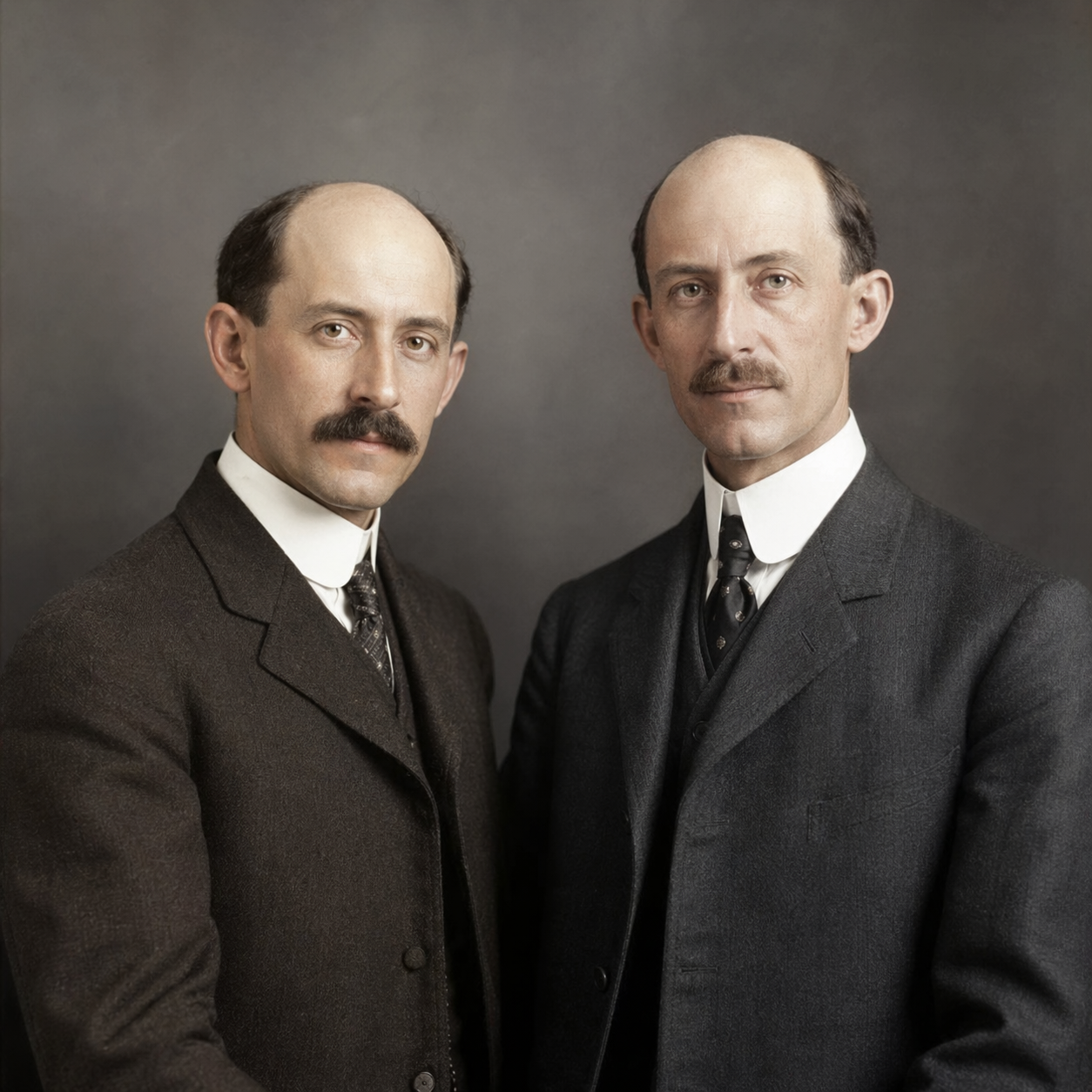
Wright Brothers (Orville & Wilbur) — "The machine is practically ready for its public demonstration."
The machine is practically ready for its public demonstration.
The machine is practically ready for its public demonstration.
Click any product to generate a realistic preview. Up to 3 at a time.
* Initial load can take up to 90 seconds — revising the preview in another color is nearly instant.
"The public is very enthusiastic about our machine."
"If its engine stops, it must fall with deathly violence, for it can neither glide like the aeroplane or float like the balloon. The helicopter is much easier to design than the aeroplane, but is worth…"
"The age of the flying machine is coming; it is not here yet, but it is coming."
"We have been making daily flights, and the machine is working perfectly."
"The machine was kept in the air for 59 seconds and traveled 852 feet."
American aviation pioneers who achieved the first sustained powered controlled airplane flight at Kitty Hawk, NC, on December 17, 1903. Closely associated with Octave Chanute (their gliding mentor and aeronautical correspondent). For an intellectual contrast, see Samuel Pierpont Langley, Smithsonian Institution Secretary and government-funded aviation researcher — Langley's Aerodrome crashed twice into the Potomac in October-December 1903 with $50,000 of War Department funding; the Wright Brothers' bicycle-shop empiricism beat Langley's institutional Big Science by 9 days. The most-cited example in engineering history of empirical-tinkerer beating institution-funded credentialism.
Found in 1 providers: grok
1 source checked
Confidence that years of private testing and refinement have finally brought the invention to a state worthy of showing the world. It marks the shift from secretive workshop development to public proof — the moment private achievement becomes public fact, inviting scrutiny, validation, and recognition from skeptics who doubted it was real.
After their 1903 Kitty Hawk success, Orville and Wilbur deliberately avoided public flights for years, protecting their design while seeking patents. Their 1908 demonstrations — Orville at Fort Myer, Wilbur at Le Mans — were the culmination of that restraint. Their engineering obsession meant 'practically ready' carried real weight; they did not rush or exaggerate milestones.
By 1908, European aviators were catching up fast and openly disputing American claims to powered flight. Military interest was growing, and the U.S. Army had issued contracts contingent on demonstration. Public skepticism was rampant — newspapers had largely ignored Kitty Hawk. A successful public flight would settle the argument, establish patent priority, and unlock government and commercial contracts simultaneously.
AI-generated insights based on extensive research and information for context. Factual errors? Email [email protected].
Your cart is empty