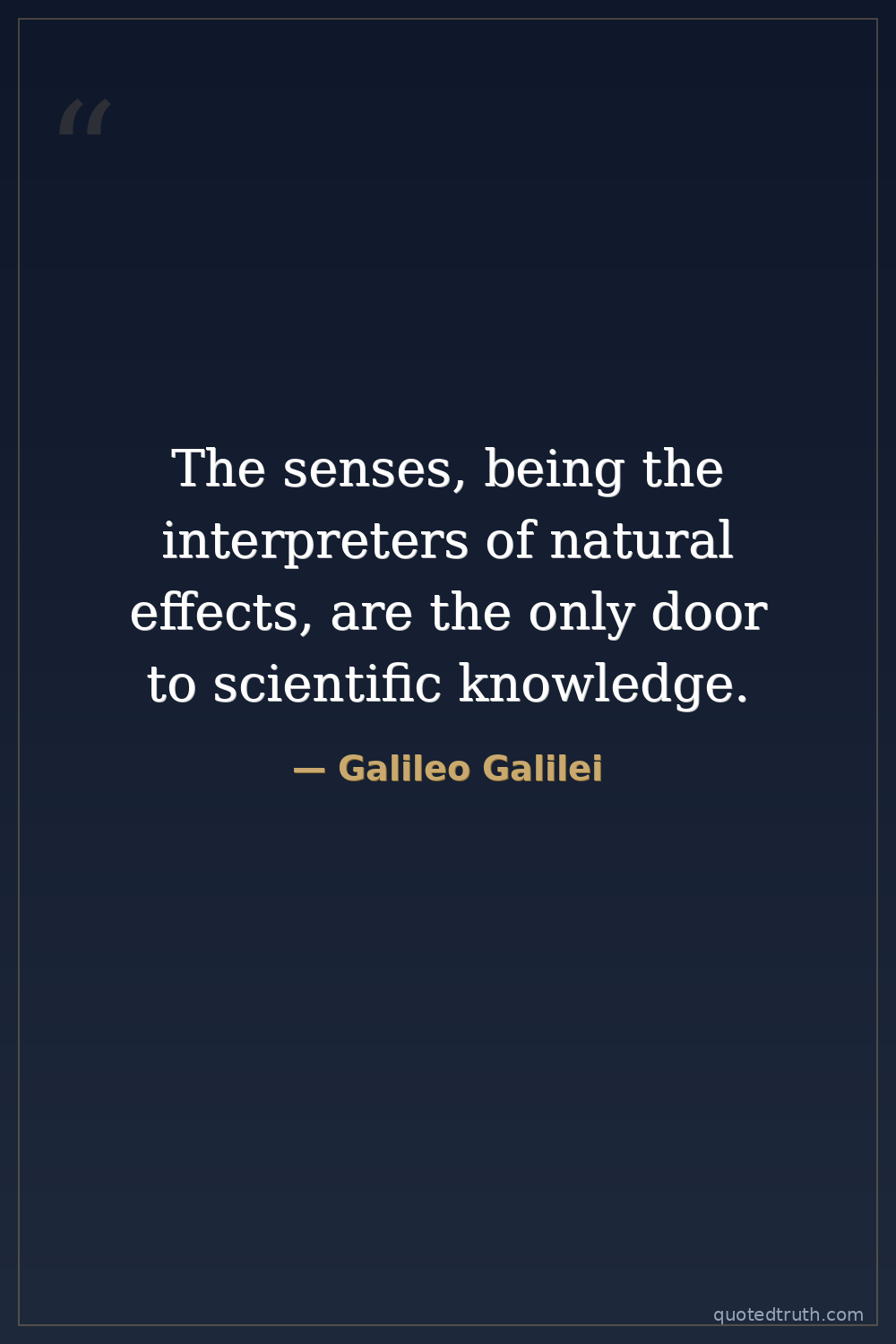
Galileo Galilei — "The senses, being the interpreters of natural effects, are the only door to scie…"
The senses, being the interpreters of natural effects, are the only door to scientific knowledge.
The senses, being the interpreters of natural effects, are the only door to scientific knowledge.
Click any product to generate a realistic preview. Up to 3 at a time.
* Initial load can take up to 90 seconds — revising the preview in another color is nearly instant.
"I am about to take leave of this earth, and I can say that I have seen more wonders than any man before me."
"The purpose of science is not to open the door to infinite wisdom, but to set a limit to infinite error."
"And finally, if the earth were to stop spinning, then the water in the oceans would fly off, and the mountains would crumble. So it must be moving."
"It is not in the power of any created being to make things true or false, but only to discover what is true or false."
"The more I study nature, the more I stand amazed at the work of the Creator."
Found in 1 providers: grok
1 source checked
Knowledge about the natural world must come through direct observation and sensory experience. We cannot understand how nature works by reasoning alone or accepting inherited dogma — we must look, measure, and test. The senses are the necessary gateway; without empirical evidence gathered through observation, any claim about how the physical world operates remains speculation rather than science.
Galileo built his career on instruments that extended the senses — his refined telescope revealed Jupiter's moons, Saturn's rings, and lunar craters that overturned Aristotelian cosmology. He designed experiments measuring falling bodies and pendulums rather than philosophizing from first principles. This commitment to observation over authority drove his confrontation with the Church and made him the defining figure of empirical natural philosophy.
In early modern Europe, natural philosophy was still dominated by Aristotle's texts and Church-sanctioned cosmology, where truth derived from ancient authority and scripture rather than observation. Galileo's insistence on sensory evidence was revolutionary and dangerous — it directly challenged scholastic method. His trial by the Inquisition in 1633 demonstrated how threatening empiricism was to institutions whose power rested on revealed, text-based truth rather than measurable reality.
AI-generated insights based on extensive research and information for context. Factual errors? Email [email protected].
Your cart is empty