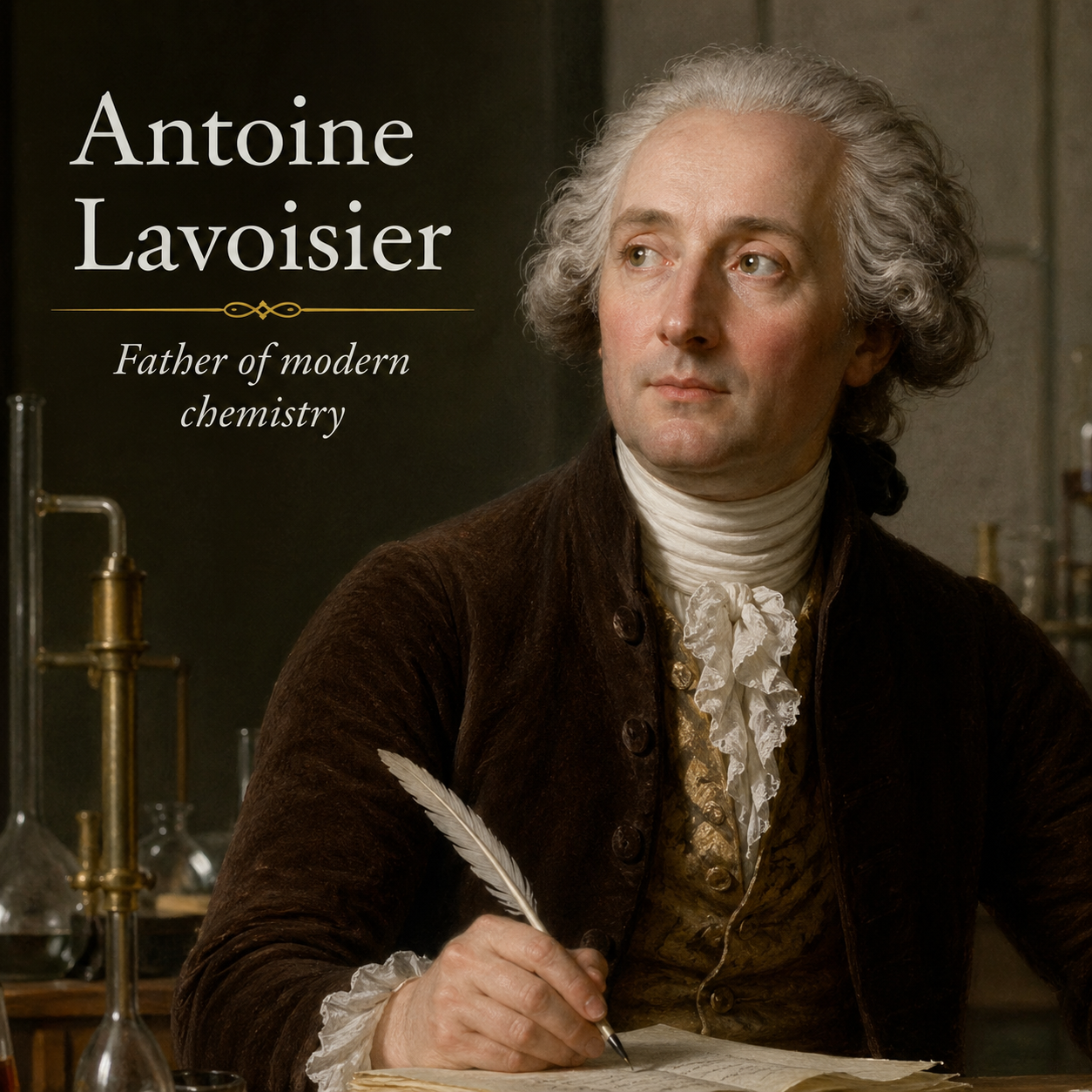
Antoine Lavoisier — "It is not sufficient to know, one must apply."
It is not sufficient to know, one must apply.
It is not sufficient to know, one must apply.
Click any product to generate a realistic preview. Up to 3 at a time.
* Initial load can take up to 90 seconds — revising the preview in another color is nearly instant.
"Life is a chemical function."
"I have no other ambition than to serve humanity."
"I have lived long enough to be certain that the world will not be ready for my discoveries until at least a hundred years after my death."
"Languages are true analytical methods; algebra, which is adapted to its purpose in every species of expression, in the most simple, most exact, and best manner possible, is at the same time a language…"
"The art of drawing conclusions from experiments and observations consists in evaluating probabilities and in judging if they are great enough to constitute proofs."
Found in 1 providers: grok
1 source checked
Knowledge alone is passive and incomplete. True understanding demands action—putting what you know into practice. This is a call against intellectual complacency: mastering facts, theories, or skills means nothing until tested and made productive in the real world. The gap between knowing and doing is where potential dies. Real progress happens only when knowledge is deliberately translated into purposeful application that changes something tangible.
Lavoisier didn't merely theorize—he transformed chemistry through relentless experimentation. He applied careful measurement to disprove phlogiston theory and identify oxygen's role in combustion. As a public administrator, he applied science to improve French gunpowder production and agricultural yields. He quantified rather than speculated, insisting chemistry become a rigorous applied discipline. His entire career embodied the conviction that scientific knowledge only matters when it reshapes how people actually work and live.
Lavoisier lived during the Enlightenment, when France's intellectual culture celebrated reason yet often remained trapped in philosophical abstraction. The philosophes filled encyclopedias with ideas, but translating them into practical reform was painfully slow. Alchemy still haunted chemistry. Industrial advances in Britain showed what applied science could achieve economically. Lavoisier's insistence on measurement and real-world use helped define the crucial transition from speculative natural philosophy to modern empirical science during a revolutionary age.
AI-generated insights based on extensive research and information for context. Factual errors? Email [email protected].
Your cart is empty