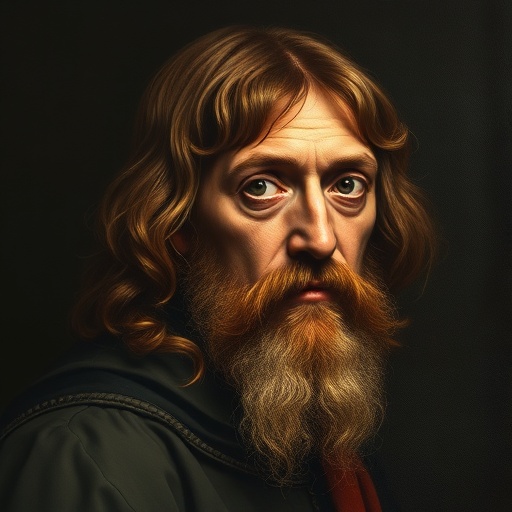
Nicolaus Copernicus — "It is not the earth that is the center of the universe, but the sun."
It is not the earth that is the center of the universe, but the sun.
It is not the earth that is the center of the universe, but the sun.
Click any product to generate a realistic preview. Up to 3 at a time.
* Initial load can take up to 90 seconds — revising the preview in another color is nearly instant.
"It is enough if the hypotheses save the phenomena."
"In the midst of all dwells the Sun. For who indeed could place this lamp of a better position in this most beautiful temple, than that from which it can at once illuminate all?"
"The earth, too, has other motions than that of the daily rotation."
"Therefore, if the Earth moved, it would necessarily move with a triple motion: one, the diurnal rotation on its own axis; another, the annual revolution around the Sun; and a third, the motion of its …"
"Knowledge makes a bloody entrance."
This is a paraphrase of his core idea, not a direct quote. Copernicus did not explicitly state it this way in 'De Revolutionibus'. He proposed a heliocentric model.
Date: 1543
GeneralFound in 1 providers: grok
1 source checked
Earth does not occupy a special central position in space — the sun sits at the center of our planetary system. This challenges the intuitive human assumption that we stand at the heart of everything. It insists that evidence and mathematical reasoning must override comfort and tradition. Our planet is simply one body among others, orbiting a star rather than being the fixed anchor around which all creation revolves.
Copernicus spent over thirty years refining his heliocentric model before publishing it in 1543, the year he died — reportedly receiving the printed pages on his deathbed. A trained mathematician and Catholic canon, he built his case through careful geometric calculation rather than speculation. His cautious, methodical temperament is embedded in this claim; he didn't assert it lightly. It represents the central intellectual conviction of his entire life, carried quietly for decades before he released it to the world.
In Copernicus's Europe, the geocentric model — Earth fixed at the universe's center — was scientific consensus endorsed by the Catholic Church and grounded in Aristotle and Ptolemy. Challenging it risked theological condemnation. The Renaissance was reshaping art and humanism, but astronomical orthodoxy remained rigid. His heliocentric proposal, published as the Protestant Reformation fractured Christendom, planted the seed of the Scientific Revolution — the radical notion that mathematical evidence could legitimately overturn centuries of received, Church-sanctioned wisdom.
AI-generated insights based on extensive research and information for context. Factual errors? Email [email protected].
Your cart is empty