Wright Brothers (Orville & Wilbur) — "It is not the man who has done the most, but the man who has done the best, who …"
It is not the man who has done the most, but the man who has done the best, who is most deserving of praise.
It is not the man who has done the most, but the man who has done the best, who is most deserving of praise.
Click any product to generate a realistic preview. Up to 3 at a time.
* Initial load can take up to 90 seconds — revising the preview in another color is nearly instant.
"The greatest danger in flying is the ground."
"We kept at it, and we kept on learning."
"We thought that we had solved a problem, but we had only created a new one."
"The problem was not to build a machine that would fly, but to build a machine that would fly safely."
"Instead of falling to the floor, as we expected, it flew across the room till it struck the ceiling, where it fluttered awhile, and finally sank to the floor."
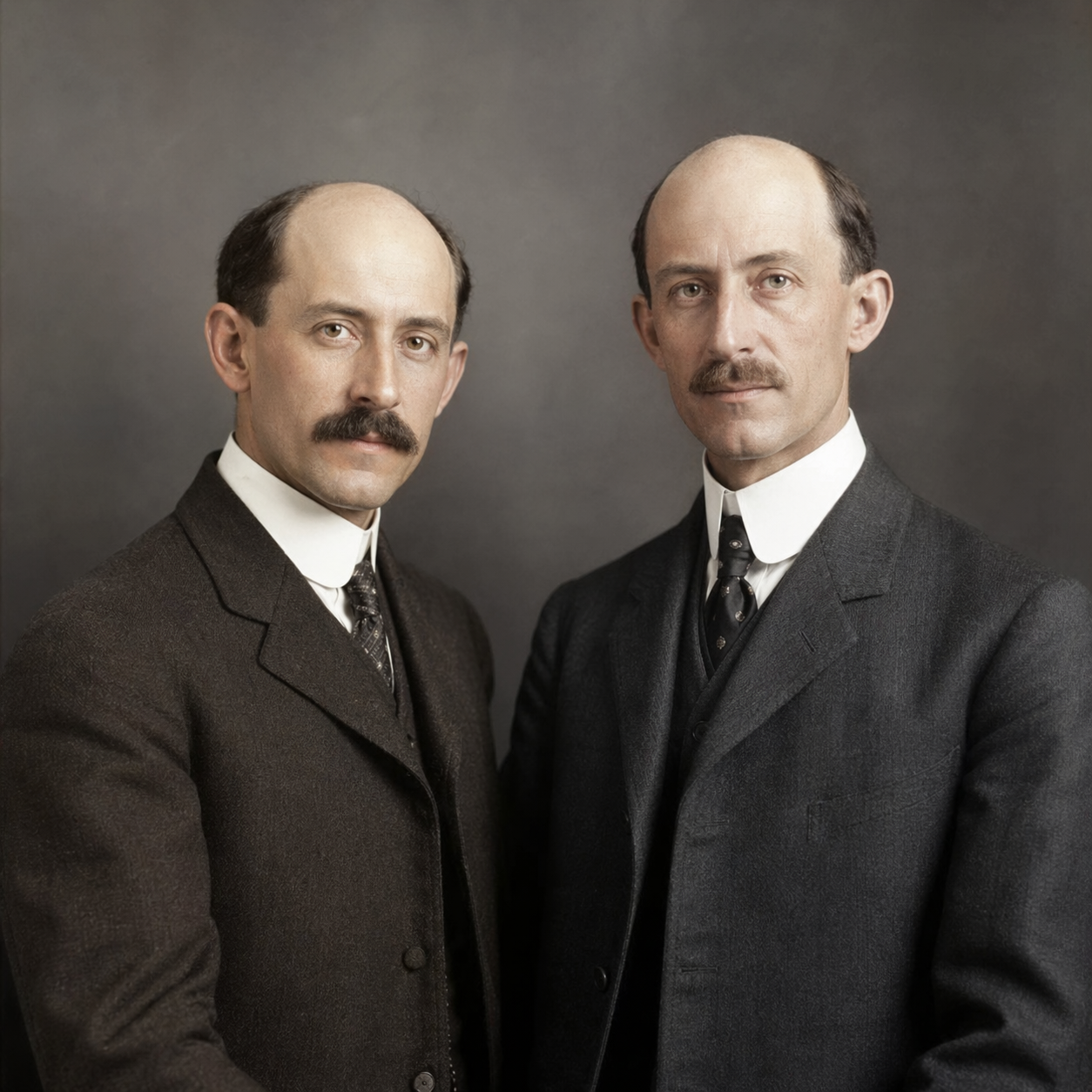
American aviation pioneers who achieved the first sustained powered controlled airplane flight at Kitty Hawk, NC, on December 17, 1903. Closely associated with Octave Chanute (their gliding mentor and aeronautical correspondent). For an intellectual contrast, see Samuel Pierpont Langley, Smithsonian Institution Secretary and government-funded aviation researcher — Langley's Aerodrome crashed twice into the Potomac in October-December 1903 with $50,000 of War Department funding; the Wright Brothers' bicycle-shop empiricism beat Langley's institutional Big Science by 9 days. The most-cited example in engineering history of empirical-tinkerer beating institution-funded credentialism.
Found in 1 providers: grok
1 source checked
Quality matters more than quantity. This quote argues that the volume of one's output shouldn't determine recognition — doing something exceptionally well earns more honor than doing many things adequately. It challenges cultures that reward busyness and productivity metrics over craftsmanship and precision. True achievement isn't measured by how much you've attempted, but by how well you've executed what you took on. Excellence, not prolificacy, is the real standard of worth.
The Wright Brothers were self-taught bicycle mechanics who beat well-funded rivals — including Samuel Langley, who had a $70,000 Smithsonian grant — to achieve powered flight at Kitty Hawk in 1903. They didn't build more prototypes than competitors; they built better ones, meticulously studying aerodynamics, constructing their own wind tunnel, and solving the three-axis control problem others ignored. Their triumph was the product of deliberate precision, not prolific output.
The early 1900s were defined by industrial mass production and a cult of output — factories, assembly lines, and Taylorist efficiency dominated American culture. Simultaneously, a competitive race for powered flight attracted dozens of well-publicized, heavily funded teams. In that climate, raw effort and resources were assumed to determine success. The Wrights' victory demonstrated otherwise: a systematic, quality-obsessed approach by two modest craftsmen outpaced every better-resourced competitor of their era.
AI-generated insights based on extensive research and information for context. Factual errors? Email [email protected].
Your cart is empty