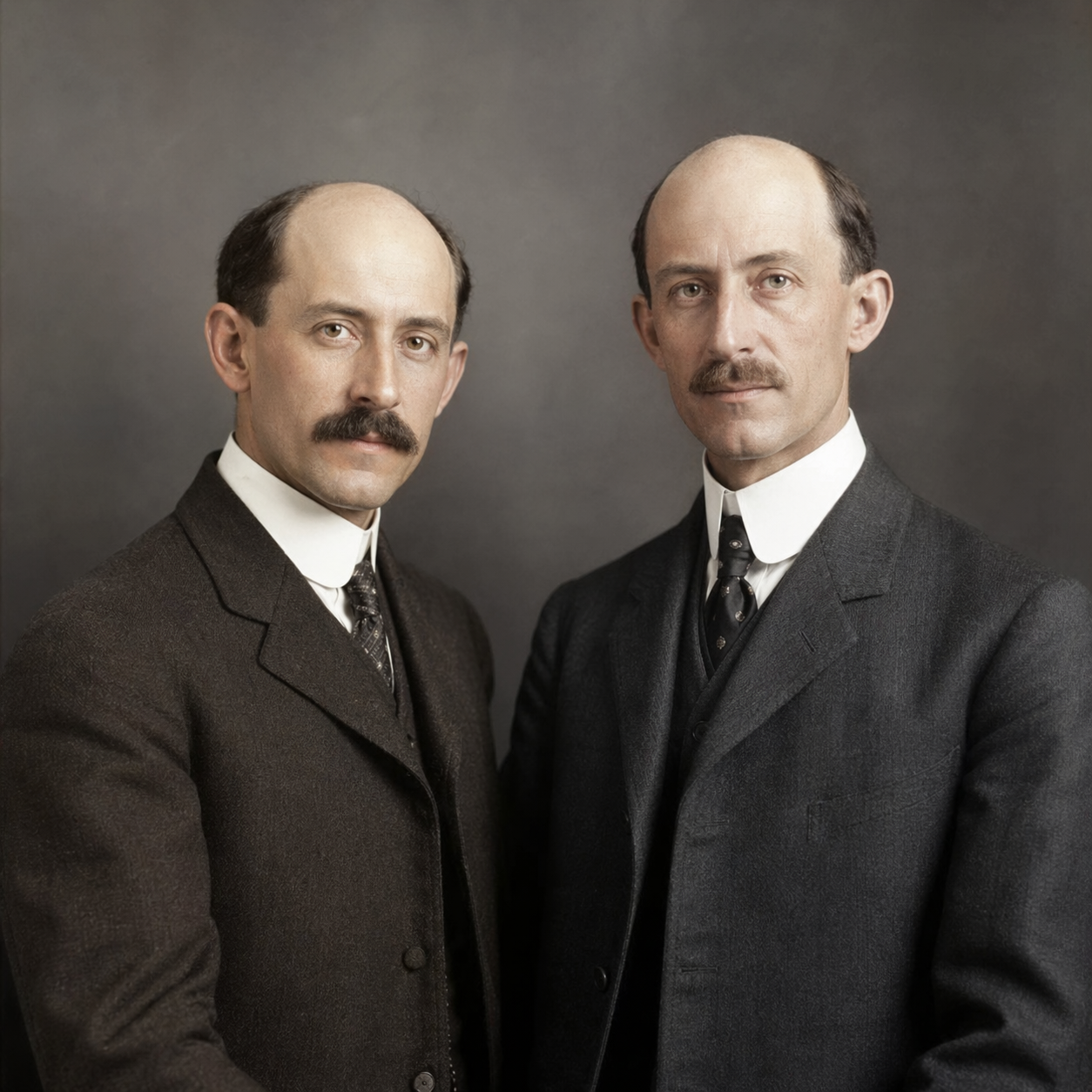
Wright Brothers (Orville & Wilbur) — "The machine is under perfect control and can be turned in any direction at will."
The machine is under perfect control and can be turned in any direction at will.
The machine is under perfect control and can be turned in any direction at will.
Click any product to generate a realistic preview. Up to 3 at a time.
* Initial load can take up to 90 seconds — revising the preview in another color is nearly instant.
"It is not in the nature of man to be content with things as they are."
"We were not seeking fame or fortune, but simply to solve a problem."
"We could not understand how it was that the best scientists could not fly a machine. We thought that they must be working on the wrong principle."
"The difficulties were great, but our faith was greater."
"We did not find it necessary to use any of the formulas of the scientists, but we worked out our own formulas."
American aviation pioneers who achieved the first sustained powered controlled airplane flight at Kitty Hawk, NC, on December 17, 1903. Closely associated with Octave Chanute (their gliding mentor and aeronautical correspondent). For an intellectual contrast, see Samuel Pierpont Langley, Smithsonian Institution Secretary and government-funded aviation researcher — Langley's Aerodrome crashed twice into the Potomac in October-December 1903 with $50,000 of War Department funding; the Wright Brothers' bicycle-shop empiricism beat Langley's institutional Big Science by 9 days. The most-cited example in engineering history of empirical-tinkerer beating institution-funded credentialism.
Found in 1 providers: grok
1 source checked
Achieving true control over a complex system means it does exactly what you command — every input yields a precise response. This quote asserts the aircraft isn't staying aloft by luck or brute force; the pilot steers it deliberately in any chosen direction. It's the difference between surviving a flight and commanding one — complete mastery where the machine becomes an extension of human intention rather than an unpredictable force to be wrestled.
While other aviation pioneers focused on power and lift, the Wrights identified three-axis control as the fundamental unsolved problem. Their bicycle-shop background sharpened their intuition about balance and steering. They invented wing-warping to bank and turn, building the first practical flight control system. This quote reflects their core conviction: getting airborne wasn't enough — a truly useful flying machine had to respond precisely to the pilot's will, repeatably, in any condition.
In 1903, aviation was littered with failed attempts and public skepticism. Samuel Langley's government-funded Aerodrome had crashed spectacularly into the Potomac just weeks before Kitty Hawk. Critics dismissed heavier-than-air flight as impossible. Proving control — not just liftoff — was the Wrights' strategic answer to that skepticism. An uncontrolled hop proved nothing; a steerable, repeatable flight proved a new technology. The military, press, and public needed to see mastery, not accident.
AI-generated insights based on extensive research and information for context. Factual errors? Email [email protected].
Your cart is empty