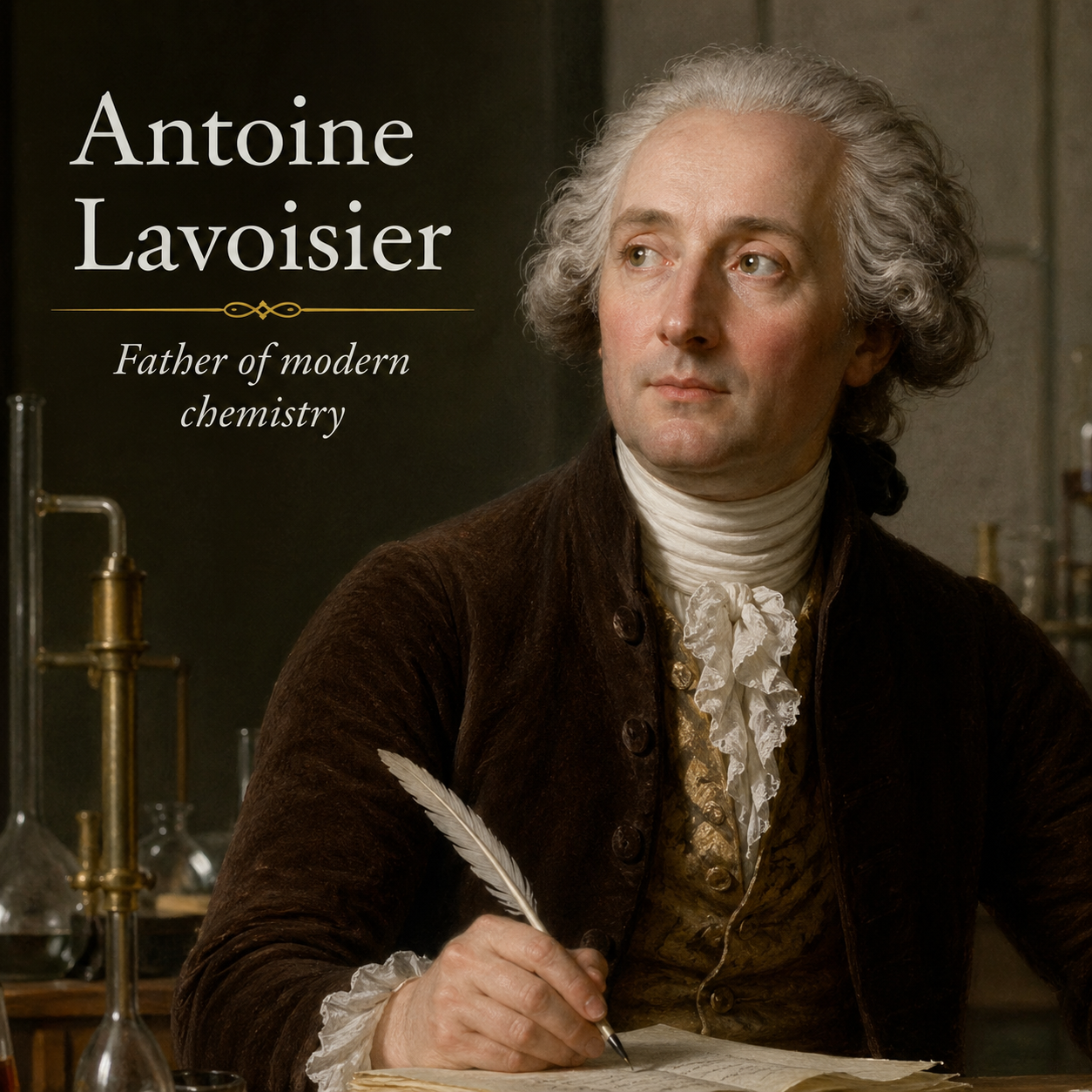
Antoine Lavoisier — "It is not the number of experiments, but their accuracy, that matters."
It is not the number of experiments, but their accuracy, that matters.
It is not the number of experiments, but their accuracy, that matters.
Click any product to generate a realistic preview. Up to 3 at a time.
* Initial load can take up to 90 seconds — revising the preview in another color is nearly instant.
"It took them only an instant to cut off that head, but France may not produce another like it in a century."
"The desire to do good is the most powerful motive of all."
"We may lay it down as an incontestible axiom, that, in all the operations of art and nature, nothing is created; an equal quantity of matter exists both before and after the experiment; the quality an…"
"The true philosopher is he who knows how to doubt."
"Imagination, on the contrary, which is ever wandering beyond the bounds of truth, joined to self-love and that self-confidence we are so apt to indulge, prompt us to draw conclusions which are not imm…"
Found in 1 providers: grok
1 source checked
Quality over quantity in scientific inquiry. A single precise, well-controlled experiment reveals more truth than dozens of sloppy ones. Precision means controlling variables, measuring carefully, and recording results faithfully. In science and any evidence-based field today, this principle holds: accurate data drives valid conclusions, while accumulated imprecise measurements only compound errors. It cuts through the temptation to equate volume of effort with quality of knowledge.
Lavoisier rebuilt chemistry on precise measurement. He used a meticulously calibrated analytical balance to prove matter is conserved during reactions — mass in equals mass out — overturning centuries of imprecise guesswork. Where predecessors ran countless informal trials, he ran fewer, methodical ones that proved decisive. His dismantling of the phlogiston theory succeeded not through repetition but through careful quantification. Precision was his signature contribution to transforming natural philosophy into modern science.
In the 18th-century Enlightenment, European science was transitioning from speculative natural philosophy to rigorous empiricism, but experimental standards remained loose. Most chemists worked qualitatively, describing reactions without measuring masses. Phlogiston theory explained combustion through an invisible substance nobody could weigh. The scientific academies of Paris and London were formalizing methodology. Precise, repeatable experimentation was becoming the marker that separated serious science from learned but untested speculation.
AI-generated insights based on extensive research and information for context. Factual errors? Email [email protected].
Your cart is empty