Charles Darwin — "It is not the strongest of the species that survives, nor the most intelligent, …"
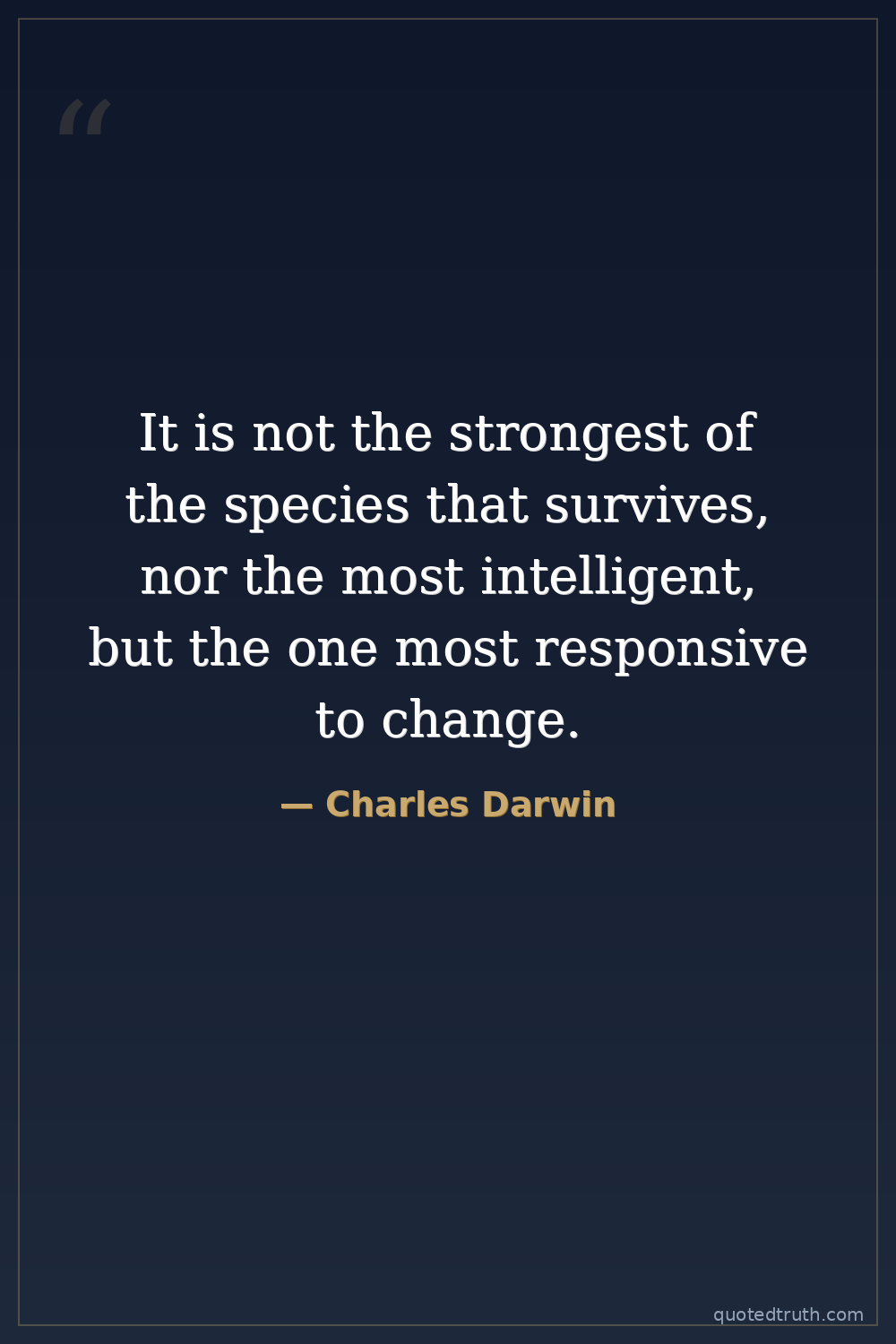
It is not the strongest of the species that survives, nor the most intelligent, but the one most responsive to change.
It is not the strongest of the species that survives, nor the most intelligent, but the one most responsive to change.
Click any product to generate a realistic preview. Up to 3 at a time.
* Initial load can take up to 90 seconds — revising the preview in another color is nearly instant.
"I feel most deeply that the whole subject is too profound for the human intellect. A dog might as well speculate on the mind of Newton."
"I have always felt a strong feeling of gratitude to those who have helped me in my work."
"I hate a Barnacle as no man ever did before, not even a Sailor in a slow-sailing ship."
"Man has risen to the very summit of the organic scale; and the fact of his having thus risen, instead of having been aboriginally placed there, is the best proof of his power of development."
"The very existence of our senses, our reason, and our intellect, is a proof that these faculties were given us for some purpose."
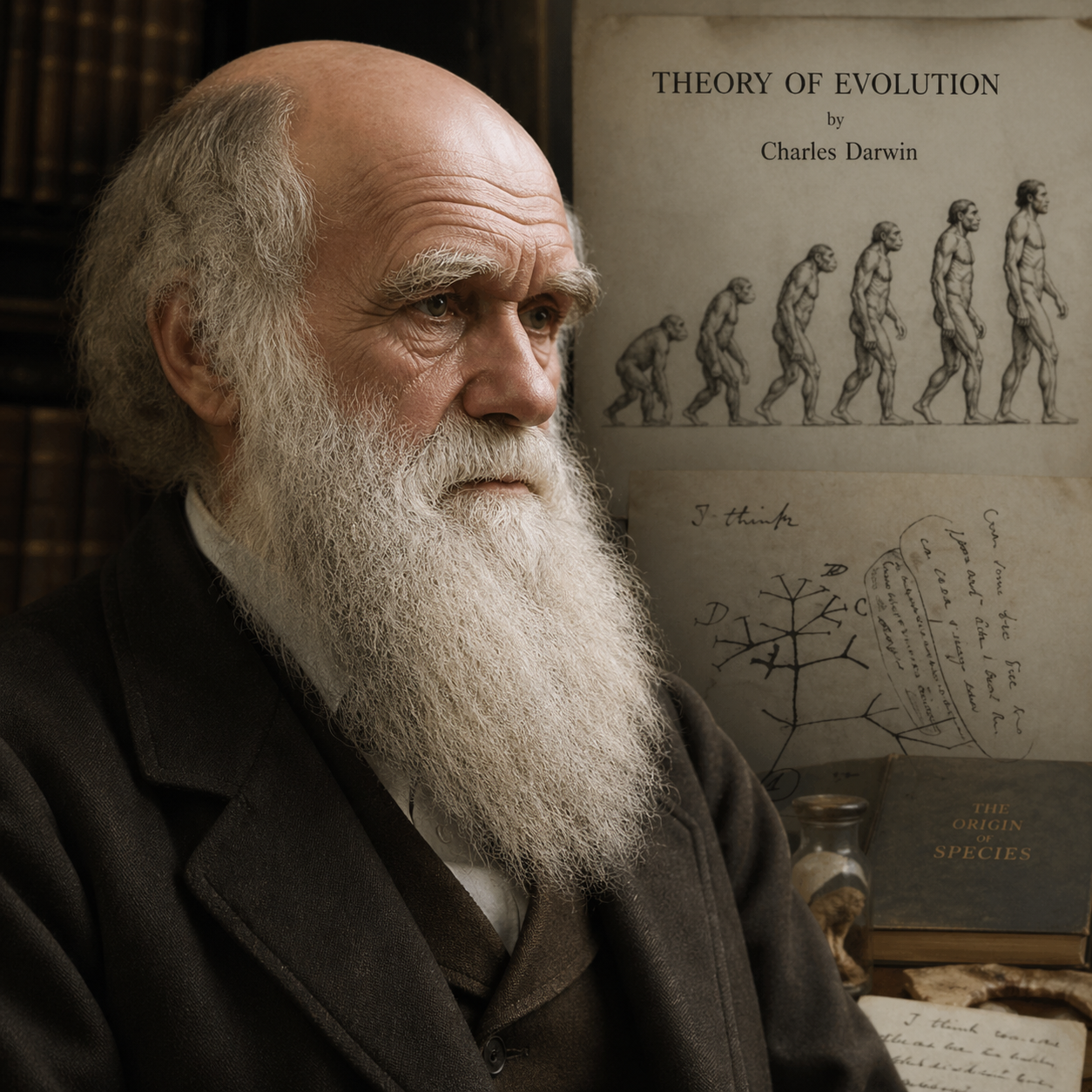
British naturalist whose On the Origin of Species (1859) established evolution by natural selection — the unifying theory of modern biology. Closely associated with Thomas Henry Huxley (his 'bulldog' public defender) and Alfred Russel Wallace (independent co-discoverer of natural selection). For an intellectual contrast, see William Paley, Anglican theologian and Natural Theology author (1743-1805) — Origin of Species is structurally a 400-page reply to Paley — Darwin admired Paley's watchmaker-argument as an undergraduate at Cambridge and then spent 20 years building the empirical machinery to displace him. The cleanest 'design argument vs natural selection' founding rebuttal in science.
The standard scholarly entry points to Charles Darwin's work: Janet Browne (Harvard, history of science) — Charles Darwin: Voyaging (1995) and The Power of Place (2002); Adrian Desmond (UCL, biographer) — Darwin: The Life of a Tormented Evolutionist (1991, with James Moore). These are the works graduate seminars cite when teaching Charles Darwin.
Often misattributed—closest in spirit to 'Origin of Species' but paraphrased.
Date: Misattributed
Power & LeadershipFound in 2 providers: grok,deepseek
2 sources checked
Survival belongs not to the biggest or smartest, but to whoever adapts quickest. Raw strength fails when conditions shift; high intelligence means nothing if it can't respond to new realities. The real competitive edge is flexibility — sensing change early and adjusting behavior, strategy, or structure accordingly. In biology, business, or daily life, the organism or person most willing to evolve their approach outlasts rigid competitors.
Darwin spent five years aboard HMS Beagle (1831–1836) documenting how isolated populations — Galápagos finches with differently shaped beaks, giant tortoises varying by island — diverged through environmental pressure. His 1859 work On the Origin of Species formalized this: organisms with heritable traits suited to shifting conditions survive to reproduce. Adaptability wasn't metaphor for Darwin; it was the precise mechanism he spent decades gathering evidence to prove.
Darwin wrote during the Victorian era — a period of explosive industrial change, colonial expansion, and scientific upheaval. The 1800s saw steam power rewrite economies, species concepts challenge biblical creation, and geologists like Lyell prove Earth was ancient and constantly changing. Against this backdrop, Darwin's insight that change itself is life's engine, not an aberration to survive, resonated deeply in a world visibly transforming faster than any prior generation had witnessed.
AI-generated insights based on extensive research and information for context. Factual errors? Email [email protected].
Your cart is empty