Charles Darwin — "The expression of the emotions in man and animals."
The expression of the emotions in man and animals.
The expression of the emotions in man and animals.
Click any product to generate a realistic preview. Up to 3 at a time.
* Initial load can take up to 90 seconds — revising the preview in another color is nearly instant.
"Looking to the world at no very distant date, what an endless number of the lower races will have been eliminated by the higher civilized races throughout the world."
"The more I see of the world, the more I am convinced of the fact that it is full of wonders."
"False facts are highly injurious to the progress of science, for they often endure long; but false views, if supported by some evidence, do little harm, for every one takes a salutary pleasure in prov…"
"There is grandeur in this view of life, with its several powers, having been originally breathed into a few forms or into one; and that whilst this planet has gone cycling on according to the fixed la…"
"Man, with all his noble qualities, with sympathy which feels for the most debased, with benevolence which extends not only to other men but to the humblest living creature, with his god-like intellect…"
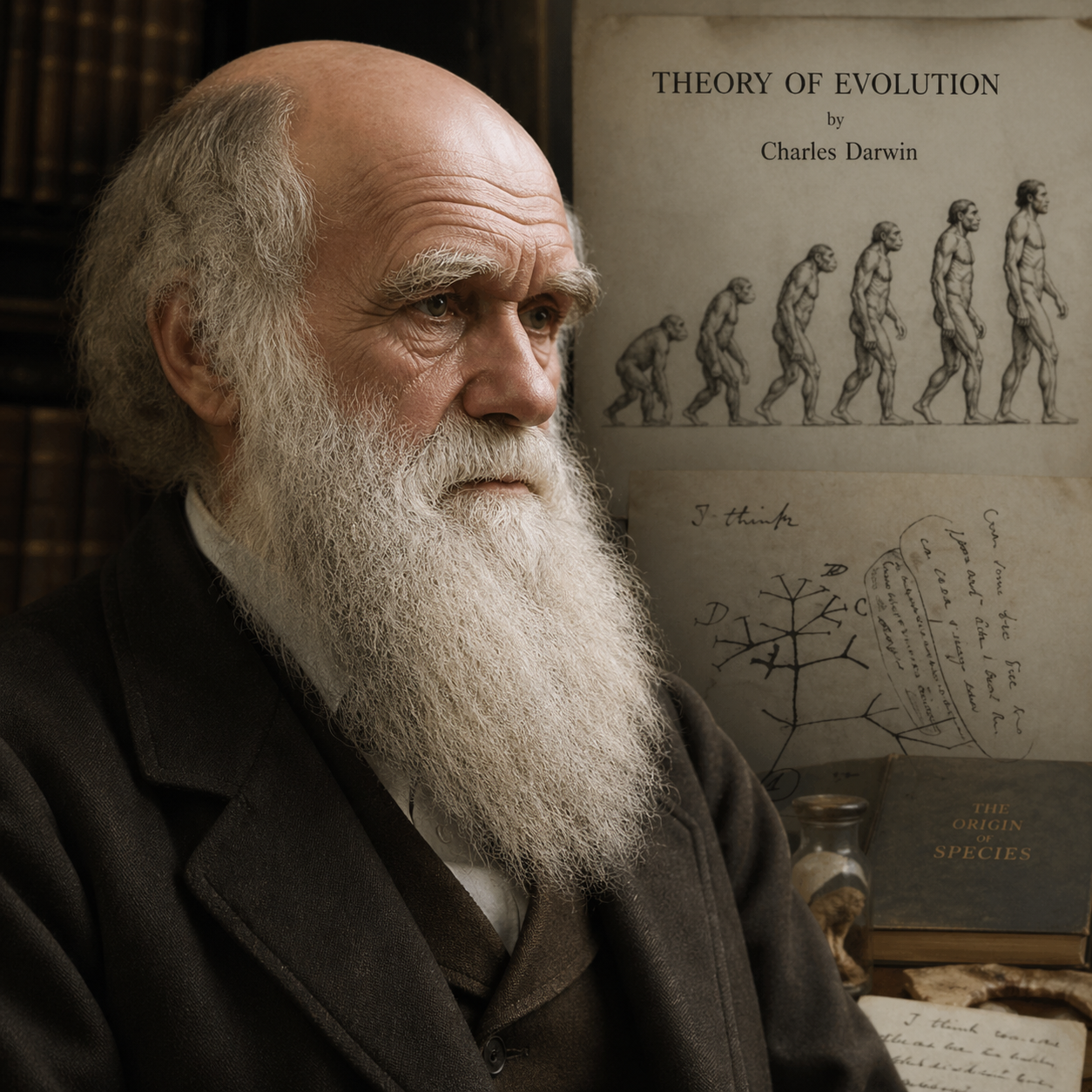
British naturalist whose On the Origin of Species (1859) established evolution by natural selection — the unifying theory of modern biology. Closely associated with Thomas Henry Huxley (his 'bulldog' public defender) and Alfred Russel Wallace (independent co-discoverer of natural selection). For an intellectual contrast, see William Paley, Anglican theologian and Natural Theology author (1743-1805) — Origin of Species is structurally a 400-page reply to Paley — Darwin admired Paley's watchmaker-argument as an undergraduate at Cambridge and then spent 20 years building the empirical machinery to displace him. The cleanest 'design argument vs natural selection' founding rebuttal in science.
The standard scholarly entry points to Charles Darwin's work: Janet Browne (Harvard, history of science) — Charles Darwin: Voyaging (1995) and The Power of Place (2002); Adrian Desmond (UCL, biographer) — Darwin: The Life of a Tormented Evolutionist (1991, with James Moore). These are the works graduate seminars cite when teaching Charles Darwin.
Found in 1 providers: grok
1 source checked
Emotional expression—facial movements, gestures, vocalizations—is not exclusive to humans but shared across the animal kingdom. What we feel and how we display it has biological roots, not merely cultural or spiritual ones. Grief, fear, joy, and disgust appear in dogs, apes, and infants alike. Our inner lives are continuous with other creatures, shaped by survival pressures over deep time rather than granted by divine privilege or human exceptionalism.
Darwin spent years documenting emotional displays in his own children, domestic animals, and zoo specimens before publishing this as a book in 1872. After 'On the Origin of Species,' he extended evolutionary thinking to psychology—a bold step. He distributed questionnaires to missionaries worldwide asking whether remote peoples showed identical expressions. His meticulous, empirical temperament drove him to use photographs to document grief and disgust, reflecting his conviction that humans are animals shaped by the same evolutionary forces.
In 1872, psychology barely existed as a formal discipline, and mainstream thought held human emotion as proof of a God-given soul separating us from beasts. Darwin published this amid furious post-Origin backlash—clergy and scientists insisted evolution could not explain the mind. Photography was newly available, enabling empirical documentation of expressions. Victorian society was grappling with industrialization, colonial encounters with 'other' peoples, and whether civilization itself was a product of nature or divine design.
AI-generated insights based on extensive research and information for context. Factual errors? Email [email protected].
Your cart is empty