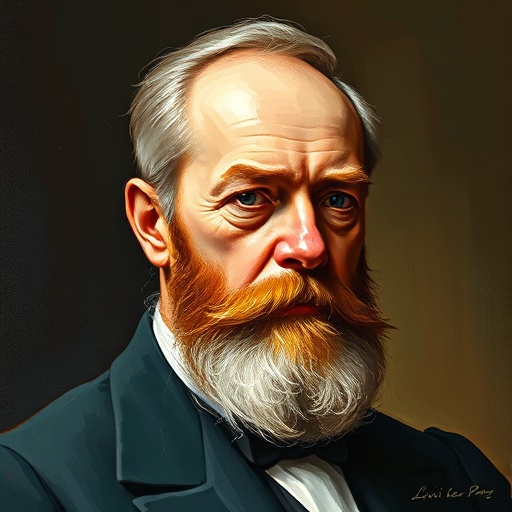
Louis Pasteur — "It is not the strongest of the species that survives, nor the most intelligent t…"
It is not the strongest of the species that survives, nor the most intelligent that survives. It is the one that is most adaptable to change.
It is not the strongest of the species that survives, nor the most intelligent that survives. It is the one that is most adaptable to change.
Click any product to generate a realistic preview. Up to 3 at a time.
* Initial load can take up to 90 seconds — revising the preview in another color is nearly instant.
"If I had the honor of being a surgeon… I would not only use absolutely clean instruments, but after having cleaned my hands with the greatest care, I would subject them to a rapid flaming."
"I have no doubt that I shall succeed in my experiments."
"I am convinced that I have found the cause of fermentation."
"The scientific method is the only one that allows us to approach the truth."
"Without laboratories, men of science are soldiers without arms."
Often misattributed to Darwin, but sometimes to Pasteur, though primary source is elusive.
Date: Late 19th Century (approx.)
Power & LeadershipFound in 1 providers: grok
1 source checked
Success and long-term endurance do not come from raw power or superior intellect alone. What truly determines who lasts is the ability to adjust when circumstances shift. Those who can read new conditions, abandon outdated habits, and reshape their approach outlive rivals who rely on past strengths. Flexibility beats dominance and cleverness when the environment itself is changing, because rigid advantages become liabilities the moment the landscape moves beneath them.
Though this quote is commonly misattributed to Pasteur (and to Darwin), it fits his working style. Pasteur repeatedly pivoted fields, moving from crystallography to fermentation, silkworm disease, anthrax, and rabies, each time adapting his methods to a new problem. His breakthroughs came from abandoning entrenched theories like spontaneous generation and reshaping laboratory practice, embodying adaptability as the true driver of scientific survival and progress.
Pasteur worked in 19th-century France during industrial upheaval, Darwin's 1859 Origin of Species, and fierce debates over disease causation. Wine, silk, and livestock industries faced ruin from unexplained spoilage and epidemics. Medicine still clung to miasma theory while germ theory emerged. Scientists, farmers, and physicians who refused to adapt to new microbial evidence lost ground, while those who embraced changing paradigms reshaped public health, agriculture, and industry across Europe.
AI-generated insights based on extensive research and information for context. Factual errors? Email [email protected].
Your cart is empty