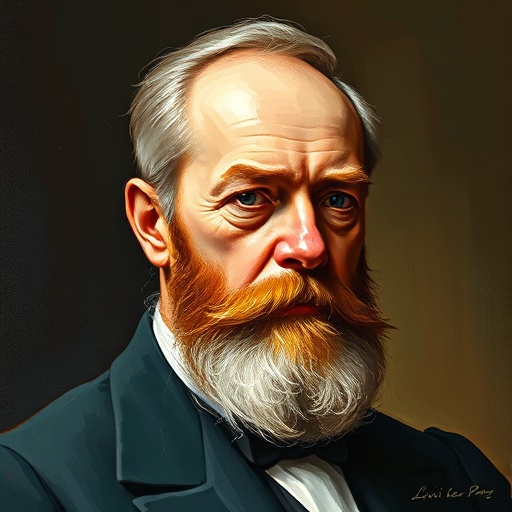
Louis Pasteur — "The greatest derangement of the mind is to believe in something because one wish…"
The greatest derangement of the mind is to believe in something because one wishes it to be so.
The greatest derangement of the mind is to believe in something because one wishes it to be so.
Click any product to generate a realistic preview. Up to 3 at a time.
* Initial load can take up to 90 seconds — revising the preview in another color is nearly instant.
"I owe everything to my wife, who has always encouraged me and shared my enthusiasm."
"The greatest victory is that over oneself."
"The scientific life is a life of constant battle against error."
"Let me tell you the secret that has led me to my goal: my strength lies solely in my tenacity."
"The universe is asymmetric and I am persuaded that life, as it is known to us, is a direct result of the asymmetry of the universe."
Found in 2 providers: grok,deepseek
2 sources checked
Believing something just because you want it to be true is the worst mental trap. When desire drives conclusions, people stop checking evidence and accept comfortable answers instead of accurate ones. Wishful thinking feels like knowledge but is actually a form of self-deception. The warning is simple: wanting something to be real does not make it real, and mistaking hope for proof leads you badly astray.
Pasteur built his career dismantling wishful beliefs with rigorous experiment. He disproved spontaneous generation, a theory many scientists clung to emotionally, by designing swan-neck flask tests that forced evidence over preference. His germ theory and pasteurization succeeded because he refused to trust intuition about invisible causes of disease. For a chemist who battled entrenched medical assumptions, this quote captures his working method: demand proof, distrust what you hope is true.
Pasteur worked in 19th-century France when medicine still mixed folk belief, miasma theory, and emerging science. Doctors resisted handwashing, spontaneous generation was mainstream, and vaccination was controversial. Industrial problems like spoiled wine and silkworm disease were blamed on mysterious forces. Pasteur's era demanded a shift from intuition and tradition to controlled experiment, and his warning against wishful belief reflected the scientific revolution reshaping biology, public health, and industry across Europe.
AI-generated insights based on extensive research and information for context. Factual errors? Email [email protected].
Your cart is empty