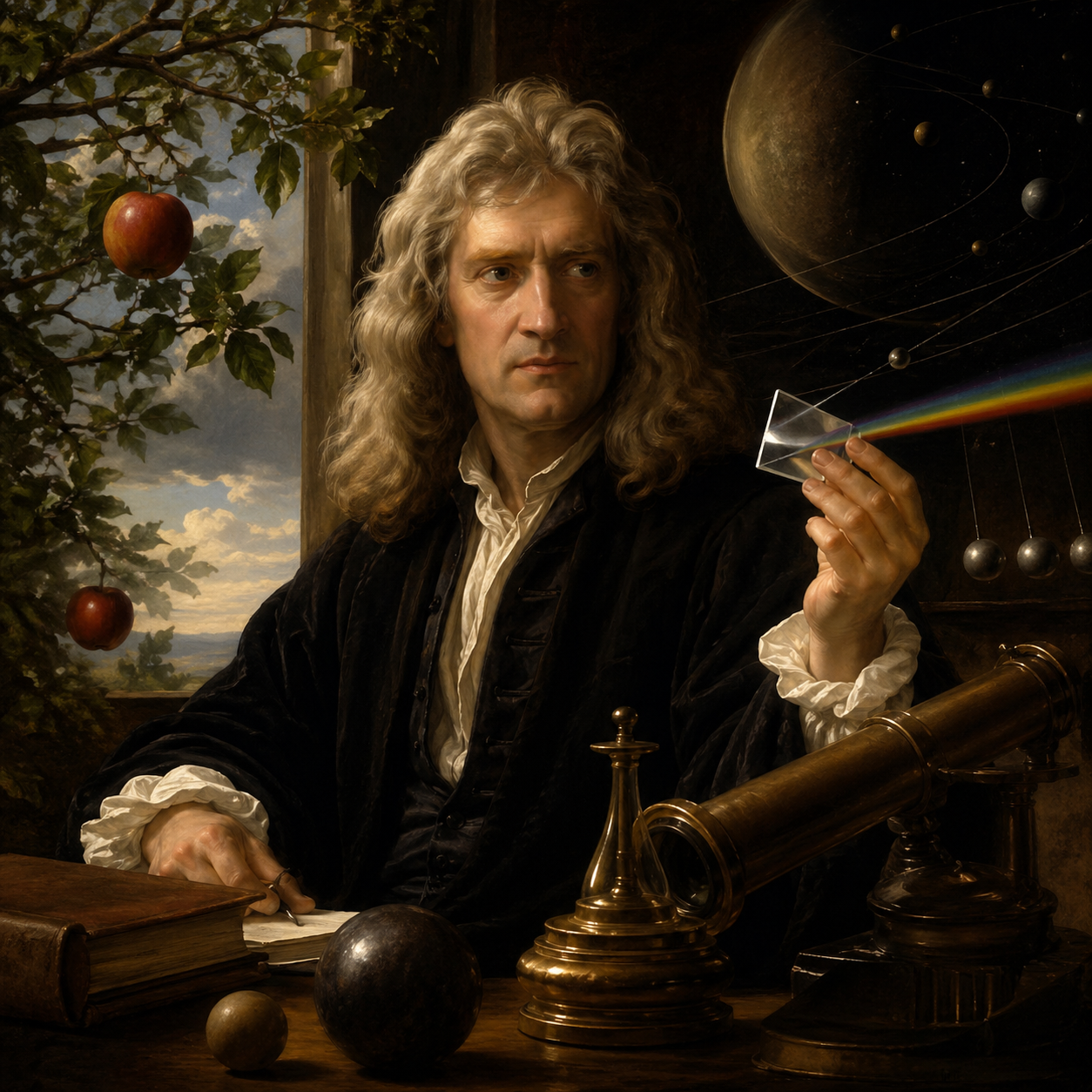
Isaac Newton — "It is possible that gravity may be essential to matter."
It is possible that gravity may be essential to matter.
It is possible that gravity may be essential to matter.
Click any product to generate a realistic preview. Up to 3 at a time.
* Initial load can take up to 90 seconds — revising the preview in another color is nearly instant.
"Plato is my friend, Aristotle is my friend, but truth is more my friend."
"Atheism is so senseless and odious to mankind that it never had many professors."
"The whole difficulty of philosophy seems to consist in this—from the phenomena of motions to investigate the forces of nature, and then from these forces to demonstrate the other phenomena."
"We build too many walls and not enough bridges."
"The attractive force of the earth acts to the greatest distance, and is observed in the fall of the moon, which is continually drawn towards the earth."
Found in 1 providers: grok
1 source checked
Newton is suggesting that gravity might not be a force imposed on matter from outside, but something woven into matter itself — an inherent property, not a separate phenomenon. Rather than gravity acting on things, it may simply be part of what matter fundamentally is. This raises a profound question: is the tendency of mass to attract other mass a built-in feature of physical reality, inseparable from existence itself?
Newton's 1687 Principia gave the world the mathematical law of universal gravitation, yet he famously refused to speculate on gravity's cause, writing 'I frame no hypotheses.' This quote reveals the private tension beneath that restraint — he genuinely wrestled with whether gravity had a physical seat in matter itself. His decades of alchemy and theological inquiry show he constantly sought the deeper nature of forces, not merely their mathematical description.
In Newton's era, 'action at a distance' — gravity pulling objects across empty space with no physical contact — was philosophically scandalous. Descartes and Leibniz demanded mechanical explanations: something must push or carry forces. The early modern scientific revolution was dismantling Aristotelian categories without consensus on replacements. Newton's speculation that gravity might be intrinsic to matter was his attempt to answer critics demanding a mechanism behind his otherwise purely mathematical law.
AI-generated insights based on extensive research and information for context. Factual errors? Email [email protected].
Your cart is empty